Introduction
Mezzanine floors solve one of warehousing's most persistent problems: running out of floor space without expanding the building footprint. The global mezzanine floor market sits at $7.9 billion in 2025, projected to nearly double by 2035. That growth reflects how many facilities are adding vertical levels to stay competitive.
But adding a mezzanine creates an immediate operational question: how do you move loads up and down safely, consistently, and without creating a bottleneck at the lift point?
The consequences of getting this wrong are real. The Liberty Mutual 2024 Workplace Safety Index puts overexertion injuries at $12.49 billion in annual direct costs and falls to a lower level at $6.13 billion — two hazard categories that mezzanine lifting directly touches.
This guide covers the four main methods for lifting loads to a mezzanine: VRC Material Lifts, forklifts with pallet safety gates, overhead cranes, and manual carrying. It includes a side-by-side comparison and a practical framework for choosing the right fit for your operation.
Key Takeaways
- VRC Material Lifts are the safest, most reliable long-term solution for facilities moving heavy loads to a mezzanine on a daily basis
- Forklifts work for facilities that already own one, but require trained operators, ample clearance, and a compliant safety pallet gate
- Overhead cranes suit very heavy or irregular loads — but they require significant ceiling height and structural investment upfront
- Manual carrying is only appropriate for very light, infrequent lifts — NIOSH caps the recommended limit at 51 lbs under ideal conditions
- If your operation lifts loads daily or handles anything over 500 lbs, a VRC pays back faster than any other option
Why Lifting Loads to a Mezzanine Requires the Right Solution
Mezzanines add valuable storage and operational space, but they introduce a vertical material flow challenge. Every time a load needs to move between levels, someone has to make a decision: who or what does the lifting, and how?
Make the wrong call repeatedly, and you end up with one of three problems:
- Safety incidents — workers injured carrying loads up stairs, or falls at an unguarded mezzanine opening
- Workflow bottlenecks — a forklift tied up for mezzanine loading that should be servicing dock doors
- OSHA exposure — unguarded floor openings, improper material hoisting, or general duty clause violations from recognized ergonomic hazards
The Variables That Drive the Decision
Before evaluating any lifting method, facility managers need clear answers on five factors:
- Load weight and dimensions — maximum weight per lift, and how loads are packaged (pallets, crates, totes, loose cartons)
- Lift frequency — loads per hour or per shift moving between levels
- Floor space and ceiling height — available footprint at the mezzanine edge and overhead clearance above the upper landing
- Budget — purchase price, installation, annual maintenance, and the cost of downtime or injuries
- OSHA compliance requirements — applicable standards vary by method and load type
Each method covered below maps directly to these variables — so the right answer depends on your specific numbers, not a general rule of thumb.
Best Ways to Lift Loads to a Mezzanine
Each method below is evaluated on safety, cost, load capacity, and operational fit. The goal is a direct match between your facility's profile and the right solution.
VRC Material Lift
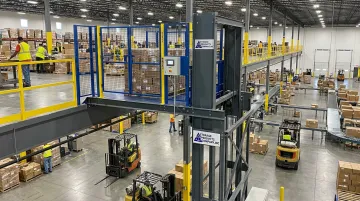
A Vertical Reciprocating Conveyor (VRC) is a self-contained mechanical lift designed specifically to move goods — not people — vertically between floor levels. VRCs fall under OSHA's material hoist standard (29 CFR 1926.552) and are governed by ASME B20.1 as conveyor equipment, not elevator code, which simplifies the regulatory path considerably.
Storage Products Company installs Pflow Industries VRC units with capacities ranging from 1,000 lbs to 50,000 lbs+ depending on configuration — straddle, cantilever, four-post, and mezzanine-integrated designs, with hydraulic or mechanical drive options. Travel heights reach 50+ feet for multi-floor applications.
What sets VRCs apart for high-frequency operations:
- Self-contained structure imposes no additional load on the mezzanine deck
- Interlocked gates at each landing prevent access while the carriage is in motion
- Overload protection, emergency stops, and secondary brake/velocity fuse systems as standard safety features
- Minimal operator training compared to powered industrial trucks
- Preventative maintenance programs (available through Storage Products Company) address drive systems, chains, cables, and safety mechanisms before failures occur
| Factor | VRC Material Lift |
|---|---|
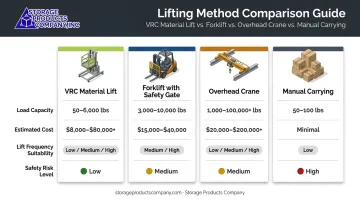
| Load Capacity | 1,000 lbs – 50,000 lbs+ (configuration-dependent) |
| Estimated Cost | Simple two-level systems from ~$10,000; complex/custom installations can exceed $100,000; pricing on request |
| Best For | High-frequency lifting of pallets, crates, and totes in warehouses, distribution centers, and manufacturing facilities |
Forklift with Safety Pallet Gate
Many facilities already own a forklift and use it to deposit loads at the mezzanine edge through a safety pallet gate — a section of guardrail that opens to receive the forks. It gets the job done, but it's an adapted use of equipment, not a purpose-built solution.
OSHA 29 CFR 1910.28 requires fall protection at any edge 4 feet or more above a lower level, and 29 CFR 1910.29 sets guardrail specifications. A compliant safety pallet gate is not optional — it's a legal requirement if this method is used.
Key operational drawbacks to weigh:
- Requires significant floor clearance for forklift maneuvering at the mezzanine edge
- Load misalignment at height creates fall risk for the pallet and potential structural damage to the deck
- Ties up an expensive piece of equipment for a task a dedicated lift handles more efficiently
- An OSHA fatality report (Accident 119291.015) documents a worker killed after falling approximately 8 feet through hinged mezzanine gates at a forklift loading dock area
Safety pallet gates range from approximately $1,200 for basic pivot gates to over $10,000 for wider rollback models accommodating two-wide pallet placement.
| Factor | Forklift + Safety Pallet Gate |
|---|---|
| Load Capacity | 3,000 – 10,000 lbs (varies by forklift model) |
| Estimated Cost | New electric forklift from ~$25,000+; safety pallet gate $1,200–$10,000+; ongoing forklift maintenance |
| Best For | Facilities already owning a forklift, with ample maneuvering space and low-to-moderate lift frequency |
Overhead Crane
Overhead cranes hoist loads via rigging across a beam system mounted to the building structure. They handle very heavy or awkwardly shaped loads with precision and are governed by OSHA 29 CFR 1910.179.
The trade-off is structural commitment — and cost. Key installation constraints include:
- Building structure must support the crane's full rail system and rated load
- OSHA requires a minimum 3-inch overhead clearance between the crane and any obstruction above the mezzanine level
- Specialized structural engineering, building integration, and installation drive costs well above other options
- Justification typically requires the crane to serve multiple lifting purposes across the facility, not mezzanine access alone
Workstation bridge cranes handle lighter applications (250–4,000 lbs), while industrial top-running cranes can manage 20 tons or more — but those systems are rarely justified solely for mezzanine loading unless the crane serves multiple material handling purposes across the facility.
| Factor | Overhead Crane |
|---|---|
| Load Capacity | 250 lbs (workstation) to 20+ tons (industrial) |
| Estimated Cost | Among the highest-cost options; requires structural engineering, building integration, and specialized installation — obtain vendor quotes for accurate figures |
| Best For | Facilities with very heavy or irregular loads, high ceiling clearance, and where the crane serves multiple lifting purposes beyond mezzanine access |
Manual Carrying
Manually carrying loads up mezzanine stairs is only appropriate for very light, infrequent lifts. The NIOSH Lifting Equation sets a maximum load constant of 51 lbs — and that figure drops significantly when accounting for lift frequency, vertical distance, horizontal reach, and load grip difficulty.
OSHA's General Duty Clause requires employers to protect workers from recognized hazards likely to cause serious physical harm. Repeated manual carrying of industrial loads up stairs qualifies as a recognized hazard under that standard.
There is no "good technique" workaround for loads above NIOSH limits. Proper form reduces injury risk for occasional light lifts. It does not make heavy or frequent industrial carrying safe. The risks compound quickly:
- Musculoskeletal injuries from repeated stair climbing with load
- Increased workers' compensation exposure and OSHA liability
- Productivity loss from fatigue, injury, and downtime
| Factor | Manual Carrying |
|---|---|
| Load Capacity | 51 lbs maximum under ideal conditions; lower with frequency, height, or grip factors |
| Estimated Cost | No equipment cost — but factor in workers' compensation exposure, productivity loss, and OSHA liability |
| Best For | Very light loads lifted infrequently; not a viable solution for regular industrial operations |
How to Choose the Right Lifting Method for Your Facility
No single method is right for every operation. Work through these four checkpoints before committing to a solution.
1. Define Your Load Requirements
Identify the maximum weight per lift and how loads are packaged. A facility moving individual cartons has different needs than one moving loaded pallets. Manual carrying and lighter VRC configurations have hard upper limits — knowing your maximum load eliminates options immediately.
2. Measure Lift Frequency
Count how many loads per shift need to move between levels. High-frequency operations — several loads per hour, consistently throughout the day — justify a purpose-built VRC. A facility with a forklift already on the floor and only a few mezzanine lifts per shift may not need a dedicated system.
3. Audit Your Facility Constraints
- Available floor area — VRCs occupy a compact, defined footprint; forklifts need wide approach lanes and turning radius clearance
- Overhead clearance — cranes require clearance above the upper lift point; VRCs need room for carriage travel plus a structural header
- Building structure — overhead crane rail systems require building integration which many facilities can't support without structural modifications
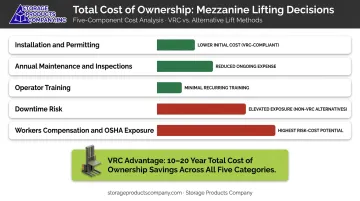
4. Calculate Total Cost of Ownership
Purchase price is only part of the equation. Include:
- Installation and permitting
- Annual maintenance and inspections
- Operator training (forklifts require certified operators)
- Downtime risk if the primary lift method is unavailable
- Workers' compensation and OSHA citation exposure
Once those factors are tallied, the math often shifts. A VRC's higher upfront cost frequently produces a lower total cost over a 10–20 year horizon than forklift-dependent alternatives. Pflow Industries notes VRCs can be up to 70% more cost-effective than alternative vertical transport systems when full lifecycle costs are included — though that figure reflects manufacturer data and should be validated against your specific operational profile.
5. Work with an Experienced Installation Partner
The right partner will assess your site, produce AutoCAD layout drawings, and recommend the configuration that fits your operation — not just the most familiar one. Storage Products Company brings 43+ years of VRC and mezzanine installation experience across warehouses, distribution centers, and manufacturing facilities throughout Alabama and the broader Southeast. They handle the full scope: equipment specification, engineering, installation, and ongoing preventative maintenance.
Conclusion
The right mezzanine lifting solution sits at the intersection of load capacity, lift frequency, available space, and long-term cost. For most industrial facilities running regular operations, a VRC Material Lift delivers the strongest combination of safety, OSHA compliance, and operational reliability. Forklifts are a practical workaround for low-frequency applications in facilities that already own the equipment. Overhead cranes make sense when very heavy loads are involved and the building can support them. Manual carrying is reserved for edge cases only — light loads, low frequency, and never at industrial scale.
Before committing to any solution, consult a material handling specialist who can assess your specific facility layout and operational requirements. Storage Products Company works with warehouses, distribution centers, and manufacturing facilities across the Southeast as a single-source resource — covering site assessment, AutoCAD design, equipment specification, installation, and ongoing maintenance. If you're ready to move materials between levels more safely and reliably, it's a practical place to start.
Frequently Asked Questions
What is a mezzanine lift?
A mezzanine lift (also called a VRC or mezzanine goods lift) is a mechanical system designed to transport goods vertically between a ground floor and a mezzanine level. It is goods-only — no personnel are permitted to ride — and operates under ASME B20.1 conveyor standards.
How much weight can a mezzanine floor take?
Industrial mezzanines are engineered for specific point and distributed loads, with capacity defined during the structural design phase. Always confirm that your chosen lifting method does not impose loads beyond the mezzanine's engineered rating.
What is the difference between a VRC and a freight elevator?
A VRC (Vertical Reciprocating Conveyor) is goods-only, governed by ASME B20.1, and requires no personnel — which keeps inspection and compliance requirements far simpler. A freight elevator carries both goods and attendants under ASME A17.1 elevator code, with much higher installation costs and ongoing inspection obligations.
Can you use pallet racking as a mezzanine?
Structural pallet racking systems can be engineered to support a mezzanine-style platform (rack-supported mezzanine), but this must be designed and certified to applicable ANSI/RMI standards. Standard pallet racking is not a substitute for a purpose-built mezzanine structure and should never be used as one without proper structural engineering.
What is the correct technique for lifting heavy loads?
For loads above 51 lbs or any repeated industrial lifting, proper technique alone is not enough. NIOSH and OSHA both require mechanical lifting equipment in those conditions — manual handling guidance applies only to occasional, light, one-off lifts.
What safety features should I look for in a mezzanine lifting solution?
Essential features include interlocked gates at each landing, emergency stop controls, overload protection sensors, secondary brake or velocity fuse devices, non-slip platform surfaces, and compliance with OSHA material hoist standards. For VRCs specifically, verify compliance with 29 CFR 1926.552 and ASME B20.1 requirements.