The challenge is that dock levelers aren't interchangeable. The right type depends on your facility's truck mix, volume, environmental requirements, and budget — and choosing incorrectly creates real consequences: worker injuries, accelerated equipment wear, and unplanned downtime.
This guide covers all 8 types of dock levelers, how each one works, and what to consider when selecting the right one for your operation.
Key Takeaways
- A dock leveler bridges the height gap between a building's dock floor and a truck bed for safe loading and unloading.
- The 8 types: mechanical, hydraulic, air-powered, vertical, edge-of-dock, rail, telescoping lip, and specialty/portable.
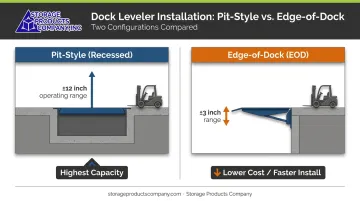
- Pit-style levelers handle ±12 inches of height variation (±18 inches with special configurations); edge-of-dock levelers top out at roughly ±3 inches.
- Hydraulic levelers offer the best combination of safety, capacity, and long-term ownership cost for high-volume operations.
- Selecting the right type means matching truck variation, load weight, facility environment, and total budget — upfront cost and long-term maintenance included.
What Is a Dock Leveler?
A dock leveler is a mechanical device — permanently or semi-permanently installed at a loading dock — that creates a ramped bridge between a building floor and a truck bed. As defined by ANSI MH30.1 and MH30.2, a dock leveling device is designed to withstand loads from material handling equipment and compensate for height differentials between a stationary dock and a movable transport vehicle.
Two Main Installation Configurations
All 8 leveler types fall within or around two structural categories:
- Pit-style (recessed): Installed into a concrete pit in the dock floor, flush with the dock surface when stored. Widest operating range and highest capacity options.
- Edge-of-dock (EOD): Mounted directly to the face of the dock wall with no pit required. Lower cost, faster to install, but limited vertical range.
Core Components
Every dock leveler shares three fundamental components:
- Deck: The ramp surface that forklifts and pallet jacks drive across
- Lip: The hinged extension that reaches out to rest on the truck bed
- Activation system: Controls how the leveler raises and positions itself. Common types include mechanical (spring-and-chain), hydraulic (push-button cylinder), and air-powered (inflatable bladder)
Each type handles these three components differently — which is what separates one dock leveler from the next.
8 Types of Dock Levelers
While every dock leveler serves the same purpose, they differ significantly in how they're powered, installed, and what environments they're suited for. Choosing the wrong type is one of the most common and costly mistakes in dock equipment planning.
1. Mechanical Dock Levelers
[Image: mechanical dock leveler — spring-and-linkage pit leveler with pull chain]
A mechanical dock leveler is a pit-style unit powered by a spring-and-linkage system. The deck is held in an "upward biased" position by the spring tension. The operator pulls a release chain to raise the deck, then walks it down onto the truck bed, where a ratchet mechanism locks it in place. No electrical power is needed.
Capacity range: Approximately 25,000–50,000 lbs (varies by manufacturer series) Operating range: ±12 inches from dock level; special configurations to ±18 inches
Best for:
- Low-volume docks
- Facilities without reliable electrical power at the dock
- Operations with tight upfront budgets
Trade-offs: Requires the most physical effort to operate. Mechanical safety legs prevent the ramp from falling more than about 4 inches below dock level, but this is less reliable than hydraulic velocity fuse protection. Tends to accumulate higher service and maintenance costs over time compared to powered alternatives.
2. Hydraulic Dock Levelers
[Image: hydraulic dock leveler — push-button pit leveler with hydraulic cylinder]
A hydraulic dock leveler is a pit-style unit powered by a hydraulic cylinder system. The operator presses a button, the deck raises smoothly, the lip extends automatically, and the leveler lowers onto the truck bed. The entire sequence is push-button — no manual lifting, no pull chains.
Capacity range: Up to 30,000–120,000 lbs depending on the series (the widest range of any leveler type)
Key safety feature: Hydraulic in-line velocity fuses prevent free fall if a truck pulls away during loading. According to Rite-Hite's RHH-5000 specifications, the velocity fuse can stop rapid descent within 3 inches under a heavy load.
Best for:
- High-volume distribution centers and manufacturing facilities
- Heavy load applications
- Facilities prioritizing safety and long-term ownership cost
Trade-offs: Higher upfront cost than mechanical. Requires electrical power. The combination of velocity fuse protection and push-button operation makes hydraulic levelers the default choice for high-volume dock operations.
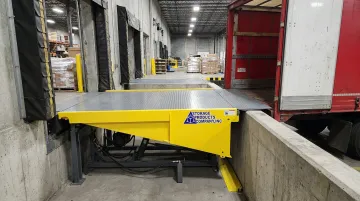
Storage Products Company supplies hydraulic pit levelers through their dock equipment partner Dock Systems Inc., with capacity ratings from 20,000 lbs to 80,000 lbs+, installed by factory-recommended and insured technicians.
3. Air-Powered Dock Levelers
[Image: air-powered dock leveler — pneumatic bladder pit leveler]
An air-powered (pneumatic) dock leveler uses a low-pressure, high-volume air bladder system installed in the pit. A small blower motor inflates the bladder to raise the deck and extend the lip, all triggered by a single button press on standard 120V single-phase power.
Capacity range: Approximately 30,000–80,000 lbs (Kelley aFX series) Operating range: Up to ±12 inches from dock level
Best for:
- Mid-volume facilities wanting push-button ease without full hydraulic investment
- Operations looking for simpler mechanical design and lower maintenance touch points
Trade-offs: Maximum load capacity is generally lower than hydraulic models at the high end. The air bladder system is simpler mechanically than hydraulic but still requires electrical power. Most air-powered levelers include a "stump-out" safety feature: structural legs that prevent below-dock falls if a truck pulls away unexpectedly.
4. Vertical Dock Levelers
[Image: vertical dock leveler — deck stored upright inside building, door closed to floor]
A vertical dock leveler stores in an upright position inside the building rather than lying flat in a pit. When stored, the overhead door closes directly to the concrete pit floor (not over the leveler), creating a complete seal between the dock environment and the building interior. Typically hydraulically operated.
Best for:
- Temperature-controlled environments (cold storage, freezer docks)
- Food processing and pharmaceutical facilities with hygiene requirements
- High-security operations where trailers can back in with doors closed
- Facilities with strict rodent and debris control requirements
According to Pentalift's vertical leveler design guide, vertical storage reduces energy loss by minimizing air exchange and helps control rodents, vermin, and debris, none of which a standard pit leveler can match.
Trade-offs: Higher cost and more complex installation than standard pit levelers. Requires specific door clearance and building infrastructure. For facilities where sanitation and climate control are non-negotiable, the cost premium is justified.
5. Edge-of-Dock (EOD) Levelers
[Image: edge-of-dock leveler — face-mounted compact leveler with integral bumper]
An edge-of-dock leveler mounts directly to the face of the dock wall — no concrete pit required. It includes an integral bumper set and a short ramp that adjusts up or down to meet the truck bed. Available in mechanical or hydraulic activation.
Operating range: Recommended ±3 inches; maximum ±5 inches from dock level (per Poweramp specifications) Capacity: Up to approximately 35,000 lbs Common widths: 66 and 72 inches
Best for:
- Facilities with consistent truck bed heights near dock level
- Retrofit applications where pit construction isn't feasible
- Low-to-medium volume operations with tighter budgets
Trade-offs: The narrow vertical range is the defining limitation. Any facility serving a diverse truck fleet with varying trailer heights will quickly run into problems with an EOD leveler. Pallet jack under-clearance must also be verified, as the leveler's profile affects usable clearance beneath the deck.
Storage Products Company supplies edge-of-dock levelers through Dock Systems Inc., specifically positioned as the appropriate choice for retrofit situations or dock conversions where pit infrastructure doesn't exist.
6. Rail Dock Levelers
[Image: rail dock leveler — horizontally sliding leveler for rail car service]
A rail dock leveler is a specialized variation designed exclusively for loading and unloading rail cars rather than truck trailers. It installs on a sliding rail system that moves horizontally along the track, positioning the leveler to align with specific rail car doors. Rail levelers offer manual or hydraulic horizontal movement, with hydraulic deck operation standard.
Capacity range: 30,000–80,000 lbs Standard widths: 7–10 feet
Each rail dock leveler is custom-built for the specific facility and rail track configuration where it will be installed. The horizontal positioning capability is something no standard dock leveler can provide.
Best for: Facilities that receive or ship via rail — grain terminals, bulk material processors, manufacturing plants with rail spurs
Trade-offs: Application is narrow (rail-only), installation is complex and fully custom, and cost is substantially higher than any standard dock leveler type. If your facility doesn't handle rail cars, this type isn't relevant.
7. Telescoping Lip Dock Levelers
[Image: telescoping lip dock leveler — adjustable extending lip on hydraulic leveler]
A telescoping lip dock leveler features an adjustable lip that can extend or retract in length, rather than the fixed-length lip found on standard levelers. This lets the leveler bridge larger gaps or accommodate trucks with recessed, stepped, or non-standard rear configurations, which is a consistent challenge with refrigerated trailers that have thick rear walls.
The NORDOCK NVTL, for example, uses push-button controls for both deck and lip movement. The standard lip projects 15 inches beyond a 4-inch bumper, with the ability to extend further as needed. Capacity ratings run from 30,000–50,000 lbs in 5,000 lb increments.
Best for:
- Facilities serving a diverse mix of trailer types and configurations
- Docks that frequently handle refrigerated trailers or specialty vehicles
- Operations where standard lip length causes bridging or sealing problems
Trade-offs: More mechanical complexity in the lip assembly than a fixed-lip leveler. That complexity requires more maintenance attention over time. If your trailer mix is consistent and standard, a fixed-lip hydraulic leveler is simpler and more economical.
8. Specialty and Portable Dock Levelers
[Image: portable dock leveler — freestanding steel ramp used at ground level or between dock positions]
This category covers non-standard configurations that don't fit neatly into the seven types above. The most common subtypes:
- Portable dock levelers: Freestanding, movable units that can be repositioned between dock doors or used at grade level. Per ANSI MH30.1, these are defined as not permanently affixed to either the transport vehicle or dock structure, and movable by manual effort or powered equipment.
- Custom configurations: Oversized load applications, facilities with non-standard dock heights, or operations with unique structural constraints that standard units can't accommodate.
OSHA 1910.26 requires portable dockboards to support the maximum intended load, remain secured against movement during use, and include safe handling means.
Best for:
- Facilities without permanent dock infrastructure
- Seasonal operations needing flexible dock capacity
- Ground-level delivery positions
Trade-offs: Portable units require manual repositioning for each use and don't match the durability or throughput capacity of permanently installed levelers. They're a practical solution for low-frequency or flexible applications, not a substitute for fixed equipment in high-volume dock operations.
How to Choose the Right Dock Leveler
Four variables drive the right dock leveler selection: your truck fleet composition, load capacity requirements, operational environment, and total cost of ownership. Getting any one of them wrong leads to equipment that underperforms, wears prematurely, or creates safety gaps.
Match the Leveler to Your Truck Fleet
Truck height variation is the most important factor. If your dock serves a consistent, predictable fleet where trailer beds stay close to dock height:
- An edge-of-dock leveler (±3 inch range) may be sufficient and cost-effective
For docks handling a mixed fleet — refrigerated trailers, flatbeds, vans, and standard dry vans — trailer heights can vary widely:
- A pit-style leveler with ±12 inch range (±18 inches with special configuration) is necessary
- Hydraulic is recommended for this application
Most common dock height is 48–52 inches, but trailer bed heights vary based on load weight, tire pressure, and trailer type. That variation alone often disqualifies edge-of-dock levelers for mixed-fleet operations.
Calculate Load Capacity Correctly
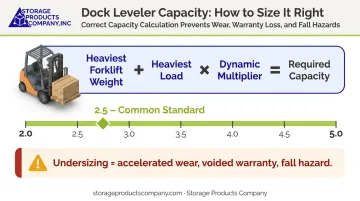
Don't guess on capacity. According to Pentalift's capacity guidance, the required static capacity is:
Heaviest forklift + heaviest load × dynamic load multiplier
The common multiplier is 2.5, though it can range from 2.0 to 5.0 depending on forklift speed and ramp angle. Undersizing capacity accelerates wear, voids warranties, and creates fall hazards when the leveler deflects under load.
Factor in Your Operational Environment
| Environment | Recommended Type |
|---|---|
| Temperature-controlled / cold storage | Vertical dock leveler |
| Food processing / pharmaceutical | Vertical dock leveler |
| Rail car loading/unloading | Rail dock leveler |
| Refrigerated trailer-heavy fleet | Telescoping lip leveler |
| Standard warehouse / distribution | Hydraulic pit leveler |
| Low-volume / consistent truck height | Edge-of-dock leveler |
Weigh Upfront Cost vs. Lifetime Cost
Mechanical levelers carry lower installation costs but higher long-term maintenance costs — springs, linkage wear, and operator strain add up over time. Hydraulic and air-powered levelers cost more upfront but require less frequent service because components only bear load during active operation.
No published dollar figure exists for a clean 10-year ownership comparison between types, but the directional difference is consistent: powered levelers reduce lifetime service costs for any dock operating above low-volume thresholds.
If you're working through these tradeoffs for a facility in Alabama or the Gulf Coast region, Storage Products Company's 43+ years of dock equipment experience — covering installation, preventative maintenance, and repair — gives you a practical resource for matching the right leveler to your specific operation.
Common Mistakes to Avoid
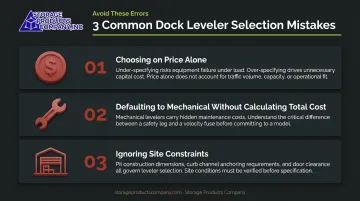
Three mistakes account for most dock leveler selection problems:
Choosing based on price alone. Both over-specifying and under-specifying create real problems. An edge-of-dock leveler on a dock with wide truck height variation is a safety hazard. An industrial hydraulic leveler in a two-dock, low-volume facility is unnecessary spend.
Defaulting to mechanical without accounting for total cost. Mechanical levelers carry the lowest upfront price, but cumulative maintenance costs, physical strain on workers, and less reliable free-fall protection (mechanical safety legs vs. hydraulic velocity fuses) shift the total cost picture over a 10-year period.
Ignoring site constraints before specifying. Each leveler type has infrastructure requirements that must be in place before the equipment arrives:
- Pit levelers need a properly constructed concrete pit; retrofitting one adds significant cost
- Edge-of-dock levelers must anchor to structural curb channels embedded in concrete
- Vertical levelers require specific overhead door clearance and structural support
Auditing site conditions before selecting a leveler type prevents expensive project changes after equipment is ordered.
Conclusion
Dock levelers are critical loading dock infrastructure, and choosing the wrong type creates compounding operational problems. The eight types covered here each serve distinct applications based on:
- Activation method (mechanical, hydraulic, air-powered)
- Installation configuration (pit, edge-of-dock, portable)
- Operating range and lip length
- Load capacity requirements
- Environmental and temperature conditions
The right leveler means safer operations, better throughput, lower maintenance costs, and longer equipment life. The best starting point is an honest assessment of your facility's actual conditions — truck fleet, volume, environment, and budget — rather than defaulting to whatever's familiar or cheapest upfront.
Frequently Asked Questions
How do I choose the right dock leveler?
No single factor determines the right choice — all five work together:
- Truck height variation: Pit-style if your fleet varies; edge-of-dock if heights are consistent
- Capacity: Calculate using the forklift-plus-load formula, not forklift weight alone
- Environment: Temperature control, hygiene requirements, and rail access each affect the right type
- Budget: Weigh upfront cost against long-term maintenance across the leveler's lifespan
- Cycle volume: High-cycle docks favor hydraulic or air-powered; low-volume docks can support mechanical
What is the difference between a dock lift and a dock leveler?
A dock leveler bridges the gap between dock floor and truck bed for everyday loading, typically within ±12 inches of dock level. A dock lift raises or lowers the entire dock platform for trucks with extreme height differences that exceed a standard leveler's range. They serve different applications and differ significantly in installation complexity.
What do dock levelers look like?
A dock leveler is a steel ramp (the deck) with a hinged plate at the front (the lip) that extends out to rest on the truck bed. Pit-style levelers sit flush with the dock floor when stored; edge-of-dock levelers mount visibly on the dock face. During use, the ramp angles up or down to bridge the height difference.
What is the most common type of dock leveler?
Hydraulic pit-style levelers are currently the most widely specified in high-volume facilities, valued for push-button operation, hydraulic free-fall protection, and lower long-term maintenance costs. Mechanical pit levelers were historically more common and remain in use at lower-volume docks and cost-constrained applications.
What is the standard working range of a dock leveler?
Pit-style levelers typically operate 12 inches above and 12 inches below dock level, with special configurations reaching 18 inches in both directions. Edge-of-dock levelers are limited to approximately ±3 inches (recommended) and ±5 inches (maximum) from dock level.
How long do dock levelers typically last?
With proper maintenance, dock levelers generally last 10–15 years or more. Hydraulic and air-powered models tend to outlast mechanical units in high-cycle applications — their components are only under stress during use, unlike mechanical springs that remain under constant tension.