Introduction
A cantilever rack failure isn't a slow-moving problem. On August 7, 2019, a cantilever racking system broke at a weld point, tipped forward, and falling pipes struck three employees — all three were hospitalized. That OSHA accident record captures exactly what happens when structural degradation goes undetected: sudden collapse, serious injury, and an immediate operational shutdown.
Cantilever racks carry risks that standard pallet racking doesn't. Their open-face design, projecting horizontal arms, and typical loads — steel bar stock, lumber, PVC pipe — create structural demands that degrade over time through static load stress, forklift impacts, and environmental exposure.
Unlike a beam-and-upright system where damage is often confined to a single bay, a compromised cantilever arm or column can destabilize an entire rack section.
This guide covers the inspection points, frequencies, and failure patterns that safety and operations managers need to keep cantilever systems running without incident.
Key Takeaways
- Inspect cantilever racks formally at least annually; high-traffic or heavy-load areas warrant every six months
- Key checkpoints: arms, uprights, bracing, base plates, anchor bolts, load distribution, and surface condition
- Visible damage (bent arms, cracked welds, loose anchors) requires immediate unloading and isolation before repairs
- OSHA's General Duty Clause and ANSI MH16.3-2025 are the primary regulatory framework
- A complete safety program requires both documented daily checks by trained staff and periodic formal reviews
Why Cantilever Rack Inspections Are a Safety Priority
Cantilever rack safety isn't a setup concern you address once at installation. Static loads, forklift impacts, and environmental exposure all degrade structural integrity over time. A rack that passed inspection two years ago may have absorbed multiple minor impacts since then — each one creating stress that isn't visible until it fails under load. Understanding the structural risks specific to cantilever systems, and the standards that govern them, is what makes inspections actionable rather than routine.
Unique Structural Risks of Cantilever Racking
Cantilever systems are structurally different from standard pallet racking in ways that matter for inspection:
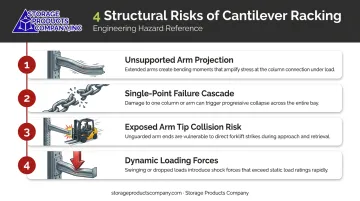
- Arms project horizontally without front vertical support, making them vulnerable to bending moment forces — particularly when loads are placed too far toward the aisle and away from the column
- A single arm or upright failure can compromise the entire bay, unlike pallet rack where damage tends to stay contained
- Exposed arm tips face direct forklift collision risk in open-aisle environments, and according to RMI, collisions can compromise arm capacity and cause failure
- Arms and connections carry dynamic loading forces — they must withstand a downward impact load of 25% of the handled unit load, plus an upward force equal to 25% of that load during loading and unloading
The long, heavy materials cantilever racks typically store — lumber, steel bar stock, PVC pipe, metal sheets — amplify every one of these risks.
Regulatory Standards You Need to Know
Two frameworks govern cantilever rack safety in the U.S.:
OSHA's General Duty Clause (Section 5(a)(1)) requires employers to provide a workplace free from recognized hazards likely to cause death or serious physical harm. There is no OSHA standard specifying a cantilever rack inspection interval, but 29 CFR 1910.176(b) requires stored materials to be stable and secure against collapse.
OSHA citations in damaged rack situations consistently cited failure to isolate compromised sections before returning them to service — a procedural gap that inspections are specifically designed to close.
ANSI MH16.3-2025 (the current RMI specification for industrial steel cantilevered storage racks) covers design, testing, and utilization — including anchor bolt inspection requirements, load arm capacity, and impact force specifications. Retaining your original engineering drawings and load specifications is essential; they're your benchmark for every inspection going forward.
Storage Products Company designs cantilever rack systems to RMI/ANSI specifications and conducts inspections against those same standards, so every finding has a documented engineering baseline to reference.
The Cantilever Rack Inspection Checklist
A thorough inspection walks every aisle from top to bottom and front to back, documents findings with a consistent checklist, and uses original load specs as the reference point. Nothing should be evaluated from memory.
Structural Integrity: Arms, Uprights, and Columns
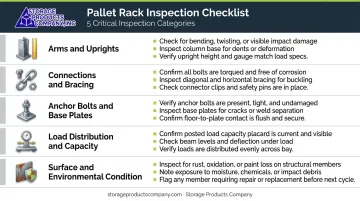
Cantilever arms — check for:
- Visible deflection or permanent sag under load (arms should remain level when fully loaded)
- Upward or downward tilting at rest
- Bending, cracking, or deformation indicating moment overload or impact damage
- Permanent deflection — this indicates metal fatigue; the arm must be removed from service
Upright columns — check for:
- Dents, buckling, or impact damage, particularly at the base where forklift strikes are most common
- RMI tolerance: columns must be straight and plumb within ±0.5 inches per 10 feet of column height
- Arm-to-column joint alignment: arms should be within 0.25 inches of the face of the column with the arm under load
Welds — inspect closely at:
- Cracked or failed welds at arm-to-upright joints, bracing connectors, and base plate connections
- Rust trails or hairline cracks at weld points — these are early stress fatigue indicators, not cosmetic issues
- A 2019 OSHA-documented cantilever collapse traced back to a single failed weld — treat every weld point as a structural load-bearing connection, not a finish detail
Connections, Bracing, and Hardware
- Verify all horizontal and diagonal bracing is present, properly aligned, and securely fastened
- Any bay missing bracing must be immediately isolated from use
- Check that locking pins, bolts, and fasteners at arm connections are fully seated and undamaged
- Flag any loose, missing, or substitute hardware for immediate replacement — non-original hardware creates new failure points
Anchoring and Base Plate Condition
ANSI MH16.3 specifically recommends both initial and repeated periodic re-inspection of anchor bolt installations.
- Inspect base plates for corrosion, warping, cracking at welds, or deformation from impact
- Confirm anchor bolts are tight, flush with base plate holes, and show no signs of loosening
- Inspect the concrete slab near uprights for cracking or settlement that could compromise anchor integrity
Storage Products Company's rack inspection services explicitly cover anchor bolt assessment as part of the compliance-grade inspection process — findings are documented and classified by severity.
Load Distribution and Capacity Compliance
- Verify stored materials on each arm level fall within the rated arm capacity and cumulative column capacity
- Confirm loads are distributed evenly across arms — ANSI MH16.3 requires loads to be symmetrically placed and evenly distributed in the down-aisle and cross-aisle directions
- Do not load beyond the arm tip; consult your original engineering drawings for specific load placement requirements
- Confirm rated load signs are visible and legible on every bay — OSHA enforcement actions have cited missing or faded load placards as standalone violations
Environmental and Surface Conditions
Surface condition issues compound structural risks — treat any visible degradation as a prompt for closer structural review, not a cosmetic flag.
- Check outdoor racks and those near washdown zones or chemical storage for active corrosion, flaking paint, bubbling, or pitting on all steel surfaces
- Surface degradation can conceal deeper structural weakening — visible rust is an inspection trigger, not a cosmetic note
- Confirm capacity labels remain legible; replace faded or missing placards before returning the bay to service
How Often Should You Inspect Cantilever Racks?
RMI guidance establishes annual formal inspections as the minimum baseline — but that floor is not the ceiling. Most operations with moderate activity should inspect every six months. High-traffic or previously damaged rack sections warrant quarterly checks.
Scheduled Inspection Cadence
| Operation Type | Recommended Frequency |
|---|---|
| Low-traffic, light loads | Annually |
| Moderate activity, standard loads | Every 6 months |
| High-traffic, heavy loads | Quarterly |
| Previously damaged rack | After repair, then quarterly |
Unscheduled Inspection Triggers
Any of these events requires an immediate focused inspection before the affected rack section returns to service:
- Any forklift or equipment impact with an upright, arm, or bracing — regardless of how minor it appears
- Changes in stored load type or weight
- Layout reconfiguration or addition of new arm levels
- Discovery of damage during a routine walkthrough
Two Types of Inspection — Both Are Required
Routine internal checks (daily or weekly in high-traffic areas): trained warehouse staff conduct visual walkthroughs to catch obvious damage before it escalates. Think of these as the early-warning layer that keeps formal inspection findings manageable.
Formal documented inspections (semi-annual or annual): conducted with a standardized checklist, producing a written report with damage classification and repair recommendations. For annual reviews, a qualified third-party inspector adds a critical layer of objectivity. Storage Products Company conducts inspections against RMI/ANSI specifications and delivers documented compliance records — the kind of paper trail that holds up under an OSHA audit or insurance review.
Common Cantilever Rack Inspection Mistakes to Avoid
Most cantilever rack failures trace back to the same handful of preventable mistakes. These four come up repeatedly in OSHA citations and post-incident reviews.
Skipping Post-Impact Inspection
Forklift strikes that appear cosmetic frequently cause internal stress or hidden weld cracking. That damage only becomes apparent under full load, sometimes through sudden collapse. Every impact is a deferred failure point until proven otherwise by a hands-on inspection.
Loading a Visibly Damaged Rack
RMI is direct: damaged rack should not be used until repairs or replacement are complete. One OSHA citation specifically noted that damaged rack areas were not relieved from load or taken out of service before operations continued. The correct protocol is to unload immediately, isolate the section, and tag it out of service.
Relying on Undocumented Walkthroughs
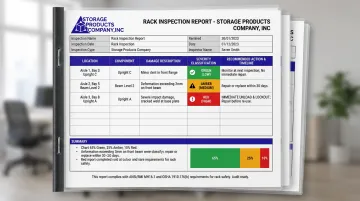
Informal checks produce no compliance trail for OSHA audits or insurance reviews. They also tend to miss high-level arm connections, base plate corrosion, and bracing gaps. A professional inspection should produce a written report with clear severity classifications — the kind of documentation an auditor can actually evaluate. Storage Products Company's inspection service delivers exactly that, using a green/amber/red severity system tied to specific repair timelines.
Modifying the System Without Engineering Review
RMI states that users must avoid modifying rack systems because changes can affect load ratings. Unauthorized field welding, non-OEM hardware substitutions, or unapproved structural changes introduce new failure points and create compliance exposure. Any modification should be reviewed by the original rack manufacturer or a qualified rack design engineer before implementation.
Conclusion
Cantilever rack safety depends on three interconnected practices: documented inspections at the right frequency, immediate response when damage is found, and using original engineering specifications as the benchmark throughout the system's service life.
Schedule inspections as routine operational discipline. Consistent inspections protect workers, preserve inventory, extend rack service life, and keep the facility in compliance.
When inspections reveal damage that warrants replacement or reconfiguration, Storage Products Company handles every step:
- On-site damage assessment
- AutoCAD layout redesign
- Teardown of compromised sections
- New system installation through factory-recommended, insured installers
With 43+ years of experience serving warehouse operations across Alabama and the Southeast, Storage Products Company is positioned to ensure the replacement system meets proper specifications from day one.
Frequently Asked Questions
How often should cantilever racks be inspected?
ANSI MH16.3 and RMI guidance establish annual formal inspections as the minimum. High-traffic or heavy-load operations should inspect every six months or quarterly. Any forklift or equipment impact triggers an immediate unscheduled inspection before that section returns to service.
What should be checked during a cantilever rack inspection?
Core checkpoints include:
- Arm and upright condition (bending, weld cracks, permanent sag)
- Bracing and hardware integrity
- Anchor bolt and base plate security
- Load distribution against rated capacity
- Surface condition for corrosion or environmental damage
- Capacity signage legibility (a compliance requirement)
Does OSHA require cantilever rack inspections?
OSHA does not publish a specific inspection interval for cantilever racks. The General Duty Clause and 29 CFR 1910.176(b) require employers to address recognized storage hazards, and ANSI MH16.3-2025 along with RMI guidelines fill that gap. Documented inspections are reviewed during OSHA compliance audits.
Do cantilever racks need to be bolted to the floor?
Yes. Floor anchoring is required for cantilever rack stability; anchors transfer horizontal seismic and lateral forces from columns into the concrete slab. ANSI MH16.3 recommends both initial and repeated periodic re-inspection of anchor bolt installations as part of the routine inspection process.
How much does a cantilever rack inspection cost?
Costs vary based on facility size, rack quantity, and whether the inspection is conducted internally by trained staff or by a third-party provider. Professional rack inspection services are typically quote-based rather than published rate schedules — contact Storage Products Company for a quote based on your facility's size and rack count.