The honest answer is that pallet racking costs vary widely. A basic selective system might run $50 per pallet position in materials. A gravity flow system can push past $450. And that's before labor, permits, or design fees touch the number.
This guide breaks down cost ranges by system type, explains what actually moves prices up or down, surfaces the hidden expenses most buyers miss, and walks through what professional installation looks like from site assessment to final sign-off.
Key Takeaways
- Pallet racking costs range from $50 to $450+ per pallet position, depending on system type
- Material costs are only part of the budget: labor, permits, equipment rentals, and layout design all factor into the final number
- Selective racking is the most accessible entry point; drive-in and gravity flow systems cost more but serve specific high-density needs
- Factory-recommended installation protects your warranty and keeps the system OSHA/RMI compliant
- Only a site-specific quote with a CAD layout plan gives you a number you can actually build a budget around
Pallet Racking Cost by System Type
Pallet racking is priced per pallet position—the space required to store one pallet. This metric makes cost comparisons across different systems and project scales straightforward. Keep in mind that steel market conditions, rack height, weight capacity, and bay configuration all push numbers within each range.
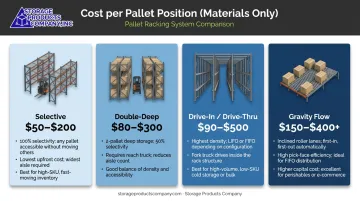
Single-Deep (Selective) Pallet Racking
Selective racking is the industry baseline. Every pallet gets direct forklift access. SKUs can be rotated freely. Bays reconfigure easily when storage needs shift.
Cost range: $50–$200 per pallet position (materials; installation additional)
This is the most budget-accessible option and the most widely deployed system in distribution centers, manufacturing plants, and 3PL warehouses. Storage Products Company's Frazier and UNARCO lines both cover selective rack—Frazier's structural steel version is the better choice for high-traffic, forklift-intensive environments where upright damage is a recurring problem.
Key trade-offs to weigh:
- Uses more floor space per pallet stored than high-density alternatives
- Roll-formed construction is more susceptible to forklift impact damage than structural steel
Double-Deep Pallet Racking
Double-deep systems place a second row of pallets behind the first, increasing storage density without the full commitment of a drive-in system. The trade-off: you need a deep-reach forklift to access the back position, and FIFO rotation becomes more complicated.
Cost range: $80–$300 per pallet position (materials)
The added cost reflects additional structural components and the specialized equipment requirement. For operations with a high number of SKUs in moderate volumes, double-deep often hits a practical sweet spot between density and accessibility.
Drive-In / Drive-Thru Racking
Drive-in systems let forklifts enter the rack structure itself, placing pallets on interior rails. Drive-in operates LIFO (last-in, first-out); drive-thru has entry and exit aisles for FIFO. Both eliminate cross-aisles to dramatically increase storage density—up to 75% more pallets than conventional selective rack by removing aisle space entirely.
Cost range: $90–$500 per pallet position (materials; wide range reflects structural complexity and configuration depth)
The higher cost comes from precision anchoring, rail installation, and the engineering required to ensure structural integrity when forklifts operate inside the rack. Best suited for:
- Cold storage and frozen goods facilities
- Bulk goods and beverage distribution
- High-volume operations with limited SKU variety
Gravity Flow (Pallet Flow) Racking
Pallet flow is the premium option. Pallets load from the rear and ride forward on roller lanes to the pick face automatically—strict FIFO rotation with no forklift repositioning at the pick face. It eliminates cross-aisles and can yield double or triple the capacity of selective systems.
The roller lane components, precision lane calibration, and installation complexity make this the highest-cost system type—$150–$400+ per pallet position in materials. It's the right system for operations where rotation discipline is non-negotiable:
- Food distribution and perishable goods
- Pharmaceutical and healthcare supply chains
- Any facility operating under strict FIFO compliance requirements
What Drives Pallet Racking Installation Costs?
The rack system type sets a baseline. Everything below determines where your project actually lands within—or above—those ranges.
Labor and Installation Crew
Labor is frequently the largest variable cost outside materials. BLS May 2023 data for structural iron and steel workers shows mean hourly wages ranging from $24.01 in Texas to $44.56 in New York—nearly a 2x spread for the same work. Regional wage rates alone can move a mid-sized project by tens of thousands of dollars.
Crew experience matters just as much as location. Factory-recommended installers like those used by Storage Products Company follow manufacturer specifications precisely, reducing the risk of misalignment, improper anchoring, and rework. A cheaper general contractor crew that misses an anchoring spec can void warranty coverage and create safety liability that costs far more to fix than the day-rate savings.
Warehouse Layout and Height
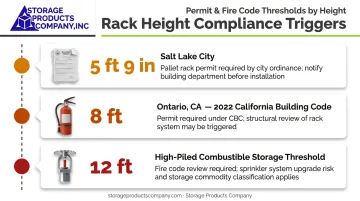
Floor conditions, ceiling height, aisle width requirements, and integration with existing conveyors or dock equipment all affect installation complexity. Taller systems trigger additional requirements:
- Salt Lake City requires a building permit for racking over 5 ft 9 in
- Ontario, CA requires permits for storage racks over 8 ft under the 2022 California Building Code
- High-piled combustible storage thresholds (commonly 12 ft, or as low as 6 ft for high-hazard commodities) can trigger fire code reviews and sprinkler upgrades
Uneven floors require shimming and additional leveling work. Existing columns, dock doors, and utility runs often force layout compromises that add installation time.
Material Quality and Rack Configuration
Several spec decisions directly affect unit cost:
- Structural steel costs more than roll-formed but holds up longer in forklift-intensive environments where uprights take regular impact
- Upright depth (36", 42", or 48") should match your pallet depth minus 6"—Cisco-Eagle's standard rule of thumb for proper overhang clearance
- Galvanized pallet rack averages 3–4 times the cost of standard racking, but pays for itself in cold storage, wash-down, and high-humidity environments where powder coat fails faster
Permits, Seismic Calculations, and Inspections
Local building codes, fire marshal requirements, and seismic zone classifications can require stamped engineering drawings, load capacity certifications, and third-party inspections. Permit fees commonly add 10%–30% to racking and installation cost, and permit approval timelines can run 4–10 weeks depending on the jurisdiction.
In seismic zones, ASCE 7 Section 15.5.3 and IBC special inspection requirements can add engineering fees, specialized anchoring, and inspection costs on top of standard permit fees. Skipping permits exposes your operation to stop-work orders, forced rack removal, and insurance claim denials—consequences that routinely exceed the cost of compliance by a wide margin.
Design and Space Planning
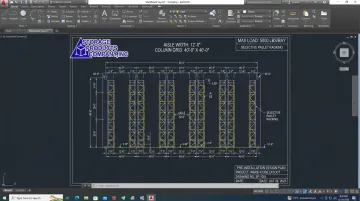
AutoCAD layout design covers rack elevations, aisle widths, load configurations, and equipment placement before any material is ordered. Getting this right upfront prevents costly reconfigurations mid-installation—changes after anchoring begins typically add days of labor and can require reordering components. Storage Products Company develops detailed CAD layouts as part of the pre-installation process so the system is fully optimized before a single upright ships.
Hidden Costs Most Buyers Overlook
Even experienced operations managers get caught by line items that don't show up in an initial rack quote.
Equipment Rentals During Installation
High-lift platforms are typically required to assemble tall rack systems. Scissor lift rental runs $100–$425 per day or $250–$950 per week, depending on lift height and equipment class. If the facility doesn't own the right equipment, these costs land on the project budget.
Compliance-Triggered Upgrades
Reconfiguring rack layout can trigger fire suppression reviews, emergency egress changes, or lighting updates that have nothing to do with the rack itself but surface during the permitting process. High-piled storage calculations—which include a 48" perimeter aisle around storage arrays—can pull previously compliant areas into regulated territory.
Operational Downtime
There's no invoice line for lost productivity during installation, but it's a real cost. Pausing or rerouting warehouse operations adds up quickly. Scheduling installation during slow periods and working with an installer who can phase work or operate after hours keeps that impact manageable. Storage Products Company structures projects around both options when the work and facility schedule allow for it.
The Pallet Racking Installation Process: What to Expect
Step 1 – Site Assessment and Layout Design
A qualified installer surveys the facility: floor conditions, ceiling height, column grid, existing infrastructure, lift truck fleet, and storage goals. Storage Products Company uses AutoCAD technology to produce detailed layout drawings defining exact rack placement, aisle widths, and load configurations before any equipment is ordered. This step is where most projects either get set up for success or set up for expensive surprises.
Step 2 – Permitting and Engineering Review
Once the layout is finalized, applicable permits are pulled. In seismic zones or for tall systems, stamped engineering calculations are submitted for review. Permit approval timelines vary significantly by municipality—build 4–10 weeks of lead time into any project plan that requires a permit.
Step 3 – Delivery, Assembly, and Anchoring
Once materials arrive on site, installation crews assemble frames per engineered drawings, level all components, and anchor uprights to the floor per manufacturer and code specifications. Following manufacturer guidelines precisely matters for more than just safety—Frazier's Two Year Pallet Rack Damage Warranty, available through Storage Products Company, requires proper installation to remain valid.
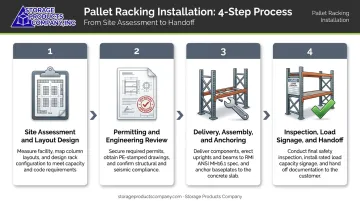
Step 4 – Inspection, Load Signage, and Handoff
The project closes with a formal inspection—internal, third-party, or both depending on jurisdiction—followed by a walkthrough with the facility manager to confirm everything meets spec. Required load capacity signage is installed per ANSI MH16.1, which mandates permanent load plaques (minimum 50 sq in.) posted in conspicuous locations showing maximum permissible unit load and total load per bay.
This documentation protects the business during future audits and insurance reviews.
New vs. Used Pallet Racking: Is It Worth the Savings?
Used pallet rack can save 30%–50% on material costs compared to new. For selective systems in lower-risk environments, that's a legitimate option—particularly for distribution center expansions on tight budgets or warehouse startups where cash flow is constrained.
The risks are real, though:
- Impact damage or corrosion may not be visible during a quick inspection
- Mixing components from different manufacturers is not advisable—RMI explicitly warns that rack systems are designed for specific applications and mixed components can void load ratings
- Used rack from liquidation or auction rarely comes with documentation on prior loading history
Decision framework:
| Scenario | Recommendation |
|---|---|
| Single-deep, low height, inspected source | Used rack is viable |
| Tall systems (20'+ uprights) | New rack only |
| Cold storage / food-grade environment | New rack with appropriate finish |
| High-density drive-in or flow systems | New rack only |
| Manufacturer warranty required | New rack only |
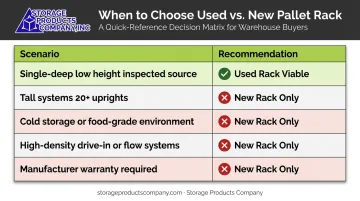
If you go the used route, make sure your source inspects rack against RMI/ANSI MH16.1 standards. Storage Products Company does exactly that before resale—and can fill gaps with new components where inspected pieces don't pass.
Frequently Asked Questions
How much does it cost to install pallet racking?
Full installed cost (materials + labor + permits) runs $100–$400+ per pallet position, varying significantly by system type, project size, and regional labor rates. A small selective system in a straightforward facility lands near the lower end; tall, complex, or permit-intensive projects push higher. Get a site-specific quote for an accurate number.
How much does a drive-in racking system cost?
Drive-in systems run approximately $90–$500 per pallet position for materials, with installation adding to the total. The higher cost reflects precision anchoring, interior rail installation, and engineering requirements. For high-volume storage of homogeneous product, the density advantage over selective rack often justifies the premium.
What is the most flexible racking system that offers 100% selectivity?
Single-deep selective pallet racking provides direct forklift access to every pallet without moving others—true 100% selectivity. It's the preferred system for diverse SKU environments and the most cost-accessible entry point, making it the right starting configuration for most warehouse operations.
What are the OSHA standards for pallet racking?
OSHA does not have a dedicated pallet racking standard. Instead, it enforces general material storage requirements under 1910.176(b) and applies ANSI MH16.1 (the RMI standard) as design and abatement guidance in rack-related citations. Key requirements include posted load capacity signs, regular inspections, and prompt repair or replacement of damaged components.
Should I hire professional installers or install pallet racking myself?
DIY installation is feasible for small, simple single-deep systems at modest heights. For anything involving height, heavy loads, or permitting requirements, professional installation is the right call. Improper anchoring or misalignment can void manufacturer warranties and create safety liability that far exceeds the labor cost saved.
How long does it take to install a pallet racking system?
Small selective systems can be installed in 1–3 days. Large or complex installations run 3–6 weeks. Permitting adds 4–10 weeks of lead time before physical installation begins, depending on the jurisdiction. Build buffer into any project timeline that requires a permit—approval schedules are rarely predictable.