High-density storage systems address this pressure directly. Rather than spreading inventory across more floor space, they concentrate it into a smaller footprint by eliminating redundant aisles and using depth and height more aggressively.
This article covers what high-density storage systems are, the main types available, the tangible benefits they deliver, which industries see the strongest return, and the practical steps to implement them without costly mistakes.
Key Takeaways
- High-density storage maximizes capacity by eliminating redundant aisles and concentrating goods into a compact footprint.
- Common types include mobile shelving, push-back racking, pallet flow racks, drive-in racking, and carton flow systems.
- Key benefits: dramatically more pallet positions, reduced facility costs, enforced inventory rotation, and improved worker safety.
- SKU count, turnover velocity, product type, and building constraints all determine which system fits your operation.
- Successful implementation starts with a thorough space and inventory audit, backed by AutoCAD layout modeling before equipment is ordered.
What Is a High-Density Storage System?
High-density storage is a warehousing approach that maximizes usable space by eliminating redundant access aisles and storing goods in deep, compact configurations. Conventional selective racking gives every pallet its own dedicated access point — which means a large share of your floor plan is occupied by aisles that only one forklift uses at a time.
High-density systems work differently. Rather than expanding outward with more aisles, they extend depth — multiple pallets stack behind one another in a single lane, and the total number of aisles required drops sharply.
The Core Trade-Off
The fundamental compromise is selectivity versus density. In most high-density configurations, you cannot access every pallet independently without moving others first. That's an acceptable trade-off when:
- You store large quantities of a relatively small number of SKUs
- Floor space is expensive or constrained
- Avoiding a facility expansion is a financial priority
- Product rotation follows a predictable FIFO or LIFO pattern
Conventional selective racking remains the better choice when operations require simultaneous, direct access to a wide variety of SKUs throughout the day.
Mobile pallet racking is worth noting here as a distinct option — it retains direct access to every stored pallet by opening only the required aisle on demand, effectively resolving the density-versus-selectivity trade-off entirely, at a higher upfront cost.
Types of High-Density Storage Systems
High-density solutions range from simple mechanical systems operated with standard forklifts to fully automated retrieval equipment. The right choice depends on inventory profile, building constraints, throughput requirements, and budget.
Mobile Shelving and Mobile Pallet Racking
Mobile shelving (for lighter goods, files, and smaller items) and mobile pallet racking (for full pallet loads) share the same operating principle: units are mounted on wheeled carriages that glide along floor-embedded rails. The ranges compress together when not in use, opening a single working aisle only where access is needed.
This is the only high-density system that provides direct access to every individual stored item or pallet — no working around other inventory to reach what you need. These systems typically deliver 2–3x the storage density of traditional fixed shelving by eliminating multiple fixed aisles.
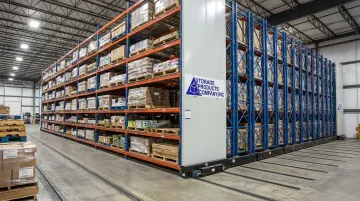
Storage Products Company offers lateral movable units in manual, mechanical, and powered drive configurations, with aisle-occupancy sensors standard to prevent units from closing on personnel.
Push-Back Racking
Push-back racking loads pallets from the front of the lane. Each new pallet pushes the previous ones backward along inclined cart rails. When the front pallet is removed, the ones behind it roll forward automatically under gravity.
Key characteristics:
- Operates on LIFO (Last In, First Out)
- Stores 2–6 pallets deep per lane in UNARCO configurations
- Different SKUs can occupy different levels within the same bay — a major advantage over drive-in racking
- Suits mixed-SKU environments with moderate turnover
Storage Products Company supplies push-back systems through both Frazier Industrial and UNARCO Material Handling — with configurations that can deliver up to 90% more storage capacity than standard selective racking.
Pallet Flow Racks
Pallet flow (also called live pallet racking) uses gravity-fed lanes on a slight incline. Pallets load at the high end and flow forward to the picking face as positions are vacated.
- Enforces strict FIFO inventory rotation — essential for perishables, date-coded products, or cold storage
- Lanes can run up to 20 pallets deep (UNARCO specifications)
- The system can run 100% full while still providing product availability at the discharge face — an advantage over drive-in racking, where voids are required for forklift entry
- Frazier Industrial pallet flow systems available through Storage Products Company are backed by the Two Year Pallet Rack Damage Warranty
Drive-In Racking
Drive-in racking allows forklifts to enter the rack structure itself to deposit and retrieve pallets. Lanes are dedicated to a single SKU and accessed from one face (drive-in) or both faces (drive-thru).
- Best suited for high-volume, low-SKU operations: bulk commodities, beverages, frozen food cases
- Eliminates aisles to store up to 75% more pallets than conventional selective racking
- Operates on LIFO for drive-in configurations
- Maneuvering a forklift deep into the rack structure is operationally slower than front-loading systems
Drive-in racking works best when a single product fills an entire lane. Operations storing three or fewer SKUs in large quantities tend to see the strongest ROI from this configuration.
Carton Flow Systems
While the systems above operate at the pallet level, carton flow rack addresses smaller items and mixed-case picking. Gravity-fed lanes at the carton or tote level store items in roughly half the space required by static shelving, while maintaining FIFO access at the pick face. They handle fast-movers, slow-movers, odd-shaped cartons, bins, and totes.
Key Benefits of High-Density Storage Systems
Maximum Space Utilization
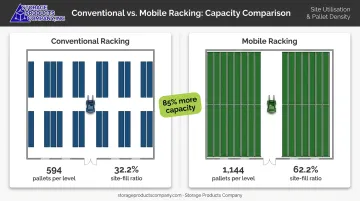
The density gains from high-density storage are well-documented. In a Mecalux analysis of a 1,768 sq m warehouse, a conventional counterbalanced forklift layout achieved 594 pallets per level and a 32.2% site-fill ratio. The same footprint using mobile racking achieved 1,144 pallets per level and a 62.2% site-fill ratio — nearly double the pallet positions.
SSI Schaefer reports mobile racking can increase storage capacity by up to 85% compared to conventional pallet racking. Push-back systems deliver comparable gains for facilities where full mobile racking isn't required.
Reduced Operating Costs
High-density systems attack operating costs from two directions:
- Deferred expansion — more pallet positions in the existing footprint means avoiding or delaying a lease extension, second location, or new construction. With U.S. logistics rents still 59% above 2019 levels, that deferral has real dollar value.
- Cold storage savings — denser storage reduces the refrigerated volume that must be maintained. Jungheinrich notes compact mobile racking is specifically suited for cold stores to minimize footprint and reduce operating costs. SSI Schaefer rates its mobile racking systems for temperatures as low as -30°C.
Improved Inventory Management
High-density systems don't just store goods — they enforce a rotation discipline:
| System | Rotation Method | Best For |
|---|---|---|
| Pallet flow rack | FIFO | Perishables, date-coded goods, pharmaceuticals |
| Push-back rack | LIFO | Non-perishable, non-date-sensitive products |
| Drive-in rack | LIFO | Bulk single-SKU commodities |
| Carton flow rack | FIFO | Case picking, high-velocity SKUs |
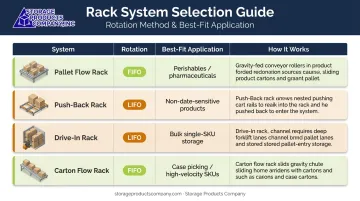
Mismatching system to rotation method is a common source of preventable waste — particularly in food, beverage, and pharmaceutical distribution where expired stock carries direct financial and compliance consequences.
Enhanced Worker Safety and Ergonomics
Fewer aisles means fewer points where forklifts and pedestrians share space — and that layout change has a measurable safety impact. OSHA estimates 35,000 serious forklift injuries and 62,000 non-serious injuries annually, with pedestrian strikes as the leading cause of fatalities. High-density systems reduce these risks in two ways:
- Fewer aisles means fewer forklift-pedestrian conflict points throughout the facility
- Shorter travel distances reduce worker fatigue and cumulative injury risk
Storage Products Company supplies rack protection accessories — column protectors, end-of-aisle guards, guard rails, and bollards — that complement any high-density installation. Mobile shelving systems include aisle-occupancy sensors that prevent the units from closing when a worker is present.
Scalability Without Physical Expansion
Modular racking configurations — particularly push-back and pallet flow — can be extended, reconfigured, or reallocated as SKU counts and inventory volumes shift. For operations absorbing new product lines, seasonal volume swings, or e-commerce growth, that reconfigurability avoids the cost and disruption of a facility move.
Which Industries Benefit Most from High-Density Storage?
The ROI case for high-density storage is strongest where floor space is expensive, SKU counts are manageable, or inventory rotation is time-sensitive:
- Distribution centers and 3PLs — high pallet volumes across a manageable SKU range
- Manufacturing facilities — components, tools, and WIP stored near assembly lines with limited floor area
- Retail back-of-house — seasonal stock fluctuations requiring flexible, dense storage
- Cold storage and food/beverage — refrigerated space is among the most expensive per square foot; denser storage reduces energy overhead
- Automotive parts distributors — thousands of unique part numbers requiring organized, accessible storage across carton flow, selective, and shelving systems
Of these, cold storage shows the sharpest growth trajectory right now.
Cold Storage: A High-Growth Application
Frozen food demand is rising.
The AFFI reported first-half 2024 unit gains including frozen fruit (+8.8%), processed chicken (+9.6%), and tater tots (+8.2%) versus the same period in 2023. U.S. gross refrigerated storage capacity stands at 3.70 billion cubic feet (USDA, 2023), and operators under pressure to expand capacity without building new refrigerated space are natural candidates for mobile racking and pallet flow systems.
Across all these industries, the pattern holds: high-density storage pays off most when pallets-per-SKU ratios are high and cost-per-square-foot pressure is significant. Facilities paying premium rates per square foot — whether for refrigerated space in Birmingham or warehouse square footage in Mobile — tend to see the fastest payback periods on dense storage investments.
Best Practices for Implementing High-Density Storage
Conduct a Space and Inventory Assessment First
Before selecting any system, audit both your inventory and your building:
Inventory inputs:
- SKU count and pallets per SKU
- Product dimensions and pallet weight
- Turnover velocity (fast, medium, slow movers)
- Required rotation method (FIFO vs. LIFO)
Building inputs:
- Clear ceiling height
- Floor load capacity
- Column spacing and grid
- Fire code constraints (high-piled storage thresholds)
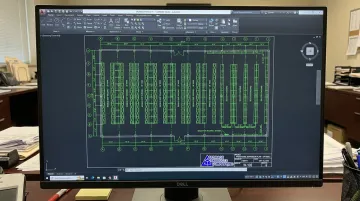
Storage Products Company provides AutoCAD layout design services that model different configurations digitally before any equipment is ordered. Each model draws on ceiling height, column grid, fire code requirements, and inventory profile to identify the optimal layout — catching conflicts before any equipment is ordered and preventing costly reconfigurations after installation.
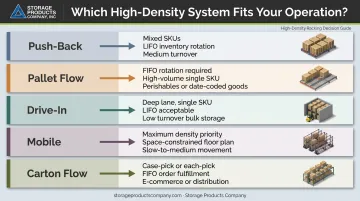
Match the System to Your Inventory Profile
No single high-density system suits every operation. A practical matching guide:
- Push-back racking → mixed SKUs, medium turnover, LIFO acceptable
- Pallet flow rack → FIFO required, perishables, date-coded goods
- Drive-in racking → single-SKU, bulk volume, LIFO
- Mobile racking → slower-moving goods needing direct access to every location
- Carton flow → high-SKU case picking, small-item density
Start with the highest-density requirements — typically fast-moving, high-volume SKUs — then layer conventional selective racking for the remainder of your inventory. Hybrid configurations are common and often the most cost-effective solution.
Plan for Compliance, Safety, and Scalability
Several regulatory requirements directly shape high-density rack design:
- Fire codes (2024 IFC): High-piled combustible storage is defined as anything exceeding 12 feet (6 feet for high-hazard commodities). Storage over 500 sq ft triggers Chapter 32 fire protection requirements. Deep-lane racks over 20 feet that don't meet NFPA flue spacing may require in-rack sprinklers at every tier.
- Structural standards: Rack systems should be designed to RMI ANSI MH16.1 specifications. Storage Products Company provides PE-stamped drawings for permit-required installations.
- ADA compliance: Mobile shelving in accessible spaces must maintain a 36-inch minimum clear aisle width per ADA accessible route requirements.
Design with future growth in mind as well. A modular configuration that extends in place avoids a full teardown when SKU counts increase — protecting the original investment.
Train Staff and Manage the Transition
Equipment changes require clear communication before go-live:
- Brief all warehouse personnel on load limits, safe operating procedures for new system types, and emergency protocols
- Ensure load-capacity placards are posted and legible (an ANSI MH16.1 compliance requirement)
- Schedule a post-installation rack inspection to confirm anchor integrity, beam clip seating, and plumb tolerances before full operation begins
Storage Products Company provides RMI/ANSI MH16.1 rack inspection services post-installation, documenting condition by severity and identifying any components requiring action before inventory loading begins.
Frequently Asked Questions
What is high-density storage?
High-density storage is a warehousing method that maximizes storage capacity by eliminating redundant access aisles and concentrating goods into deep, compact structures. It allows significantly more pallet positions or storage locations within the same floor area compared to conventional static shelving or selective racking.
How do you optimize warehouse storage?
Start with a space and inventory audit covering SKU count, pallet quantities, turnover velocity, and building constraints. From there, high-density racking reduces aisle waste, vertical height is used more effectively, and fast-movers are positioned nearest dispatch. An AutoCAD layout review before any purchase commitment confirms the configuration works in your actual space.
What is the 5S rule in warehousing?
5S is a lean methodology: Sort, Set in Order, Shine, Standardize, Sustain. High-density storage systems directly support the "Set in Order" and "Sustain" steps by providing structured, space-efficient locations for all inventory — making it easier to maintain organization over time.
What are the four types of warehousing?
The four general warehouse types are private, public, bonded, and distribution center/fulfillment warehouses. High-density storage systems are applicable across all four — the right system depends on the operation's inventory profile, throughput requirements, and available budget.
What is the best warehouse inventory management system?
The right WMS depends on operational scale and complexity. What matters most from a storage design standpoint is that the WMS integrates cleanly with the physical infrastructure — automated high-density systems rely on that connection to track inventory locations and manage retrieval sequences accurately.