Introduction
Pick the wrong upright depth and your pallets sit flush on the beams with no overhang — a tip-over waiting to happen. Order beams using outside measurements instead of inside, and they won't seat into the uprights at all. Choose rack height based on ceiling clearance alone and ignore your forklift's reach limit, and your top storage levels become permanently inaccessible.
Pallet rack dimensions are structural parameters — they determine load capacity, forklift clearance, and storage density simultaneously. Change one, and the others shift with it.
This guide covers every critical dimension category — upright depth and height, beam length and face height, and aisle width — with details on:
- How each dimension is correctly measured
- How dimensions combine to determine load ratings
- What ANSI MH16.1-2023 and OSHA require
- Where the most expensive ordering mistakes happen
Key Takeaways
- Upright depth: 36″, 42″, and 48″ are standard — 42″ pairs with the 48″ GMA pallet
- Beam length: typically 8′–12′, measured inside-edge to inside-edge between uprights
- Beam face: 2.5″–6.5″ range; deeper face = higher capacity for the same length
- 8′–30′+ upright heights available — ceiling clearance, forklift reach, and fire codes are the practical limits
- Aisle width is equipment-driven — counterbalanced forklifts need ~12′+; VNA systems can operate in ~6′
What Standard Pallet Rack Dimensions Actually Define
Pallet rack dimensions aren't interchangeable choices — each one performs a specific structural function, and they're all connected.
The Three Dimension Categories
| Category | What It Controls |
|---|---|
| Upright frame (height + depth) | Column capacity, pallet depth accommodation, vertical beam spacing |
| Beam (length + face height) | Bay width, pallet count per bay, load per pair |
| Aisle width | Forklift access, rack row count, floor footprint |
Change beam length and you change the unsupported span, which changes the rated load per pair. Change upright height without adjusting beam spacing and column capacity drops. Mismatched dimensions don't just reduce efficiency — they can invalidate manufacturer load ratings entirely.
The GMA Pallet Baseline
Most selective rack systems are designed around the 48″ × 40″ GMA standard pallet. Upright depth derives from pallet depth — typically pallet depth minus ~6″ to allow a 3″ overhang front and back. Beam length derives from pallet width multiplied by the number of pallets per bay, plus required clearances between pallets and between pallets and uprights.
Nominal vs. Actual Measurement
This is where ordering errors start. Two conventions apply — and they point in opposite directions:
- Beam length = inside-edge to inside-edge between uprights (clear span)
- Upright depth = outside-edge to outside-edge of the frame
Confusing these two produces components that physically won't fit. The Ridg-U-Rak product guide confirms that beam length equals the column side-face-to-side-face distance, with total bay width being beam length plus column width (typically adding 3″–4″ per column).
RMI/ANSI Standards
ANSI MH16.1-2023 governs the design, testing, and utilization of industrial steel storage racks. It sets the engineering criteria that determine how dimensions translate into allowable load ratings — which is why two racks with identical dimensions can carry different rated loads depending on whether they're spec'd to this standard. Every properly specified rack system should reference RMI-compliant load ratings, not generic capacity estimates from a product sheet.
Standard Upright, Beam, and Depth Dimensions
Upright Depth
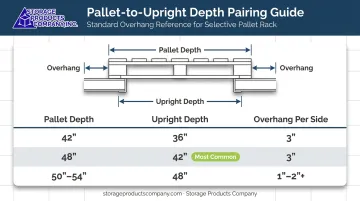
The three most common upright depths are 36″, 42″, and 48″. The 42″ depth is the most widely used because it pairs with the standard 48″ deep GMA pallet, delivering a 3″ overhang front and back. That overhang matters — it's what allows proper beam-to-pallet load transfer and forklift placement.
Pallet depth to upright depth reference:
| Pallet Depth | Upright Depth | Overhang Each Side |
|---|---|---|
| 42″ | 36″ | 3″ |
| 48″ | 42″ | 3″ |
| 50″–54″ | 48″ | 1″–2″+ |
Manufacturer data (Ridg-U-Rak) also lists 24″, 30″, 44″, and 60″ depths for specialized applications. Depths below 24″ are not suitable for palletized storage — those are hand-stacking configurations only.
Upright Height
Storage Products Company sources Frazier uprights from 8′ through 30′+ (custom heights available). Three constraints determine your practical maximum:
- Ceiling clearance — fire codes require 18″ minimum between stored goods and sprinkler heads per OSHA 29 CFR 1910.159(c)(10)
- Forklift reach height — the rack can't exceed what the lift truck can actually reach
- Overhead obstructions — HVAC, lighting, and structural members all create hard stops
Beam Length and Face
Beam lengths span from 36″ to 192″ (UNARCO) and 48″ to 156″ (Ridg-U-Rak). For standard two-pallet bays using 40″ wide GMA pallets, 8′ and 9′ beams are the most commonly used lengths.
Critical measurement rule: beam length is always measured inside-edge to inside-edge — not total bay width. Total bay width equals beam length plus the combined column widths (typically 3″–4″ per column, per Ridg-U-Rak data).
Beam face height (the top-to-bottom depth of the beam) runs from 2.5″ to 6.5″ across major manufacturers. A deeper face increases load capacity without changing beam length. UNARCO notes its 6″ profile is specifically designed for longer spans and heavy loads — evaluate both face height and beam length together against the manufacturer's RMI-rated capacity chart for your configuration.
Storage Products Company carries Frazier structural rack — RMI-rated systems backed by a two-year pallet rack damage warranty — and provides AutoCAD layout design to match beam and upright specs to your actual load profile.
Aisle Width
Aisle width falls outside the rack itself, but it directly controls how many rack rows fit in your building — making it a dimension that shapes your entire layout. Equipment type drives the requirement:
- Counterbalanced forklifts: Toyota's calculation model yields roughly 146″ (~12.2′) for a standard counterbalanced truck with a 48″ pallet load
- Reach trucks: can operate in aisles as narrow as 7′ depending on model and load
- VNA (very narrow aisle) systems: ~6′ aisles using wire-guided turret trucks or swing-reach equipment
These are equipment-specific values, not universal OSHA requirements. Always validate aisle width against your specific forklift model and load dimensions.
How Pallet Rack Dimensions Determine Load Capacity
Load capacity isn't a fixed property stamped on a rack — it's a calculated result of several interacting variables.
What Drives Upright Frame Capacity
The longer the unsupported column length between the floor and the first beam (or between beam levels), the lower the column's axial load capacity. Ridg-U-Rak's capacity charts explicitly vary allowable loads based on unsupported column length and vertical beam spacing. A 20′ upright with beams spaced 60″ apart has a different capacity than the same upright with beams at 36″ spacing.
Beam placement height directly affects structural capacity — so it's an engineering decision, not just a storage preference.
What Drives Beam Capacity
Two variables determine beam capacity:
- Deeper face height increases capacity for the same span
- Longer beams carry less weight per pair than shorter beams with the same profile
UNARCO rates beam capacities for uniform loads per pair, calculated per current RMI standards. Do not apply generic capacity estimates — use the manufacturer's actual capacity chart for your specific beam length, face height, steel gauge, and connector type.
OSHA and Load Signage
Knowing your capacity numbers only matters if they're posted and enforced. OSHA 1910.176(b) requires stored material to be stacked and limited in height to remain stable. ANSI MH16.1-2023 requires every rack installation to display clearly posted load signage and to operate within design limits. OSHA has cited RMI/ANSI compliance as the accepted corrective path for rack loading violations.
Exceeding posted capacity is both a safety violation and grounds for voiding manufacturer warranties. During rack inspections, missing or illegible load-capacity placards are among the most common compliance deficiencies flagged — and among the easiest to correct before a citation occurs.
How to Correctly Measure Pallet Rack Components
Four measurement rules prevent the most common ordering errors:
- Beam length = inside-edge to inside-edge (clear span between column faces)
- Upright depth = outside-edge to outside-edge of the frame
- Frame height = floor (just above base plate) to top of upright column
- Beam face = top to bottom of the beam's front profile — this is the primary capacity indicator
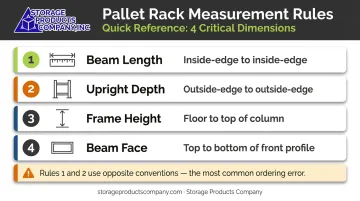
Rules 1 and 2 follow opposite conventions, which is where most ordering confusion originates.
Adding to an Existing Rack System
Getting the measurements right is only part of the equation when expanding an existing installation. You also need to verify the connector/hole pattern type — teardrop, keystone, and structural bolt-on connections are not interchangeable, even when all measured dimensions appear identical. Mismatched connector types won't seat properly even when beam length and upright depth match.
Storage Products Company's AutoCAD layout service documents existing rack configurations and confirms component compatibility before new equipment is ordered, which helps avoid costly returns and field-fit problems.
Common Dimension Mistakes and What Goes Wrong
Wrong Upright Depth for Actual Pallet Size
The most frequent error: selecting upright depth based on a general recommendation rather than measuring the actual pallet. A warehouse using 42″ deep pallets needs 36″ uprights — not 42″. With 42″ uprights, the pallet sits flush with the beam faces, eliminating the required overhang. No overhang means improper load transfer to the beams and a higher tip-over risk.
Beam Length Miscalculation
Two versions of this mistake:
- Using total bay width instead of inside measurement — produces beams too long to seat into the connector slots
- Omitting clearance allowances — ignoring the space between adjacent pallets and between pallets and uprights produces beams that are too short, creating unsafe loading conditions
Height Selection Without Checking Forklift Reach
Choosing rack height based only on ceiling clearance is a common and expensive error. Two separate failure modes make this mistake costly:
- Forklift reach gap — if your forklift can't reach the top beam level, that storage is inaccessible dead space, not added capacity
- Sprinkler clearance — stored goods within 18″ of sprinkler heads create an immediate fire code violation
- Aisle-equipment mismatch — rack height decisions must account for the actual equipment operating in that aisle, including turning radius and mast height at elevation
Getting height right means confirming forklift specs before finalizing the design, not after.
Frequently Asked Questions
What is the standard pallet racking size?
The most common configuration is 42″ deep uprights, 8′–9′ beams, and upright heights between 16′ and 20′ for most warehouse applications. These dimensions are designed around the 48″ × 40″ GMA standard pallet.
What are two common pallet rack depths?
The two most common depths are 36″ and 42″. The 42″ depth pairs with 48″ deep pallets; the 36″ depth pairs with 42″ deep pallets. Both provide the required 3″ front-and-back overhang for proper load transfer.
What is the average height of warehouse racking?
Most warehouse racking runs between 16′ and 20′. Uprights are available from 8′ up to 30′+, but practical height is capped by ceiling clearance (with 18″ required below sprinkler heads), forklift reach height, and local fire code requirements.
What is the standard width of a racking aisle in a warehouse?
Aisle width falls into three categories based on equipment type: standard selective racking with counterbalanced forklifts (~12′+), narrow-aisle reach trucks (as narrow as 7′), and VNA systems (~6′ using specialized turret trucks). The category you choose directly determines how many rack rows fit in your building.
What is the OSHA standard for pallet racking?
OSHA 1910.176(b) requires stored material to remain stable and not create a hazard. ANSI MH16.1-2023 requires load capacity placards on all rack installations. OSHA enforcement can reference ANSI/RMI standards, and damaged rack must be unloaded immediately until repaired or replaced.
How high should pallets be stacked in a warehouse?
Stacking height is governed by the rack's rated beam capacity and vertical beam spacing. All stored goods must remain at least 18″ below sprinkler heads per OSHA 1910.159(c)(10). Never exceed the posted load capacity placard for the bay.