Introduction
Refrigerated warehouse space is expensive — and not just to lease. According to Cushman & Wakefield's 2024 cold storage analysis, new cold storage construction costs nearly double that of ambient warehousing, with below-freezing facilities running $275+ per square foot compared to $77–$139 per square foot for dry warehouses. Every poorly utilized cubic foot of cooled space is a cost you're paying to refrigerate air.
Demand is only growing. The USDA reports U.S. refrigerated warehouse capacity grew from 3.73 billion cubic feet in 2021 to 3.99 billion cubic feet by October 2025 — a nearly 7% increase across 931 facilities nationwide. Fitting more product into that capacity — without compromising safety or throughput — starts with the racking system holding it all up.
Cold storage racking demands deliberate design choices that standard ambient systems simply aren't built for. Extreme temperatures, condensation cycles, restricted-visibility forklift operations, and spoilage risk create conditions where the wrong rack selection costs far more than the equipment itself.
This guide covers the science behind cold's effect on steel, how to choose between structural and roll-formed racking, which racking systems perform best in refrigerated environments, and what layout and protection factors matter before you purchase.
Key Takeaways
- Cold temperatures reduce steel toughness, making impact resistance — not load capacity — the primary material selection concern
- Structural steel is recommended for forklift-operated cold storage; roll-formed is acceptable for hand-pick-only environments
- Rack system selection hinges on turnover rate and storage density: pallet flow suits FIFO perishables, drive-in maximizes density, and selective rack prioritizes access
- Anti-corrosion finishes, safety accessories, and professional layout design prevent premature failure, injury risk, and costly redesigns in refrigerated environments
Why Cold Storage Racking Requires a Different Approach
The Stakes Are Higher Than a Standard Rack Failure
Cold storage facilities exist to protect the cold chain: the unbroken temperature-controlled path that food, pharmaceuticals, and biologics must travel from production to delivery. A rack failure in a dry warehouse is serious. In a cold storage facility, that same failure also means product spoilage, potential contamination, cold chain breaks, and regulatory exposure.
The design bar is higher — and that affects every decision from steel specification to rack layout.
Steel Behavior at Low Temperatures
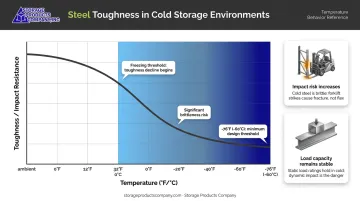
Steel doesn't simply weaken under cold — its behavior changes in a more specific way. At sub-zero temperatures, steel's toughness (its ability to absorb impact energy without cracking) decreases, even though its load-bearing strength remains intact. This means a rack system that handles pallet loads fine under normal conditions can become more susceptible to cracking or catastrophic damage when struck by a forklift in a freezer environment.
The Rack Manufacturers Institute (RMI) has funded research testing cold-formed steel down to -60°C (-76°F). The practical implication for rack buyers: the risk in cold storage isn't spontaneous collapse under load — it's what happens when a forklift clips an upright and the steel responds more like glass than metal.
Energy Costs Create a Density Imperative
Cooling a large, poorly utilized space costs more than cooling a densely stocked one. A typical 200,000 sq ft cold storage building requires 3 to 4 MW of power, per Cushman & Wakefield. High-density racking reduces the volume of air that must be chilled, connecting storage density directly to utility savings. That savings shows up directly on your monthly energy bill.
Worker Safety Is a Design Variable
OSHA's Cold Stress Guide notes that hypothermia can occur when body temperature drops below 95°F — and that risk exists even above 40°F when workers are wet or exposed for extended periods. Frostbite and trench foot are documented risks in sub-zero environments.
Racking systems that minimize worker time in cold zones — through efficient picking lanes, logical product positioning, and fast retrieval — are a meaningful safety advantage, not just an operational one.
Condensation and Corrosion
Temperature differentials between the cold chamber and ambient air produce persistent condensation on rack surfaces and floors. On unprotected steel, that moisture accelerates rust. On concrete floors, it creates slip hazards.
These issues must be addressed in the design phase, not after installation. Key requirements include:
- Floor slope sized for condensation drainage
- Proper drainage design integrated into the layout
- Protective coatings or galvanized finishes on rack components
Structural Steel vs. Roll-Formed Racking: Which Does Your Facility Need?
The Real Distinction Is Impact Resistance, Not Load Capacity
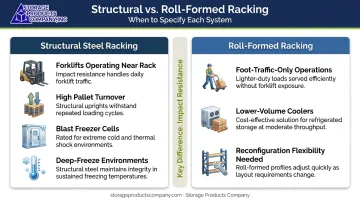
Both structural steel and roll-formed racking can handle the load capacities required for cold storage. Frozen food pallets typically weigh 2,500 to 3,500 lbs — well within the rated capacity of either system. The real decision point is impact resistance.
As RMI notes, workers in cold storage wear heavy thermal gear that restricts visibility and mobility. That increases the probability of forklift contact with rack uprights. In a sub-zero environment where steel toughness is reduced, that contact is more likely to cause serious damage than it would in a dry warehouse.
Structural Steel Racking
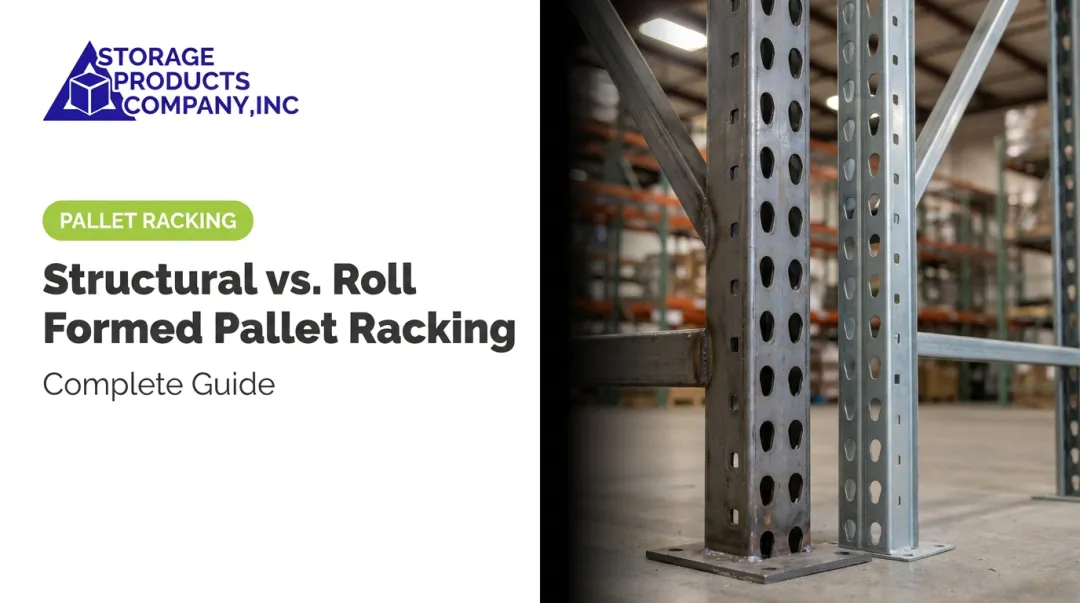
Structural rack uses hot-rolled steel channels and angles, with beams bolted directly to uprights. The construction method creates a system that better absorbs and distributes forklift impact forces rather than concentrating them at a single connection point.
Choose structural steel when:
- Forklifts operate inside or around racking in coolers or freezers
- The operation runs high pallet turnover with frequent load/unload cycles
- The facility includes blast freezer cells
- Deep-freeze environments where impact risk is elevated
Frazier Industrial, one of Storage Products Company's primary manufacturer partners, has built structural steel storage systems since 1949 and backs their rack with a Two Year Pallet Rack Damage Warranty — a meaningful advantage in demanding cold storage environments where impact events are more frequent.
Roll-Formed Racking
Roll-formed rack uses cold-bent, thin-gauge high-strength steel profiles with teardrop-style boltless beam connectors that allow tool-free height adjustments. The upfront cost is lower, and reconfiguration is easier.
When no vehicle operates near the rack, reduced cold-temperature toughness is not a concern. With impact risk eliminated from the operation, roll-formed rack performs reliably in lower-temperature environments.
Roll-formed is acceptable when:
- Operators work entirely on foot with no forklifts near the rack
- The facility is a lower-volume cooler with infrequent pallet moves
- Future reconfiguration flexibility is a primary driver
UNARCO Material Handling — another manufacturer partner in Storage Products Company's line card — produces both structural and roll-formed systems for cold storage, with galvanized and coated component options suited to low-temperature environments.
Best Pallet Racking Systems for Refrigerated Warehouses
The steel-type decision (structural vs. roll-formed) and the system-type decision are separate choices — all major racking system types can be manufactured from either material. The right system depends on your specific operation:
- SKU count and variety across your inventory
- Pallet volume per SKU and turnover rate
- Required rotation method (FIFO vs. LIFO)
- Available floor space versus usable ceiling height
Selective Pallet Rack
Every pallet position is directly accessible from the aisle without moving other pallets. It's the most common starting point for cold storage builds.
The worker safety benefit is real: operators can locate and retrieve any pallet without repositioning others, minimizing time spent in the cold per pick. Selective rack is also the most straightforward system to design around aisle-width and forklift clearance requirements.
Best for: Facilities with high SKU counts, varied pallet sizes, or operations where individual pallet access speed matters more than maximum density.
Pallet Flow Rack
Gravity-fed inclined roller lanes move pallets from a rear loading aisle to a front picking aisle, enabling strict FIFO (first in, first out) rotation. For perishable goods with expiration dates, FIFO is a compliance requirement, not just a best practice.
Specialty flow lane components — including reinforced resin-molded rollers engineered for freezer environments — maintain functionality at low temperatures where standard polycarbonate wheels can become brittle. Flow lanes can reach 20 or more pallets deep per lane.
Best for: High-volume cold storage of date-sensitive products — produce, dairy, frozen foods, pharmaceuticals — where stock rotation accuracy is non-negotiable.
Push-Back Rack
Nested carts on inclined rails load and unload from a single front aisle, operating on LIFO (last in, first out) rotation. Depth typically runs 2–5 pallets per lane. Because no rear aisle is needed, more of the expensive cooled floor space goes to product storage rather than forklift maneuvering — up to 90% more storage capacity than selective rack, per Steel King.
Best for: Cold storage of products that don't require strict date rotation, operations managing multiple SKUs simultaneously (each lane holds one SKU), and facilities where maximizing density within a limited footprint is the priority.
Drive-In and Drive-Through Rack
Both systems offer the highest storage density of any manually operated pallet rack system, typically storing 2–10 pallets deep per lane.
| System | Entry/Exit | Rotation | Best Use |
|---|---|---|---|
| Drive-In | Single aisle | LIFO | Homogeneous product, longer shelf life, blast freezer loading |
| Drive-Through | Separate entry and exit | FIFO | Perishable bulk storage requiring date compliance |
Blast freezer cells are a natural fit for drive-in rack, where rapid, high-volume pallet loading is the priority and selectivity isn't required. Drive-through suits date-sensitive bulk storage where FIFO must be maintained without the aisle overhead of selective or flow systems.
Key Factors to Consider When Designing Your Cold Storage Layout
Operational Variables That Drive System Selection
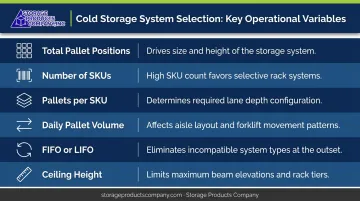
Before any system type gets shortlisted, you need clear answers to these questions:
- Total pallet positions needed — drives overall system size and height requirements
- Number of distinct SKUs — high SKU counts favor selective; low SKU counts with high volume per SKU favor drive-in or push-back
- Average pallets per SKU — determines viable lane depth for high-density systems
- Daily inbound/outbound pallet volume — affects aisle count and forklift traffic patterns
- FIFO or LIFO requirement — immediately eliminates certain system types
- Available ceiling height — cold storage buildings often have fixed clear heights that limit rack beam elevations
Physical Constraints Unique to Cold Storage
These factors often eliminate system types before product flow is even considered:
- Refrigeration unit and evaporator placement — units require clearance for airflow and service access; rack bays cannot block them
- Floor drainage slopes — condensation runoff slopes affect base-plate anchor placement and row alignment
- Door placement and staging areas — dock doors, staging lanes, and transition zones between ambient and refrigerated spaces consume floor area that must be excluded from rack footprint calculations
- Forklift equipment in use — counterbalanced lift trucks need roughly 12-foot aisles; narrow-aisle equipment can operate in tighter configurations, but equipment choice must be locked in before layout design begins
The Value of Professional Layout Design
With the constraint variables above mapped out, the next step is translating them into a verified layout — before any equipment is ordered. Discovering a refrigeration unit conflicts with a planned rack row after installation is a costly rework, often requiring rack teardown, reorder, and reinstallation.
Storage Products Company provides AutoCAD-based layout design services that incorporate ceiling height, column grid, door placement, forklift clearances, and storage density requirements into a scaled plan view — so warehouse managers and facility planners can confirm pallet slot counts and equipment clearances before a single component ships.
Protecting Your Cold Storage Rack Investment
Anti-Corrosion Finish Options
Standard primer-and-paint finishes used on dry warehouse rack are not adequate for cold storage environments where condensation is recurring. Two main options apply:
Hot-dip galvanizing (HDG): A zinc coating bonded directly to the steel surface. According to the American Galvanizers Association, HDG can provide 70+ years of maintenance-free corrosion protection. Over an 80-year lifecycle, HDG's total cost is approximately $4.61/sf versus $52.24/sf for painted steel — an 88% lifecycle cost savings. It's the preferred choice for washdown areas, dairy storage, and any environment with persistent moisture.
Epoxy powder coating / duplex systems: High-quality powder coatings provide effective barrier protection and can be combined with HDG in a duplex system that lasts 1.5 to 2.3 times the combined lifetimes of each system individually. Effective for cooler environments with moderate condensation exposure.
Both Frazier Industrial and UNARCO offer galvanized and coated component options specifically for cold storage applications.
Safety Accessories That Reduce Long-Term Repair Costs
The combination of forklift activity, temperature-induced steel stress, and moisture means damage accumulates faster in cold storage than in dry warehouses. These accessories protect the most vulnerable points:
- Column and upright protectors absorb forklift impact at the base of uprights, where contact is most common
- Row-end guards shield end-of-aisle uprights most exposed to turning forklifts
- Heavy-duty horizontal struts stiffen the frame against lateral impact forces
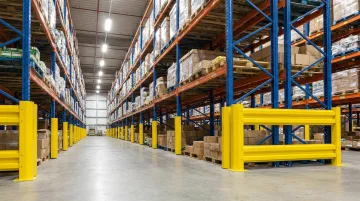
Guards must be matched to the specific upright profile, aisle width, and forklift type in use. A protector sized for a different upright profile provides false security.
Rack Inspection Cadence for Cold Storage
RMI notes that ANSI MH16.1 and MH16.3 do not mandate a specific inspection frequency — best practices range from monthly to annually depending on traffic volume and turnover rate. Cold storage facilities, given the elevated impact risk and corrosion exposure, should inspect on the more frequent end of that range.
Catching a bent upright or early-stage corrosion before it becomes a system failure costs far less than emergency repairs or product loss from a collapse. Storage Products Company provides RMI/ANSI MH16.1-compliant rack inspection services, producing documented damage reports with severity classifications so facility managers know what needs immediate attention versus continued monitoring.
Frequently Asked Questions
How much does pallet racking cost per pallet space?
Costs vary widely based on system type, steel type, and cold storage requirements. Selective rack runs approximately $50–$200 per position, while gravity flow and high-density systems can reach $150–$450 per position. Structural steel and galvanized finishes add a premium over standard roll-formed configurations. Request a project-specific quote. Cold storage variables make generic averages unreliable.
What is a pallet in cold storage?
A cold storage pallet is a wooden or plastic unit load carrying temperature-sensitive goods, stored on racking within a refrigerated or frozen environment. Confirm pallet dimensions and weights before rack design begins — frozen food pallets commonly weigh 2,500–3,500 lbs.
Can standard pallet rack be used in a freezer?
Standard roll-formed pallet rack can be used in freezers for hand-pick-only operations where no forklifts operate near the rack. Facilities using forklifts in sub-zero environments should use structural steel racking — reduced steel toughness at low temperatures makes impact events more likely to cause serious damage, and structural construction provides better impact energy absorption.
What temperature does pallet racking become a safety concern?
RMI-funded research has tested cold-formed steel down to -60°C (-76°F), showing that toughness decreases at sub-zero temperatures even as load-bearing strength stays relatively stable. Increased brittleness under impact — not spontaneous failure — is the real risk, making structural rack selection and impact protection critical in deep-freeze environments.
Is galvanized or painted racking better for cold storage?
Hot-dip galvanized racking offers superior long-term corrosion resistance in wet and condensation-prone environments. High-quality epoxy powder coatings can also be effective, particularly in cooler (above-freezing) environments. Standard warehouse paint finishes are not sufficient for environments with regular condensation or washdown activity — the coating will fail prematurely and leave steel exposed.
What should never be stored in cold rooms?
Items damaged by cold temperatures or moisture exposure — including certain electronics, non-cold-rated lubricants, condensation-sensitive materials, and flammable or outgassing substances — should not be stored in cold rooms. Per FDA guidelines, food must not be stored near chemicals, cleaning products, or in areas with leaking or condensing pipes. Storage decisions should align with food safety regulations and product manufacturer specifications.