This guide delivers a practical hydraulic dock leveler maintenance checklist organized by frequency, covers what a professional PM visit should include, outlines the OSHA standards that apply, and clarifies when a certified technician needs to step in.
The core point: most dock leveler failures are preventable. A structured maintenance routine separates a leveler that performs reliably for a decade or more from one that creates an incident or demands an emergency replacement.
Key Takeaways
- Daily cycle checks and visual inspections catch most developing problems before they escalate
- Spot hydraulic warning signs — creep, sluggish movement, fluid on the floor — and pull the leveler from service immediately
- OSHA violations at the dock can reach $16,550 per serious violation and $165,514 for willful violations
- Match PM frequency to dock traffic — quarterly for high-volume docks, semi-annual for moderate use
- Structural damage or sudden loss of support means the leveler comes out of service immediately
Why Hydraulic Dock Leveler Maintenance Can't Be Skipped
Hydraulic dock levelers face a punishment that most industrial equipment doesn't. Every shift, they absorb the impact of loaded forklifts, pallet jacks, and trailers — often in environments with moisture, debris, and temperature swings that accelerate component wear.
Three factors make hydraulic levelers particularly demanding to maintain:
- Repeated forklift loading compresses hinge pins, fatigues welds, and deforms deck surfaces over time
- Pit areas collect water, dirt, and debris that corrode the hydraulic cylinder, fittings, and structural components
- Contaminated fluid, worn seals, and pressure loss degrade performance gradually — and rarely announce themselves before something fails at the worst possible moment
According to the DOE/FEMP Operations & Maintenance Best Practices Guide, preventive maintenance saves 12% to 18% compared to reactive maintenance, with reactive costs running roughly three times higher per horsepower annually. For dock equipment, that gap widens further when you factor in unplanned downtime, emergency service premiums, and the operational disruption of a non-functional dock position.
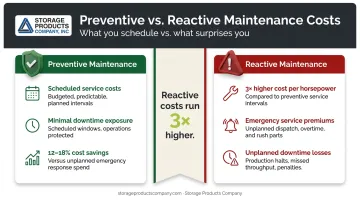
What separates high-performing dock operations from reactive ones is catching problems early — a slow fluid leak found during a scheduled check costs far less to address than a failed hydraulic seal discovered when a forklift operator notices the platform drifting mid-load. The checklist below gives you a structured way to stay ahead of both.
Hydraulic Dock Leveler Maintenance Checklist
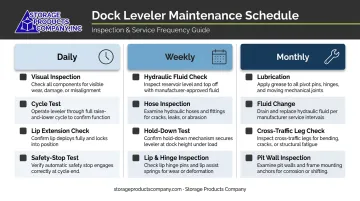
Daily Checks
Run these before the first shift or at shift start — they take under five minutes and catch the problems most likely to cause an incident.
Visual inspection:
- Deck surface — check for cracks, bent sections, or missing anti-skid grating
- Pit area — clear debris, standing water, and any obstructions
- Bumpers — confirm they're intact and securely mounted
- Hydraulic hoses, fittings, and cylinder — look for fluid seepage or staining on the dock floor
Operational cycle test:
- Run the leveler through one full cycle: raise, lip extend, lower to working position, return to stored position
- Confirm smooth movement — no jerking, hesitation, grinding, or unusual noise
- Verify the lip seats positively on the trailer floor
- Confirm the leveler returns fully to stored (raised) position when the dock is unoccupied
Control check:
- Test control panel buttons for responsiveness
- Confirm the emergency stop is functional
Weekly Checks
Hydraulic system:
- Check fluid level and condition — milky fluid signals water contamination; dark or abnormal color warrants further evaluation
- Inspect all hose connections and fittings; tighten as needed
- Test the hold-down function: lower to working position and confirm the platform holds without downward drift under simulated load (drift indicates seal wear)
Mechanical components:
- Inspect lip hinge, lip keeper, and all pivot pin hardware for wear, binding, or deformation
- Verify the lip moves freely and the keeper engages positively
- Examine deck welds and fasteners for stress cracking, particularly at high-load zones near the rear hinge
Monthly Checks
- Lubricate all pivot points, hinge pins, and roller bearings with manufacturer-recommended lubricant; document lubricant type and quantity. Dry pivot points are the leading cause of premature structural wear and operating noise
- Verify hydraulic fluid level and schedule a change per manufacturer interval — or immediately if contamination is present
- Check cross-traffic safety legs (where present) for bending, cracking, or pin damage
- Examine pit walls and floor for structural cracking that could compromise leveler anchoring
What a Scheduled Maintenance Visit Covers
Operator checks handle the surface layer. A professional PM visit goes deeper: there are five specific areas a qualified technician addresses that daily and weekly checks simply can't replicate.
1. Lubrication of All Moving Components
Every pivot joint, hinge tube, and roller bearing gets lubricated using the manufacturer-specified grade (including points not visible during routine checks). Kelley's maintenance documentation identifies the following 90-day lubrication points:
- Lip and ramp hinge pins
- Lip extension mechanisms
- Cylinder pivot pins
- Support-leg pivot pins
This single task prevents the majority of noise complaints and premature wear reported by facility managers.
2. Hydraulic System Service
Beyond a visual check, a technician evaluates fluid condition, pump pressure, cylinder seal integrity, and whether the leveler holds position without creep under simulated load. Fluid change intervals depend on environment and duty cycle: high-cycle docks and cold storage applications typically require more frequent changes than standard schedules. Manufacturer guidance and observed fluid condition should drive that decision, not a fixed calendar.
3. Structural and Deck Inspection
Kelley's manual requires 90-day visual inspection of welds under the leveler (lip plate hinge, ramp beams, and front hinge lugs) for fatigue or failure. A technician also inspects fasteners, deck plating, and the rear hinge assembly for deformation and stress cracking that daily visual checks miss, especially at stress concentration points where years of forklift loading take their toll.
4. Safety Mechanism Testing
During a PM visit, the technician verifies each safety system individually:
- Safety lock (hold-down) engagement under load
- Lip keeper operation and positive retention
- Cross-traffic leg deployment
- Emergency stop function
None of these are optional checks. Hold-down failure and unexpected platform movement are the primary mechanisms behind fall and crush injuries at the dock.
5. Documentation and Maintenance Records
Both Kelley and Blue Giant manuals state that owners must keep written records of recommended periodic maintenance and inspection findings. That documentation tracks wear trends, establishes a compliance trail for OSHA inspections, supports warranty claims, and gives facility managers the data needed to schedule repairs before they become emergencies.
Warning Signs That Require Immediate Action
Don't monitor these. Act on them.
Hydraulic warning signs:
- Slow or sluggish platform movement, or failure to reach full raised height
- Visible fluid on the dock floor or in the pit
- Downward creep of the platform under load — this signals seal wear or pressure loss that will worsen rapidly
Mechanical and structural warning signs:
- Grinding, squealing, or popping noises during operation
- Deck sections that flex or feel unstable underfoot
- Lip failing to fully extend or seat on the trailer
- Visible cracks at weld points or hinge hardware
The out-of-service rule: Kelley and Blue Giant manuals are direct on this point: structurally damaged levelers, or levelers that have experienced sudden loss of support under load, must be removed from service and inspected by a manufacturer's authorized representative before returning to operation.
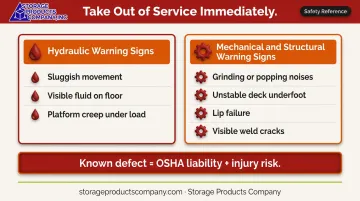
Operating a leveler with a known safety defect — particularly a hold-down failure or structural crack — creates OSHA liability and direct injury risk. "We'll get to it next week" isn't an acceptable response to a structural or hydraulic safety failure.
OSHA Loading Dock Safety Requirements
Three federal standards apply directly to hydraulic dock leveler maintenance and operation:
| Standard | What It Requires |
|---|---|
| 29 CFR 1910.22 | Walking-working surfaces kept clean, free of hazards, regularly inspected, and defects corrected or guarded |
| 29 CFR 1910.26 | Dockboards must support maximum intended load; equipment maintained to prevent transfer vehicles from running off edges |
| 29 CFR 1910.30 | Training required for employees who use dockboards and dock equipment |
| 29 CFR 1910.178 | Powered industrial truck rules for loading/unloading, including preventing truck and trailer movement while boarded |
| 29 CFR 1910.147 | Lockout/tagout required during servicing when unexpected energization or stored-energy release could injure workers |
OSHA's current penalty schedule sets serious violations at $16,550 per violation and willful or repeated violations at $165,514 per violation, for penalties assessed after January 15, 2025. Failure to abate adds $16,550 per day beyond the abatement date.
Beyond OSHA minimums, ANSI MH30.1-2022 provides industry-specific guidance on dock leveling device design and performance. OSHA citations have referenced ANSI MH30.1 as a feasible abatement method, meaning documented adherence to ANSI standards can strengthen your compliance position during an inspection.
Preventive maintenance records serve as direct documentation that your facility takes dock safety seriously — and they're often the difference between a citation and a clean inspection.
DIY Maintenance vs. Hiring a Qualified Technician
Not everything requires a service call. Some tasks genuinely belong to dock supervisors and trained operators. But the line between operator responsibility and technician work matters — crossing it the wrong way creates its own liability.
What trained operators can handle in-house:
- Daily visual and operational cycle checks
- Pit cleaning and debris removal
- Hydraulic fluid level visual checks
- Emergency stop function tests
- Basic documentation of observations
Even these tasks require documented operator training. Untrained personnel performing checks they're not qualified for introduces liability, not safety.
What requires a qualified technician:
- Hydraulic system repairs, pressure testing, and fluid changes
- Structural weld inspection and repair
- Lip mechanism adjustments
- Safety lock and hold-down servicing
- All electrical and control system work
- Any repair following structural damage or sudden loss of support
PM frequency by facility type:
- High-volume docks (frequent daily trailer movements, multi-shift operations): quarterly professional PM — Blue Giant's manual specifically calls for monthly service under multi-shift conditions
- Moderate-traffic facilities: semi-annual PM
- Low-traffic docks: annual professional service, with daily operator checks at all facilities regardless
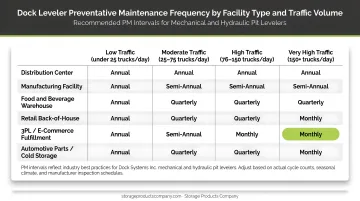
Those PM intervals are only as reliable as the service provider executing them. Storage Products Company has over 43 years of experience in dock equipment installation and service for warehouses, distribution centers, and manufacturing facilities across Alabama and the Southeast.
Working with Dock Systems Inc., a manufacturer of mechanical and hydraulic pit levelers and edge-of-dock equipment, Storage Products Company provides factory-recommended installation, preventive maintenance programs, and repair services covering the full dock perimeter: levelers, doors, seals, shelters, and bumpers — all performed by insured installers.
Frequently Asked Questions
How often should a dock leveler be serviced?
Service frequency depends on usage intensity. High-traffic docks with frequent daily movements typically warrant quarterly professional PM; moderate-traffic facilities can use semi-annual PM. Low-traffic docks may manage with annual professional service, but daily operator checks should happen at every facility regardless of PM contract frequency.
How often should dock plates be inspected?
Dock plates should be visually inspected daily for cracks, bent edges, or missing safety curbs. A thorough inspection should happen at least annually or whenever damage is suspected. Dock plates are load-bearing safety equipment: damaged plates come out of service immediately, not after the next scheduled inspection.
What is the maintenance checklist for hydraulics?
Hydraulic maintenance includes: check fluid level and condition regularly, inspect hoses, fittings, and cylinder for leaks, test pump operation and hold-down function, change fluid per manufacturer guidance or upon contamination, and lubricate associated pivot points monthly. Milky fluid means water contamination: address it immediately.
What are 5 items that regularly scheduled maintenance will check?
A professional PM visit covers five core areas:
- Lubrication of all pivot points and hinges
- Hydraulic system condition: fluid, seals, and pump pressure
- Structural integrity of the deck and welds
- Safety mechanism function, including hold-down and lip keeper
- Electrical and control system operation, including emergency stop verification
What are the OSHA rules for loading docks?
Key standards include OSHA 1910.22 (safe walking surfaces), 1910.26 (dockboard ratings and maintenance), 1910.30 (equipment user training), 1910.178 (powered industrial truck operations), and 1910.147 (lockout/tagout during servicing). Willful violations carry penalties up to $165,514 per incident.