Introduction
Lumber, steel pipe, carpet rolls, bar stock, and structural extrusions all share one problem: they don't fit standard pallet racking. The loads are too long, too irregular, or too awkward for conventional bays. The workaround is usually floor stacking — which wastes space and creates real safety hazards.
Cantilever racks solve this directly. But the value isn't just in having the right rack type—it's in how that rack is designed and configured. Arm length, arm spacing, aisle layout, and load zoning are the variables that determine whether workers retrieve materials efficiently or wrestle with every pick.
This guide covers the decisions that make cantilever rack installations actually work:
- Design principles behind arm length, spacing, and load zoning
- Aisle configuration for efficient material retrieval
- Matching rack type and duty rating to your load requirements
- Safety and compliance obligations for every installation
Key Takeaways
- Cantilever racks eliminate front columns, giving unobstructed access to long and bulky materials that pallet racking cannot accommodate
- Arm length, angle, and spacing are the design variables that most directly determine safe, efficient material retrieval
- Layout decisions (turnover-rate zoning, aisle width, and vertical space use) drive day-to-day operational efficiency
- Match rack type (roll-formed vs. structural) and duty rating to verified load weights, not estimates
- Outdoor installations require galvanized or powder-coated steel and anchor specifications that account for wind load, not just material weight
What Are Cantilever Racks and Why They Excel at Accessibility
The Open-Front Principle
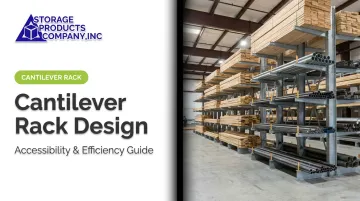
Unlike pallet racking, cantilever racks have no front vertical column. Steel King describes this as vertical supports at the rear only, with arms extending outward from the columns—creating wide-open front access for long, bulky, or awkward loads that standard rack configurations physically can't hold.
Materials of any length can be loaded from the front or side—by forklift or by hand—with nothing blocking the approach.
Four Core Components
Every cantilever rack system shares the same basic structure:
- Upright columns — wide-flange structural steel that forms the vertical backbone of the system
- Base plates — distribute column load across the floor slab and anchor the structure in place
- Arms — extend outward at adjustable heights to support stored materials; reposition as product mix changes without replacing the rack
- Diagonal bracing — ties uprights together within each bay, resisting lateral movement under load
Where Cantilever Racks Are Indispensable
These systems are the default choice for industries storing variable-length or oversized materials. Common applications include:
- Lumber yards and building materials — timber, drywall, plywood, OSB, sheet metal
- Steel service centers — pipe, bar stock, rebar, structural steel, extruded aluminum
- Manufacturing facilities — raw material storage where component lengths exceed standard pallet rack openings
- Furniture and flooring distribution — case goods, mattresses, carpet rolls, panel goods
- Automotive and industrial parts — tubes, rods, conduit, extrusions
Storage Products Company supplies cantilever rack systems through Frazier Industrial and UNARCO Material Handling, serving these applications across Gulf Coast lumber yards, Alabama manufacturing operations, and distribution facilities throughout the Southeast.
Key Cantilever Rack Design Principles for Better Accessibility
Arm Length and Overhang
Arm length must match the depth of your stored material. Three rules govern the decision:
- Too short: excessive overhang creates an unstable load and a tip hazard
- Too long: arms project into the aisle, eating clearance needed for forklift turns
- Right-sized: load sits fully supported with minimal wasted reach
UNARCO notes arms are available up to 100 inches and adjust in 3-inch increments. Storage Products Company carries arm lengths from 24 inches to 72+ inches through its manufacturer partners, covering the range needed for most pipe, lumber, and sheet goods applications.
Arm length also directly affects your aisle. Longer arms project further into the aisle space, reducing the clearance available for forklift turns and operator visibility. Treat arm length and forklift turning radius as a single decision, not two separate ones.
Arm Angle: Horizontal vs. Inclined
Arm angle is frequently overlooked in cantilever rack planning. Select the wrong type for your material and you create a rolloff hazard.
| Arm Type | Best For | Why |
|---|---|---|
| Horizontal (flat) | Lumber, sheet metal, drywall | Flat materials are stable and won't shift |
| Inclined (upward-angled) | Pipe, rod, tubing, conduit | Slope prevents cylindrical materials from rolling off |
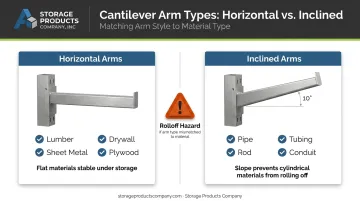
Vestil publishes 10-degree incline arm products specifically for bar stock, pipe, and tubing. Ridg-U-Rak specifies an arm pitch of ¾ inch per foot on their inclined configurations. Arm angle is typically a fixed feature of the component, not a field-adjustable setting—so confirm this with your supplier before ordering. Selecting horizontal arms for round stock is a preventable error with serious consequences.
Arm Spacing and Vertical Clearance
Vertical spacing between arm levels must exceed the height of the stored material by enough margin to allow clear insertion and retrieval without forcing or tilting the load. Ridg-U-Rak specifies a minimum 6 inches of clearance above the top arm as a baseline requirement.
Two competing factors drive spacing decisions:
- Tighter spacing = more storage tiers within a given column height
- Looser spacing = safer, easier retrieval for tall or bulky materials
The right answer depends on your material dimensions and handling method. A forklift placing long pipe needs more vertical clearance than a worker sliding a length of aluminum extrusion by hand.
Single-Sided vs. Double-Sided Configurations
Rack orientation — single-sided or double-sided — is the final spatial decision that ties arm geometry back to your floor plan.
Single-sided racks have arms on one side of the column only. They're designed for wall placement and work well where floor-to-wall positioning is the only option.
Double-sided racks have arms extending from both sides of the central column. Placed in open floor areas, they create aisles with storage access from both sides. According to Mecalux, double-sided configurations effectively double storage capacity compared to single-sided setups at the same linear footprint.
UNARCO columns are pre-punched on both sides, allowing conversion from single-sided to double-sided layouts as storage needs grow. That flexibility matters when your inventory mix or throughput changes — you're not locked into your initial configuration.
Optimizing Cantilever Rack Layout for Operational Efficiency
Zoning by Turnover Rate and Material Type
Where you put materials matters as much as how you store them.
- Fast-moving inventory belongs at lower arm levels—easily reached by forklift forks or workers without repositioning
- Slow-moving inventory can occupy upper tiers where retrieval frequency doesn't justify the extra handling time
- Heavy materials should be stored low to reduce the risk of dropped loads during retrieval
Group materials by type, length, and weight within defined rack zones. In facilities managing multiple SKUs of long materials simultaneously—steel service centers and building materials distributors are good examples—this reduces mislocation errors and improves inventory visibility without any technology investment.
Maximizing Vertical Space Without Compromising Safety
Calculating usable vertical storage height requires accounting for overhead constraints before planning arm levels:
- Start from the finished floor level
- Subtract the 18-inch minimum clearance required below sprinkler heads per OSHA 29 CFR 1910.159(c)(10)
- Subtract any HVAC, lighting, or structural clearance requirements
- Divide the remaining usable height by your required arm spacing to determine maximum tier count
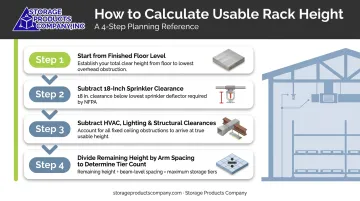
Taller rack configurations improve cube utilization—but only if your forklifts can reach the top level safely. Confirm your forklift's maximum lift height against the highest arm level before finalizing column height — a mismatch discovered after installation means rebuilding the design from scratch.
Aisle Width Planning for Forklift Access
No single published minimum aisle width applies to all cantilever rack installations. The correct aisle width depends on the forklift type, its turning radius, the arm length projection, and the width of the materials being stored.
Published forklift aisle guidance from Toyota provides reference points:
- Standard warehouse forklifts: 12–13 feet typical
- Narrow aisle equipment: 8–10 feet
- Reach trucks: as narrow as 7 feet, depending on model and load size
Verify against your specific forklift manufacturer's right-angle stacking specifications and account for the full arm projection plus load overhang when calculating clearance. For manual access without forklifts, narrower aisles may work—but ergonomic reach distances and safe manual handling weights should still inform arm height decisions.
Modular Expansion: Planning Ahead with Starter and Add-On Bays
Cantilever rack systems are modular by design. Starter bays are self-contained units with two upright columns. Add-on bays share one upright with an adjacent bay, reducing both cost and floor footprint as the system grows.
The key is planning for expansion before installation begins—not after. Reserve floor space for future bays, confirm that your slab can handle the additional column loads, and verify that aisle widths remain compliant as the footprint grows. Storage Products Company's AutoCAD layout design service produces scaled rack elevations, plan views, and aisle layouts before equipment is ordered—letting you visualize the full build-out, including future bays, and catch column conflicts, ceiling constraints, and aisle problems on paper rather than on the warehouse floor.
Choosing the Right Cantilever Rack Configuration
Roll-Formed vs. Structural Cantilever Racks
Roll-formed cantilever racks are made from cold-rolled steel with components that connect via clips and punched holes. They're easier to adjust, reconfigure, and relocate—well suited for light-to-medium duty applications with moderate inventory turnover.
Structural cantilever racks use hot-rolled steel channels and bolted or welded connections. Steel King builds its I-beam cantilever rack to 50,000 psi minimum yield strength, with freestanding heights up to 30 feet and arm lengths up to 8 feet. Frazier's KlampFast cantilever is built from 100% structural steel for heavy-duty, high-traffic environments.
Storage Products Company carries both through Frazier Industrial and UNARCO Material Handling. A quick rule of thumb for choosing between them:
- Structural: Heavy timber, structural steel, large-diameter pipe, or any permanent installation
- Roll-formed: Lighter materials, changing inventory profiles, or applications where reconfiguration is likely
Structural costs more upfront but holds up in demanding environments. Roll-formed delivers flexibility at a lower price point.
Matching Duty Rating to Load Requirements
Storage Products Company's cantilever rack lines are available in light, medium, and heavy-duty arm capacities. Here's where common applications fall:
| Duty Rating | Typical Applications |
|---|---|
| Light/Medium | Lumber, PVC pipe, furniture, sheet goods, light extrusions |
| Heavy | Steel bar stock, structural pipe, heavy timber, large conduit |
| Extra-Heavy/Structural | Structural steel, large-diameter pipe, heavy rebar bundles |
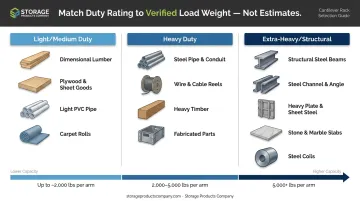
Arm capacity rating multiplied by the number of arm levels per column equals total column capacity. Always select a rack rated above your calculated maximum — forklift placement creates dynamic impact loads beyond the static weight of the material itself. Never size a rack based on estimated weights.
Vestil's published medium-duty specifications illustrate the practical differences: a 12-inch inclined arm is rated at 1,000 lbs, while an 18-inch arm of the same grade drops to 750 lbs. The longer the arm, the lower the rated capacity — factor this into your specification before finalizing arm length.
Indoor vs. Outdoor Installation
Outdoor cantilever rack installations are common in lumber yards, steel service centers, and contractor supply operations—particularly relevant along the Gulf Coast where Storage Products Company operates. The requirements differ from indoor applications in two ways.
Corrosion protection: RMI recommends galvanized finishes for outdoor or humid applications — standard paint degrades quickly outside, compromising structural integrity over time. Storage Products Company offers galvanized cantilever configurations for lumber yards, steel service centers, and open yard storage.
Foundation and wind load: Outdoor racks can reach 30 feet or taller, and RMI notes they can topple in high wind events. Base anchor specifications must account for wind load in addition to material load. Local building codes may impose additional requirements — consult a structural engineer before finalizing anchor design.
Safety, Compliance, and Ongoing Maintenance
OSHA and ANSI MH16.3 Compliance
Cantilever rack installations are governed by ANSI MH16.3, the standard specifically covering the design, testing, and utilization of industrial steel cantilevered storage racks—updated in 2025 by RMI. OSHA 29 CFR 1910.176 requires that stored materials not create hazards and that tiered storage is stable and secure.
Key compliance requirements include:
- Load limit posting at each rack bay
- Proper anchor installation per manufacturer specifications
- Manufacturer-rated capacity labeling on installed racks
- Regular inspection protocols
Storage Products Company uses factory-recommended, insured installers for cantilever rack projects, ensuring anchoring, leveling, and load ratings meet both regulatory requirements and manufacturer specifications from day one.
Regular Inspection and Damage Response
RMI recommends formal rack inspections at minimum annually, with more frequent checks—monthly for high-traffic areas, quarterly for medium-traffic—based on damage potential. Informal visual checks should follow any forklift collision or unusual loading event.
During inspections, look for:
- Bent, twisted, or cracked arms
- Damaged or deformed upright columns
- Loose, missing, or corroded anchor bolts
- Visible deflection in arms under load (a sign of overloading)
- Corrosion on outdoor installations
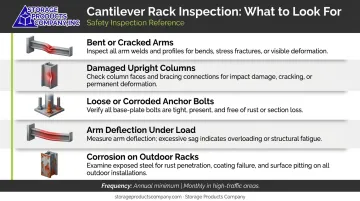
Any rack component showing structural damage—even what looks like minor bending from a forklift clip—should be taken out of service immediately. RMI is clear: damaged components reduce the weight-carrying capability of the entire system.
Storage Products Company provides post-installation preventative maintenance, arm-capacity inspections, and impact-damage assessments to keep installations compliant and load-rated throughout their service life.
Protective Accessories That Extend Rack Lifespan
A few low-cost additions reduce damage frequency and replacement costs:
- Column guards and upright protectors absorb forklift impact before it reaches the structural column
- Arm end stops and lips prevent materials from rolling or sliding off the front of the arm (Vestil includes lips as a standard feature)
- Guard rails and bollards protect end-of-aisle columns, the most impact-prone positions in any rack layout
RMI recognizes column protectors, U-shaped pipe guards, free-standing guard rails, and steel or foam column guards as standard tools for reducing forklift impact damage. In high-traffic facilities, these additions are what separates a rack system with a 20-year service life from one that needs repairs every 18 months.
Frequently Asked Questions
What is the difference between single-sided and double-sided cantilever racks?
Single-sided racks have arms on one side only and are designed for wall placement. Double-sided racks have arms extending from both sides of the central column, placed in open aisles to allow access from both directions. Double-sided configurations roughly double storage capacity per linear foot of aisle compared to single-sided setups.
How do I calculate the weight capacity I need for a cantilever rack?
Multiply the weight of the heaviest single load per arm level by the number of arm levels per upright column to get total column capacity. Always select a rack rated higher than your calculated maximum to account for dynamic impact loading during forklift placement. Static weight alone understates the actual demand on the structure.
What arm angle should I choose for different types of materials?
Horizontal arms are appropriate for flat, stable materials—lumber, sheet metal, drywall—that won't shift. Inclined arms, angled upward, are the right choice for cylindrical or round materials like pipe, rod, and tubing, where the slope prevents materials from rolling off the front of the arm.
Can cantilever racks be installed outdoors?
Yes, when specified with galvanized or powder-coated steel to resist corrosion. Outdoor base anchors must account for wind load in addition to material weight. RMI warns that tall outdoor racks can topple in high winds. Local building codes may also impose additional structural requirements.
How wide should aisles be for forklift access to cantilever racks?
No single minimum applies universally. Toyota publishes 12–13 feet for standard forklifts and 8–10 feet for narrow aisle equipment. Your correct width depends on forklift type, turning radius, arm projection, and material width, so consult your forklift manufacturer's specifications before finalizing your rack layout.
How often should cantilever racks be inspected for safety?
RMI recommends formal inspections at least annually by a qualified inspector, with monthly checks in high-traffic areas and immediate inspection after any forklift collision. Any damaged component should be taken out of service immediately and repaired or replaced before the rack returns to use.