The decision between structural and roll formed pallet racking touches load capacity, forklift traffic, environment, reconfiguration frequency, and long-term maintenance costs. This guide breaks down how each system is built, where each performs best, and the key factors that should drive your selection.
Key Takeaways
- Structural racking uses hot-rolled steel with bolted connections — heavier, stronger, and built for high-abuse environments
- Roll formed racking uses cold-rolled steel with snap-in teardrop connectors — lighter, faster to source, and easier to reconfigure
- Roll formed components typically ship same-day from stock; structural systems carry longer lead times due to custom engineering
- Structural frames can exceed 70,000 lbs capacity (Steel King SK4000)
- Engineered roll formed beams reach up to 22,500 lbs per pair (Ridg-U-Rak)
- Neither system is universally better : your load weight, traffic intensity, environment, and layout change frequency determine the right fit
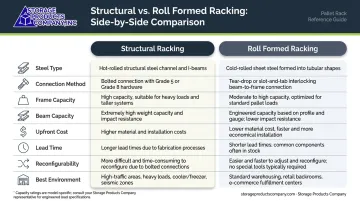
Structural vs. Roll Formed Pallet Racking: Quick Comparison
| Factor | Structural | Roll Formed |
|---|---|---|
| Steel type | Hot-rolled structural channel | Cold-rolled, shaped at room temperature |
| Connection method | Bolted — cannot be dislodged by forklift impact | Snap-in teardrop or slotted boltless connectors |
| Frame capacity (example) | Steel King SK4000: >70,000 lbs | Ridg-U-Rak slotted frame: up to 63,200 lbs (at 36" spacing) |
| Beam capacity (example) | UNARCO structural: up to ~16,000 lbs/pair | Ridg-U-Rak slotted roll formed: up to 22,500 lbs/pair |
| Upfront cost | Higher — custom engineering, skilled labor, heavier materials | Lower — standardized components, less labor |
| Lead time | Longer — custom design and engineering required | Stocked standard components can ship same day |
| Reconfigurability | Requires skilled labor; not easily changed | Beam heights adjust quickly without specialized labor |
| Best environment | Cold storage, food/bev, drive-in, high-traffic DC | Retail backrooms, 3PL, seasonal storage, lighter loads |
Capacity note: The numbers above are model-specific examples from manufacturer data, not universal ranges. Actual capacity depends on beam length, vertical spacing, ties, anchoring, and configuration. Always verify with engineered specifications for your project.
What Is Structural Pallet Racking?
Structural pallet racking is built from hot-rolled structural steel, producing dense, rigid channels and tubular sections. Components are welded and bolted together rather than snapped into place — giving structural rack its defining characteristic: bolted connections that cannot be dislodged by forklift impacts.
How It's Built
Frazier's Sentinel system uses hot-rolled structural steel beams in 3", 4", and 5" heights with boxed front columns formed from two structural channels welded back-to-back. This geometry increases both load capacity and torsion resistance — a fundamentally different structural approach, not simply heavier steel. Ridg-U-Rak specifies a minimum yield strength of 50,000 psi for their structural upright columns.
The connection hardware matters too. A 9" bolted connector provides 1" of adjustability while staying locked under impact. A roll formed teardrop connector, by contrast, can be dislodged if a forklift clips the upright at the wrong angle.
Operational Advantages
- Withstands forklift impacts without connector failure or upright deformation
- Open-back design allows washdown — critical in food processing and cold storage
- Handles extreme temperatures, including freezer warehouses where metal fatigue from temperature cycling is a real concern
- Supports significantly higher frame loads; Steel King's SK4000 structural frames exceed 70,000 lbs per frame
- Accessories like column protectors and end-of-aisle guards can be added for additional impact protection
The Trade-Offs
Structural racking costs more upfront. It requires skilled installation labor, involves longer lead times due to custom engineering, and is not easily reconfigured once installed. For facilities that frequently change SKU profiles or need to expand incrementally, that rigidity becomes a liability rather than an asset.
Use Cases for Structural Racking
Structural is the right call when:
- Distribution centers, 3PL operations, and drive-in/drive-through systems where uprights take regular forklift contact
- Food and beverage distribution, cold storage, and manufacturing facilities with dense pallet weights
- Freezer warehouses, outdoor storage, and food processing environments with washdown requirements
- High-turnover facilities where less experienced operators make more frequent upright contact
- Push-back or drive-in configurations, which generate more rail and column contact than selective rack
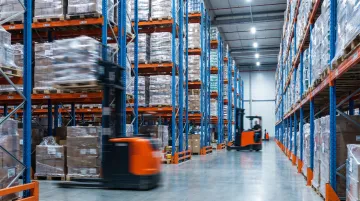
Storage Products Company installs Frazier structural rack systems with factory-recommended insured installers. Frazier backs their structural systems with a Two-Year Pallet Rack Damage Warranty — a meaningful differentiator for buyers who want manufacturer-level protection against the impact damage most common in these environments.
What Is Roll Formed Pallet Racking?
Roll formed pallet racking is made from cold-rolled steel — coils or blanks shaped into standardized uprights and beams at room temperature. The finished components connect via boltless teardrop or slotted snap-in connectors, which allows beam heights to be adjusted without tools or specialized labor.
How It's Built
Steel King's SK2000 roll formed rack uses high-strength closed tubular columns and beams with tool-free assembly. Their testing shows 250% more front impact strength, 44 times more twist resistance, and 68% more side impact resistance versus open-back columns.
Column geometry matters more than most buyers expect. Not all roll formed rack performs the same — the profile shape is a significant driver of real-world durability.
The snap-in teardrop connector is the industry standard for roll formed systems. Most manufacturers follow compatible sizing, which means components from different suppliers are often interchangeable — a practical advantage when you need to replace a damaged beam quickly or source additional components to expand an existing system.
Operational Advantages
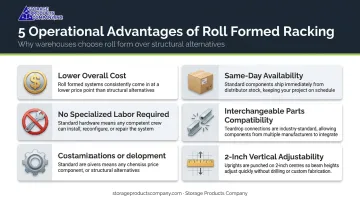
- Lower purchase price — standardized components and lighter materials reduce both material and labor costs
- Faster availability — stocked standard components can ship same day for continental U.S. orders
- No specialized labor required for assembly or beam height adjustments
- Teardrop compatibility across most brands makes sourcing replacement parts straightforward
- Beam heights adjust on 2" vertical centers, giving layout flexibility without dismantling the system
Weight Thresholds and Limits
Roll formed systems are engineered to specific load ratings that vary considerably by manufacturer and model. Ridg-U-Rak's slotted beam capacities reach up to 22,500 lbs per pair, while UNARCO's roll formed beams range from roughly 2,100 lbs to nearly 8,000 lbs per pair depending on length and profile.
Lateral impact is the real vulnerability. Roll formed connectors rely on shape to hold position, so a side hit from a forklift can dislodge a teardrop connector in a way a bolted structural connection won't allow. That difference drives most of the use case distinctions between the two systems.
Use Cases for Roll Formed Racking
Roll formed works best when:
- Loads fall within standard weight ranges — retail backrooms, case lot picking, and order picking are typical fits
- Layouts change frequently — 3PL operations with rotating client inventories or seasonal storage benefit from easy reconfiguration
- Budget is a primary driver and the application doesn't demand heavy-duty capacity
- Fast installation is required to meet a tight project timeline
Hybrid configurations — structural uprights paired with roll formed beams — offer upright durability at a lower cost than a fully structural system. UNARCO's Interchangeable Structural Rack supports this configuration directly, and it's particularly useful in seismic-sensitive regions or facilities where some forklift activity is expected but a full structural build isn't justified.
Which Racking System Is Right for Your Operation?
Key Decision Factors
Before specifying either system, evaluate these variables:
- How heavy are your pallets, and do loads consistently approach the maximum capacity?
- How many lift trucks run how many shifts, and how experienced are your operators?
- Is the environment cold storage, food processing, outdoor, or standard ambient?
- How often do you reconfigure beam heights or add and remove rack sections?
- What's the full budget — purchase price plus installation, maintenance, and replacement parts over time?
Situational Guidance
Choose structural when:
- You operate a fast-paced DC with heavy loads and multiple forklift shifts
- Your facility uses drive-in or push-back rack configurations
- You're in cold storage, freezer, food processing, or outdoor environments
- High employee turnover means less experienced operators running near uprights
Choose roll formed when:
- Loads are standard weight and traffic is lighter
- You need to reconfigure layouts seasonally or by client
- You need a system installed quickly on a tighter budget
- You're fitting out a retail backroom, pick operation, or 3PL bay with changing inventory profiles
A Real-World Example
A large distribution center documented by UNARCO faced extensive pallet rack component damage from repeated forklift impacts — ultimately requiring replacement of approximately 1,000 damaged uprights and 10,000 damaged beams. The solution was transitioning to structural pallet rack made from hot-rolled structural steel channels. The reported outcome: improved safety, reduced future damage, and lower ongoing maintenance costs.
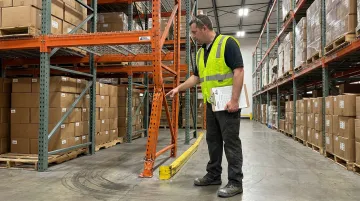
That scale of component replacement is precisely the maintenance cost that structural racking is designed to eliminate in high-traffic environments. The upfront premium on structural systems often looks different after accounting for replacement parts, labor, and downtime across several years of operation.
Total Cost of Ownership
No authoritative published dataset gives a universal structural-vs-roll-formed payback period, and any vendor claiming a specific ROI figure without project-specific data should be viewed with skepticism. What's well-supported: structural rack generates fewer replacement parts in high-abuse applications. Roll formed generates lower upfront costs in lighter-duty applications. Match the system to your actual operational conditions, not a generalized average.
Storage Products Company uses AutoCAD technology to design optimal rack layouts for warehouses and manufacturing facilities across the Southeast. If you're weighing structural versus roll formed for your operation, reach out for a consultation — the right answer depends on your facility's specific load profile, traffic patterns, and how the space needs to work.
Conclusion
Both structural and roll formed pallet racking are proven, well-engineered systems used across thousands of warehouses. The difference is fit. A roll formed system in a light-duty 3PL bay is the right tool for that job. Structural rack in a high-traffic food and beverage DC is the right tool for that one.
Matching the system to your actual operational demands drives long-term results. The deciding factors — load weight, traffic intensity, environment, and reconfiguration frequency — point clearly toward one system or the other when you map them honestly:
- Lower maintenance costs on structural systems in high-traffic environments where frequent forklift contact is inevitable
- Easier reconfiguration on roll formed systems where SKU mix or inventory layout changes regularly
- Improved worker safety when the rack system is engineered for the conditions it operates in
If you're still weighing the options for your facility, Storage Products Company can help you evaluate both systems against your specific application — and spec the right configuration from the start.
Frequently Asked Questions
What is the difference between roll formed and structural racking systems?
The primary difference is manufacturing process and connection method. Structural uses hot-rolled steel channels bolted together for maximum impact resistance. Roll formed uses cold-rolled steel with snap-in teardrop connectors, prioritizing flexibility and lower cost over raw durability.
What are the different types of pallet racking?
Common configurations include selective, drive-in/drive-through, push-back, pallet flow, cantilever, and carton flow. Drive-in and push-back systems strongly favor structural steel due to the repeated rail and column contact those configurations generate.
What can I use instead of pallet racking?
Alternatives include cantilever shelving for long or irregularly shaped items, mezzanine systems for vertical space utilization, and standard industrial shelving for lighter loads. Pallet racking remains the most space-efficient option for standard pallet storage requiring forklift access.
Is pallet racking better than pallet stacking?
Racking outperforms floor stacking for accessibility, safety, and space efficiency. It's essential for FIFO/LIFO inventory management and any operation that needs individual pallet access without disturbing surrounding loads.
What is roll formed racking?
Roll formed racking is a pallet storage system made from cold-rolled steel shaped at room temperature, with boltless snap-in teardrop connections. It's lighter, less expensive, and easier to reconfigure than structural alternatives — well-suited for lighter-duty or frequently changing storage environments.
What is the OSHA standard for pallet racking?
OSHA 29 CFR 1910.176(b) requires that stored materials not create a hazard. ANSI MH16.1-2023 is the current industry standard for industrial steel storage rack design and utilization — OSHA may reference it in citations. All rack systems should display load capacity plaques, and damaged components must be repaired or removed promptly. Consult a certified rack inspector for site-specific compliance guidance.