Introduction
If you manage a warehouse, the injury data in your sector should get your attention. According to the Bureau of Labor Statistics, warehousing and storage (NAICS 493) recorded 4.8 recordable injury and illness cases per 100 full-time workers in 2024 — more than double the private industry rate of 2.3. The same sector saw 32 fatal occupational injuries that year.
Those numbers translate directly into operational pain: worker downtime, lost productivity, potential OSHA fines up to $165,514 per willful or repeated violation, and the legal liability that follows any serious incident. The National Safety Council estimates the average cost of a workplace fatality at $1.54 million, with each medically consulted injury costing roughly $48,000.
Catching hazards before they become incidents is how you control those costs. This guide provides a practical, area-by-area warehouse safety inspection checklist — covering housekeeping, racking, equipment, electrical, fire safety, and employee compliance — so managers can identify risks early and stay OSHA-compliant.
Key Takeaways
- Warehouse injury rates run more than double the private industry average — inspections are a compliance necessity, not a housekeeping preference
- OSHA's 2023 National Emphasis Program (CPL 03-00-026) specifically targets warehousing and distribution centers for unannounced enforcement
- Run inspections at multiple frequencies: daily equipment checks, weekly zone reviews, monthly audits, and annual comprehensive evaluations
- The most common inspection failures: blocked exits, damaged racking, expired training records, and poor housekeeping documentation
- Build inspections into routine operations so compliance is always current, never reactive
What Does a Warehouse Safety Inspection Cover?
A warehouse safety inspection is a structured review of physical conditions, equipment integrity, employee practices, and documentation compliance — all measured against OSHA's 29 CFR 1910 general industry standards.
The Hazard Categories That Matter
Warehouses carry several distinct risk categories, each requiring its own inspection focus:
- Mechanical hazards — forklift collisions, racking collapse, falling loads
- Electrical hazards — exposed wiring, inadequate lockout/tagout (LOTO) procedures
- Fire risks — blocked sprinklers, improperly stored flammables, inaccessible extinguishers
- Fall risks — unguarded mezzanines, damaged walking surfaces, cluttered aisles
- Ergonomic hazards — manual material handling without proper equipment or training
What OSHA Focuses On
OSHA issued CPL 03-00-026 on July 13, 2023, establishing a National Emphasis Program specifically targeting warehouse and distribution center operations. Your facility can be selected for programmed enforcement attention — no incident required to trigger a visit.
The most frequently cited standards in FY 2025 across all industries include:
- Hazard Communication (HazCom) — 2,546 violations, ranked #2
- Lockout/Tagout (LOTO) — 2,177 violations, ranked #4
- Powered Industrial Trucks — 1,826 violations, ranked #8
- PPE (eye/face protection) — 1,665 violations, ranked #9
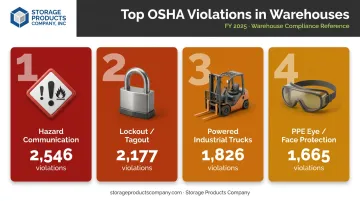
All four of these categories appear regularly in warehouse enforcement actions. OSHA audits documentation and training records with the same scrutiny it applies to physical conditions — gaps in either can generate citations.
Your Warehouse Safety Inspection Checklist
The following framework covers every major zone systematically. Warehouse managers can adapt it into a repeatable internal checklist — skipping areas means missing hazards.
General Housekeeping and Aisle Safety
Walking surfaces and aisles:
- Floors are clean, dry where feasible, free of spills, debris, and uneven surfaces (29 CFR 1910.22)
- Aisles used by forklifts maintain sufficient safe clearances and are permanently marked
- Permanent aisles are free of obstructions and in good repair (29 CFR 1910.176)
- Safety barriers physically separate pedestrian zones from forklift travel paths
- Hazard warning signage is posted in all relevant areas
Emergency exits:
- All exit routes are completely clear — OSHA explicitly prohibits placing materials in exit routes even temporarily (29 CFR 1910.37)
- Exit routes meet the minimum 28-inch width requirement at all points (29 CFR 1910.36)
- Exit signs are illuminated and visible from all approach angles
- Emergency lighting is functional and tested regularly
Storage Racking and Shelving Systems
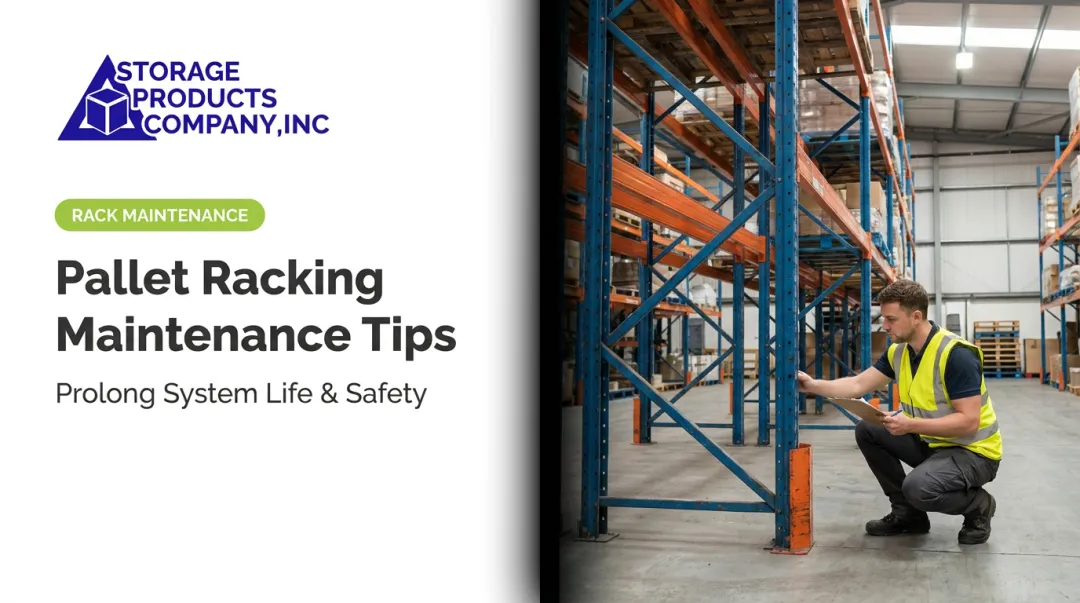
Racking failures rarely happen without warning. The warning signs just get ignored.
Structural integrity checks:
- Upright frames show no bending, twisting, or cracking (deformation in load-bearing components can escalate to catastrophic collapse)
- Welds at beam connections are intact with no visible cracking
- All beam connector safety pins/clips are properly seated
- No uprights are out-of-plumb beyond manufacturer tolerance
- Load capacity labels are posted clearly on all rack bays and are legible
Anchoring and protection:
- All rack frames are properly anchored to the floor with intact hardware
- End-of-aisle uprights (the highest forklift impact zone) have column protectors or rack guards installed
- Guard rails and bollards protect dock equipment, electrical panels, and fire suppression risers from vehicle traffic
For existing installations, Storage Products Company provides formal RMI/ANSI MH16.1 rack inspection services that produce documented condition reports using a green/amber/red severity classification — a practical resource for OSHA general duty clause compliance and insurance documentation.
Mezzanines and VRC lifts:
- Mezzanine platforms are within rated load limits, with access points properly guarded
- PE-stamped engineering drawings are on file and current
- VRC vertical reciprocating conveyors (Pflow) are functioning correctly and safety interlocks are not bypassed
Material Handling Equipment and Forklifts
Forklifts were the source of 84 work-related deaths across all industries in 2024, per the National Safety Council. Every shift begins with an inspection.
Pre-shift equipment checks:
- Forklift horn, lights, brakes, forks, and fluid levels are confirmed functional before use
- Daily pre-operation checklists are completed and logged for every truck (29 CFR 1910.178)
- Any truck with a condition adversely affecting safety is removed from service immediately , not flagged for later review
Operator compliance:
- All forklift operators have current, documented OSHA-compliant training certification on file, including operator name, training date, and evaluator identity
- Operator performance is formally evaluated at least once every 3 years
- Posted facility speed limits are enforced and visible
- Pedestrian separation protocols are followed in all high-traffic zones
Electrical Systems and Fire Safety
Electrical:
- No exposed wiring, frayed cords, or damaged outlets anywhere in the facility
- Sufficient access and working space is maintained around all electrical panels (29 CFR 1910.303)
- LOTO procedures are posted for all equipment undergoing maintenance
- LOTO energy control procedures are formally inspected at least annually (29 CFR 1910.147)
Fire safety:
- Fire extinguishers are accessible, charged, and have received their monthly visual inspection and annual maintenance check — maintenance records retained per 29 CFR 1910.157
- A minimum 18-inch vertical clearance is maintained between sprinkler deflectors and the top of stored material (29 CFR 1910.159)
- Emergency lighting is operational throughout all occupied zones
Employee Safety, PPE, and Training Records
PPE availability and compliance:
- Required PPE (hard hats, high-visibility vests, steel-toed footwear, gloves) is available, in good condition, and consistently worn
- PPE requirements are posted in applicable zones
- Employer has certified the workplace hazard assessment and PPE training per 29 CFR 1910.132
Training documentation:
- All employees have current records for hazard communication, equipment operation, and emergency procedures
- HazCom program is written, SDS sheets are accessible, and chemical labels are current (29 CFR 1910.1200)
- Missing or expired records are corrected immediately — OSHA requires documentation for PIT training, PPE assessments, LOTO inspections, and HazCom programs
How Often Should You Conduct Warehouse Safety Inspections?
The Tiered Frequency Model
| Frequency | What to Cover |
|---|---|
| Daily | Forklift pre-operation checks, aisle condition, spill response, exit clearance |
| Weekly | Dock equipment, racking condition in high-traffic zones, safety signage |
| Monthly | Full housekeeping review, fire extinguisher visual inspection, emergency lighting test, training record review |
| Annually | LOTO procedure inspection, full compliance documentation audit, comprehensive rack inspection |
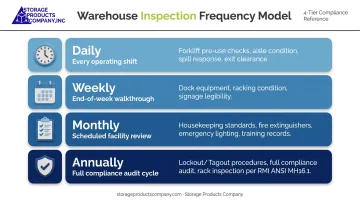
OSHA mandates several of these frequencies directly: forklifts before each shift, fire extinguishers monthly and annually, LOTO procedures at least annually, and walking surfaces regularly and as necessary.
Internal Mock Audits
Beyond required frequencies, run internal mock audits before any anticipated OSHA visit — and periodically even when no visit is expected. OSHA's National Emphasis Program means warehouses can be selected for programmed inspections without any triggering incident. Teams that only address safety in the days before a known audit are accumulating unresolved hazards.
For high-activity warehouses, a single annual cycle leaves too much ground uncovered between reviews. A stronger cadence looks like this:
- Quarterly comprehensive reviews catch equipment wear, racking damage, and procedural drift before they compound
- Post-incident mini-audits address the specific area or process involved — even for near-misses
Common Warehouse Safety Mistakes to Avoid
Skipping Documentation
Physical conditions matter, but so do records. OSHA inspectors review documentation as closely as they review the warehouse floor. Common documentation gaps that drive OSHA penalties include:
- Missing or expired training certifications
- Incomplete equipment maintenance logs
- Incident reports with no documented corrective action
- No record of follow-up after prior inspection findings
Every finding, corrective action, and training completion needs to be logged and retained.
Treating Safety as a Pre-Audit Sprint
Warehouses that address safety only when an inspection is anticipated accumulate risk continuously between those moments. An unannounced OSHA visit or an on-site incident can expose weeks or months of unresolved hazards. Compounding violations — where a previously identified issue wasn't corrected — can escalate penalties to the $16,550 per day for failure to abate category.
Dismissing Early Rack Damage
A bent upright or cracked weld gets logged as "monitor" and deferred — until it isn't. OSHA accident records document fatal rack collapses triggered by a forklift striking an upright, an impact that can look minor at the time. Any visible structural damage to load-bearing rack components warrants immediate assessment, not a future maintenance window.
Conclusion
Warehouse safety inspection effectiveness depends on consistent execution across every zone — not on thorough reviews in one area while other areas drift. Housekeeping, racking integrity, equipment condition, electrical systems, and employee training records must all be maintained together as part of an ongoing practice.
Implementing a structured, repeatable checklist approach gives warehouse managers a reliable mechanism for catching hazards before they become violations or incidents. The right physical infrastructure — properly engineered racking systems, installed rack protection, and documented inspection services — addresses the structural hazards that checklists identify but can't fix on their own.
Storage Products Company has served warehouses and distribution centers across Alabama and the Southeastern United States since 1980, providing rack systems, safety protection products, RMI/ANSI MH16.1 rack inspections, and preventative maintenance programs that support year-round compliance.
If your facility needs a professional rack assessment or help aligning your storage infrastructure with your safety program, reach out to discuss your options.
Frequently Asked Questions
What is a warehouse safety checklist?
A warehouse safety checklist is a structured document used to systematically review hazards, equipment condition, and compliance across all warehouse areas. It ensures nothing gets overlooked during inspections and creates the documentation trail OSHA expects.
What are the OSHA standards for warehouse safety?
Warehouse hazards are addressed under general industry standards in 29 CFR 1910, covering subparts for walking surfaces, exits, PPE, LOTO, fire protection, material handling, and electrical. OSHA also launched a National Emphasis Program (CPL 03-00-026) in July 2023 specifically targeting warehousing and distribution center operations.
What are the steps in a warehouse safety inspection?
- Prepare your checklist and review prior inspection findings
- Conduct a zone-by-zone walkthrough covering all key areas
- Document findings with severity classification, assign corrective actions with deadlines, and verify completion before the next cycle
How do I pass a warehouse safety inspection?
Passing consistently requires year-round preparation, not last-minute fixes. Maintain current training records, keep equipment serviced and documented, ensure aisles and exits are always clear, and run internal mock audits regularly so no area is caught unprepared during an unannounced visit.
What are the 7S rules in a warehouse?
The 7S framework extends the traditional 5S methodology by adding Safety and Spirit (or Security). It's a voluntary organizational framework for maintaining clean, orderly, hazard-free warehouses, though it is not an OSHA compliance standard.
What are the basic safety rules for a warehouse?
Always wear required PPE, keep aisles and exits clear, and never exceed posted equipment or racking load limits. Report any damage or hazard immediately, and ensure every operator is trained, certified, and documented before running any powered industrial truck.