Most warehouse managers understand beam ratings and upright frame loads. Wire decking tends to get treated as an afterthought: pick a size, drop it in, move on. But wire deck capacity is a tested, standardized value governed by ANSI MH26.2, not a rough estimate. How it's defined, measured, and matched to your rack system directly determines whether your stored loads stay secure or become a safety hazard.
This article breaks down exactly what wire deck load capacity means, how it's tested, what drives it, and how to specify it correctly — so your rack system performs as a system, not just as a collection of individually rated parts.
Key Takeaways
- Rated capacity covers uniformly distributed static loads (UDL) only — point loads, line loads, and concentrated loads fall outside this rating
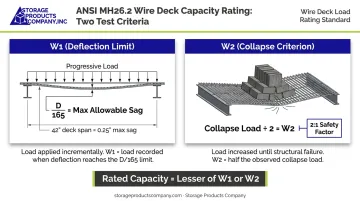
- ANSI MH26.2 sets capacity as the lesser of W1 (deflection at D/165) or W2 (half the ultimate collapse load), with a 2:1 safety factor built in
- Deck capacity must equal or exceed the beam pair's rating per pallet position; a lower-rated deck creates a weak link not shown on the load plaque
- Standard commercial wire decks typically fall in the 2,500–2,700 lb UDL range, though actual ratings depend on wire gauge, mesh pattern, channel count, and dimensions
- Adding wire decking does not increase beam capacity — it distributes weight across the beam level without changing the system's structural limit
What Load Capacity Means in Pallet Rack Wire Decking
ANSI MH26.2 defines wire decking load capacity as "the maximum uniformly distributed static load, independent of the support system." That last phrase — "independent of the support system" — is the part that changes how you apply the number.
The deck is tested and rated on its own, separately from the beams beneath it. Its capacity is a standalone value, determined through a standardized test protocol, describing what the deck surface itself can carry when weight is spread evenly across the entire deck.
A uniformly distributed load (UDL) is weight resting evenly over the complete deck surface — the way a properly stacked pallet with a spread footprint typically sits. That's different from:
- Point load — force concentrated over a very small area (machine feet, drum bottoms, narrow-based components)
- Line load — weight distributed along a single concentrated line (pipes, structural members, bar stock)
- Concentrated load — weight covering only part of the deck surface, not the full span
A UDL rating does not apply to these load types. A deck rated for 2,500 lbs UDL may fail under a 1,200 lb concentrated load placed at center span. The rating and the load type must match.
Deck Capacity vs. Beam Capacity vs. System Capacity
A pallet rack system has three distinct load ratings that interact but are not interchangeable:
- Wire deck capacity — maximum UDL the deck surface can carry
- Beam pair capacity — maximum weight per pallet position the beam level can support
- System capacity — total weight the upright frame column can handle, governed by frame engineering
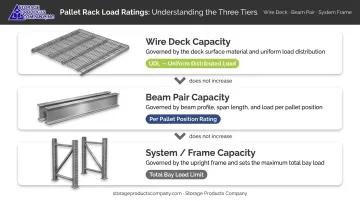
Wire decking does not increase the load capacity of rack beams. Beam-level capacity is determined by the beams and uprights — not the decking. The deck provides a stable surface and distributes weight across the beam level, but the structural ceiling of the system remains exactly where the beams and uprights set it.
Standard commercial wire decks typically carry UDL ratings in the 2,500–2,700 lb range. A 42" × 58" Nashville Wire Products deck is listed at 2,600 lbs; comparable configurations from other manufacturers run 2,500–2,700 lbs depending on wire gauge and channel depth. These are tested values under controlled, standardized conditions — not field estimates.
How Wire Deck Load Capacity Is Tested and Rated: ANSI MH26.2
ANSI MH26.2-2023 (Design, Testing, and Utilization of Industrial Storage Rack Decking) is the recognized standard for rating wire deck capacity. The Rack Manufacturers Institute (RMI) lists it as the applicable standard, and manufacturers who demonstrate conformance earn RMI R-Mark certification — a voluntary program confirming standards compliance.
The 2023 revision expanded the standard's scope beyond welded-wire mesh to cover additional deck types and loading conditions. Wire mesh pallet rack decking remains fully within scope.
Testing places a wire deck on pallet rack beams matching its specified depth. Load is applied incrementally and uniformly across the full deck surface while deflection and load values are recorded. Because the test replicates a controlled, standardized loading condition, the resulting capacity rating is independent of whatever beam system the deck sits on in the field — which matters when you're comparing specs across manufacturers.
The Two Governing Test Criteria: W1 and W2
Two separate measurements determine the rated capacity, and the more conservative result governs.
W1 — Deflection Limit: Load is applied until the deck deflects D/165, where D is the deck depth. For a 42" deep deck, that's a maximum deflection of 0.25". The load recorded at that deflection point is W1. Excessive sag signals structural distress before collapse — pallets can shift or tip on a sagging deck, creating a hazard that precedes any physical failure.
W2 — Collapse Criterion: Load continues until structural collapse. That collapse load divided by 2 is W2. The safety factor of 2.0 means the published rating is only 50% of what the deck actually failed at under test — an engineering margin built into the standard.
The lesser-of rule: Rated capacity = whichever of W1 or W2 is smaller.
A real example from J&L Wire's technical bulletin: a 42" deck yields W1 = 3,498 lbs and W2 = 3,750 lbs (collapse at 7,500 lbs ÷ 2). Rated work load = 3,498 lbs, governed by deflection. When comparing wire deck spec sheets, the published rating is always the deflection-governed number — not the maximum load the deck could theoretically hold before failing.
Key Factors That Influence Wire Deck Load Capacity
Wire deck load ratings don't come from a single specification — they're the product of four interacting variables. Getting any one of them wrong affects the others, which is why matching specs to the application matters more than picking the highest number on a product sheet.
Wire Gauge and Mesh Pattern
Heavier wire gauge reduces deflection under load. Finer mesh patterns distribute weight across more contact points, increasing surface strength. A common configuration for a 2,700 lb deck uses 6-gauge wire with a 2½" × 4" mesh pattern. Finer mesh requires more wire, which raises unit cost — that cost difference is real and worth accounting for when comparing specs across suppliers.
Support Channel Configuration
Support channels are the formed steel members welded underneath the wire mesh that transfer load to the beams. More channels — or heavier-gauge channels — increase rated capacity by reducing the unsupported span between load transfer points. A typical configuration for a 2,700 lb deck uses 14-gauge channels with 3 channels across the deck width.
Deck Dimensions
Depth must match the rack frame; width must correspond to the beam length. A deck spanning a longer distance between beams experiences greater bending forces at any given load. Mismatched dimensions aren't a design consideration — they're a specification error that can compromise the entire pallet position.
Common depths run 36", 42", 44", 48", and up to 60" for deeper frames. Width follows beam length.
Surface Coating
Coating affects long-term performance, not initial rated capacity — but corrosion degrades wire cross-section over time, reducing effective strength. For wire decking, the coating choice should match the moisture and chemical exposure the environment actually produces:
- Painted finish — adequate for standard indoor, climate-controlled environments
- Powder coat — better durability than paint, more impact resistance
- Galvanized (pre-galvanized or hot-dip) — most durable option for humidity, chemical exposure, cold storage, or food-grade environments where moisture is constant
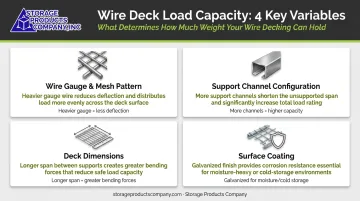
Galvanized wire decks meet ASTM A123/A123M zinc coating standards. For food and beverage warehouses, cold storage, and similar high-moisture environments, galvanized is the appropriate choice.
Specifying and Matching Wire Deck Capacity to Your Rack System
The RMI's best practice is straightforward: wire deck capacity per pallet position must be equal to or greater than the rack beam pair rating for that position.
The math is simple: A beam pair rated for 5,000 lbs typically holds two pallet positions. Each position requires its own deck rated at a minimum of 2,500 lbs. If you're running two decks side-by-side per bay, each deck covers one pallet position — so each must meet or exceed 2,500 lbs UDL on its own.
ANSI MH26.2 requires buyers to submit dimensional specifications and required load capacity to the deck manufacturer before production — not after. The deck is manufactured to your rack's specifications, not the other way around.
Load Plaques and Compliance
RMI notes that load capacity plaques are not required for wire decking itself, unlike the rack structure. But the deck rating must not fall below the capacity shown on the rack's posted load plaque. If your rack plaque shows 2,500 lbs per pallet position and your deck is rated at 2,000 lbs, you have a conflict: the posted limit exceeds the actual weakest link.
OSHA's general storage regulation (29 CFR 1910.176(b)) requires that materials stored in tiers be stacked and limited in height so they remain stable and secure against collapse. That requirement applies to the whole system — including the decking. An under-rated deck that fails isn't just a product liability issue; it's a worker safety violation.
Two compliance rules to carry into every deck specification:
- Deck UDL must meet or exceed the capacity shown on the rack's posted load plaque
- OSHA 29 CFR 1910.176(b) applies to the full storage system, not just the rack structure itself
Getting these ratings right before installation is how you avoid both safety violations and costly after-the-fact corrections. Storage Products Company has spent 43+ years configuring pallet rack systems across distribution centers, manufacturing facilities, food and beverage warehouses, automotive parts operations, and pharmaceutical distribution facilities throughout the Southeast. Matching wire deck ratings to beam configurations and load profiles, verified through AutoCAD layout design before purchase, is part of every rack system project.
Risks of Exceeding Rated Wire Deck Load Capacity
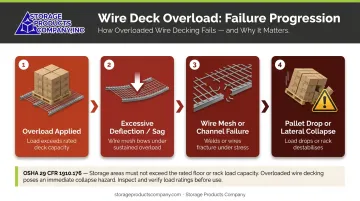
Overloading a wire deck follows a predictable progression. Excessive deflection (sag) comes first, destabilizing pallets and the loads on them. If overloading continues, the wire mesh or support channels fail — potentially dropping a pallet to a lower level or collapsing laterally into adjacent rack bays or personnel.
That failure sequence is exactly what RMI warns against: a capacity mismatch creates a structural weak point, and when it gives way, a worker is in the path. OSHA citation Case 1529215.015/01001 documents this outcome directly — employees exposed to struck-by and crushing hazards from overloading and failure of a storage rack system.
The Point Load Problem
Total weight being within the UDL rating doesn't guarantee safety if the load geometry is wrong. A single heavy drum placed at the center of a deck applies a concentrated load that stresses the wire mesh far beyond what the UDL rating accounts for — especially if the drum has small contact feet.
Per RMI: unless decking is specifically engineered for concentrated or point loading, it could bow, buckle, sag, or otherwise fail, increasing the risk of load falling. For these applications, a specialty deck or supplemental support is required, and the deck manufacturer must be consulted before the load goes on the rack.
Compliance and Liability
Under-rated wire decks create a systemic mismatch with real consequences:
- A deck rated below the rack's posted capacity creates a direct non-conformance — and an insurance coverage gap
- Under-rated decking contributing to a collapse triggers potential OSHA liability under 29 CFR 1910.176(b)
- Mismatched specifications void deck and rack warranties
ANSI MH26.2 requires capacity confirmation before production: retrofitting a specification after the fact doesn't correct a structural mismatch that was present from the start.
Common Misunderstandings About Wire Deck Load Ratings
Wire decking adds capacity to rack beams
It doesn't. Wire mesh decking does not increase the rated capacity of the beam pair or upright frame — beam-level capacity is set entirely by the structural members themselves. Decking improves load distribution across the beam surface and prevents items from falling through, but the load limit posted on the rack doesn't change when you add decking.
The UDL rating applies to any load type
Operators storing drums, machine components, or bundled stock often unknowingly apply point or concentrated loads to decks rated only for UDL (uniformly distributed load). Staying within the posted weight limit isn't enough — load geometry matters as much as total weight.
RMI states that standard wire decking should not be used for anything other than uniformly distributed load storage unless the deck is specifically engineered for hand stacking or point loading.
Any wire deck works as a replacement or upgrade
Wire decks are not interchangeable. Substituting a deck with a lower capacity rating — or dimensions that don't match the beam depth — compromises the integrity of that pallet position. Before any replacement or upgrade, verify:
- Deck depth matches frame depth
- Deck width matches beam span
- Channel configuration matches original specification
- Rated UDL meets or exceeds beam pair rating for the position
Frequently Asked Questions
What is wire mesh decking?
Wire mesh decking is a welded-wire surface accessory that rests on pallet rack beams, spanning the gap between them to provide a stable platform for stored items. It's standard in warehouses, distribution centers, and manufacturing facilities. The open-wire design maintains fire sprinkler access and keeps stored inventory visible.
How much weight can wire mesh hold?
Standard wire mesh decks are typically rated for 2,500–2,700 lbs UDL per ANSI MH26.2 testing, though exact capacity depends on wire gauge, mesh pattern, channel configuration, and dimensions. The deck rating must always equal or exceed the rack beam pair rating for the pallet position it covers.
How do you calculate pallet rack load capacity?
Pallet rack load capacity covers two ratings: beam pair capacity per pallet position and upright frame capacity per bay column. Wire deck capacity is its own separate rating that must equal or exceed the beam pair rating — confirm this with the deck manufacturer before ordering.
How much weight can a pallet rack support?
Total rack capacity is set by the manufacturer and posted on the system's load capacity plaque. If the wire deck is rated lower than the beam pair for that position, the deck becomes the actual weak link — regardless of what the plaque states.
Does OSHA require weight capacity on racks?
OSHA 29 CFR 1910.176(b) requires stored materials to remain stable and secure, which covers the full rack system including decking. RMI guidelines under ANSI MH16.1 recommend posted load plaques on all rack systems. Wire decking doesn't need its own plaque, but its capacity cannot fall below the rack's posted limit for that pallet position.
How do you measure for wire decking?
Wire deck depth must match the rack frame depth (common sizes: 36", 42", 44", 48", 60") and width must correspond to the beam length. Per ANSI MH26.2, buyers must submit dimensional specifications and required load capacity ratings to the deck manufacturer before ordering — fit and capacity must be confirmed before production, not after delivery.