Neglected maintenance creates a predictable chain of problems: forklift-damaged uprights left unaddressed, corroded base plates weakening anchor integrity, overloaded beams sagging beyond safe limits. Each issue compounds under daily load stress until a section fails. OSHA's accident database contains 946 results for "Storage Rack," including a 2024 fatality where an employee fell approximately 88 inches from a five-level pallet rack during inspection.
This guide covers why maintenance matters, the four core types of racking maintenance, early warning signs to watch for, and a practical inspection schedule designed to maximize both system lifespan and worker safety.
Key Takeaways
- Pallet racking requires continuous, active maintenance — not just a one-time setup check
- The four core maintenance types are routine/preventive, corrective/reactive, condition-based monitoring, and major overhaul
- Key warning signs: bent uprights, sagging beams, missing safety clips, corroded base plates, leaning rack sections
- A structured schedule — daily walkthroughs, weekly hardware checks, monthly assessments, annual professional inspections — cuts failure risk significantly
- Preventive maintenance costs far less than reactive repair — OSHA willful violations can reach $165,514 per incident
Why Pallet Racking Maintenance Matters
Pallet racking represents a significant capital investment, and that investment only pays off when systems stay structurally sound across their intended lifespan. Routine maintenance is what makes that happen.
The Safety Stakes Are Real
Damaged uprights, overloaded beams, or missing anchor bolts don't degrade in isolation. They compound under daily load stress until a section fails, often triggering a cascading collapse that injures workers and destroys inventory.
One OSHA case makes the stakes concrete: a May 1997 accident at a retail warehouse involved a bent rack section reported approximately 30 minutes before collapse. The bays were 16 feet tall and loaded with 21,000 to 26,000 pounds of material. The damage was visible. The collapse was preventable.
The Compliance Exposure
OSHA doesn't have a dedicated pallet racking standard, but 29 CFR 1910.176(b) requires that stored materials not create hazards and that tiered storage remain stable against sliding or collapse. The General Duty Clause fills the gap — it applies to recognized hazards even when no specific standard exists.
When violations occur, the penalties add up fast:
- Serious violation: up to $16,550 per violation
- Failure to abate: $16,550 per day beyond the deadline
- Willful or repeated violation: up to $165,514 per violation
Those figures cover only the regulatory side. A rack collapse also triggers product loss, facility downtime, injury claims, and emergency replacement costs — all of which dwarf the cost of routine inspections. That financial reality connects directly to day-to-day operations.
Productivity Consequences
When a rack section is tagged out due to damage, surrounding aisles may be blocked, forklifts rerouted, and picking operations disrupted. A single compromised bay can slow throughput across an entire facility for days.
The starting point matters. Racking installed correctly by factory-recommended installers following ANSI MH16.1 specifications is far less likely to develop early structural issues. Storage Products Company's installation teams build to those specs, giving maintenance programs a stronger foundation from day one.
Types of Pallet Racking Maintenance
Maintaining a pallet racking system isn't a single task. The most effective programs combine four distinct maintenance types rather than relying on any one approach alone.
Routine / Preventive Maintenance
This is the foundation of any racking safety program: scheduled inspections conducted by trained warehouse personnel covering uprights, beams, connections, floor anchors, and load capacity signs.
Typical tasks include:
- Checking upright plumb — RMI guidelines allow no more than 0.5 inch per 10 feet of height in cross-aisle and down-aisle directions
- Verifying beam connector safety pins are in place
- Inspecting base plates for damage or corrosion
- Confirming load capacity placards are visible and accurate
- Ensuring nothing is stored above rated capacity
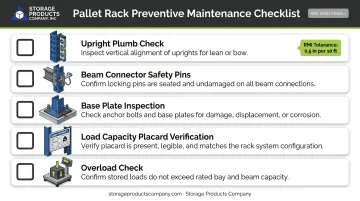
Storage Products Company's preventive maintenance program covers anchor integrity, beam-connector wear, and upright damage assessment against factory-recommended procedures — catching developing issues before they require emergency repair or component replacement.
Corrective / Reactive Maintenance
Corrective maintenance kicks in when damage is discovered. Common triggers include:
- A forklift impact that bends or cracks an upright
- A dropped pallet that deforms a beam
- A routine inspection revealing a pulled floor anchor or cracked weld
When damage is found, repairs should begin immediately — not deferred.
The risk of a reactive-only approach: problems compound between inspections, increasing sudden-failure risk. By the time damage is severe enough to be obvious, multiple components often require replacement rather than one. Emergency repairs cost significantly more than prevention.
Condition-Based / Monitoring Maintenance
Rather than inspecting purely by calendar, condition-based maintenance tracks the observed state of each rack bay over time using standardized checklists and damage logs.
Patterns in where damage recurs reveal systemic problems — a specific aisle where forklift impacts are frequent, or a section prone to moisture intrusion. ANSI/RMI standards recommend maintaining detailed records for every inspection; these records support informed repair-versus-replace decisions and provide documentation of due diligence during OSHA audits or incident investigations.
Storage Products Company's RMI/ANSI MH16.1 rack inspection service produces documented reports using a green/amber/red severity classification. Each report identifies components requiring immediate action and recommends repair, replacement, or load reduction — the structured output a condition-based program depends on.
Major / Overhaul Maintenance
Deep-level servicing beyond routine checks: full upright frame replacement, re-anchoring entire rack rows, reconfiguring layout to reduce high-impact zones, or upgrading decking and beam connectors across a large bay.
Major maintenance is triggered by accumulated damage, a significant forklift collision, a near-miss event, or findings from an annual professional inspection. It's required any time structural damage affects the load-bearing integrity of multiple connected components, or when a professional inspector determines piecemeal repairs are no longer sufficient.
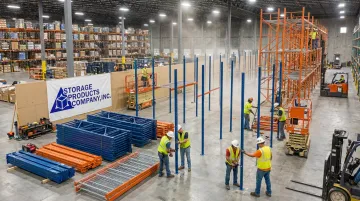
Storage Products Company handles these projects through its rack relocation and reconfiguration service — including systematic teardown, component condition assessment during disassembly (a safety-critical step that prevents damaged components from being reinstalled), and reinstallation to ANSI MH16.1 specifications.
Warning Signs Your Pallet Racking Needs Attention
Many racking failures don't happen without warning. They follow a visible progression that, if caught early, prevents catastrophic outcomes. Recognizing these signs early is everyone's job — not just managers — so training all warehouse personnel to spot and report them is essential.
Visible Structural Damage
Critical red flags:
- Bent, bowed, or twisted upright columns — even minor bending reduces load capacity, though the exact percentage depends on component geometry and loading conditions; any visible deformation warrants engineering review
- Beams with visible sag or deflection under load
- Cracks or deformation at weld points
- Any rack section visibly out of plumb beyond the 0.5 inch per 10 feet RMI tolerance
RMI's position is clear: damaged rack should be unloaded, isolated from service, and evaluated by a qualified engineer before reuse. There's no safe threshold for guessing.
Loose, Missing, or Compromised Hardware
Components to check:
- Beam safety clips (locking pins) — a missing clip allows the beam to dislodge under upward force
- Anchor bolts securing uprights to the floor
- Nuts and bolts on bolted-braced upright frames
- Base plates — cracked or warped plates are a serious concern
Loose or missing hardware often indicates a prior impact that was never formally logged. Hardware checks are one of the most effective early-detection tools available, even when structural damage isn't yet visible.
Environmental Deterioration
Rust and corrosion are slow but serious threats. Moisture from humidity, temperature fluctuations, or cleaning chemicals progressively weakens steel at base plates, anchor zones, and welded joints. The danger: corrosion degrades structural integrity before visible surface rust appears.
Warehouses in coastal or high-humidity regions — including Gulf Coast facilities across Alabama, Mississippi, Louisiana, and Florida — face accelerated corrosion risk at base plates and lower upright sections. RMI specifically flags these environments as conditions that shorten rack service life:
- Refrigerated coolers and cold storage areas
- Washdown and food-grade processing areas
- High-humidity or chemical-exposure zones
Galvanized or coated racking is the right specification for these conditions. Storage Products Company's manufacturer partners — including Frazier Industrial and UNARCO — offer coated systems designed for corrosive environments, and the company's inspection services can assess whether existing rack shows early corrosion damage.
Operational Red Flags
Patterns that demand immediate formal inspection:
- Rack sections that visibly lean or shift when loaded
- Pallets that consistently slide or tip on beams
- Floor anchors pulling out of cracked or deteriorated concrete
- Forklifts repeatedly clipping the same uprights
- Staff reporting instability when accessing upper levels
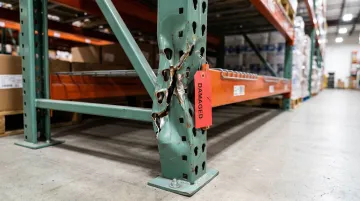
Recurring near-miss events are operational data. Treat them as inspection triggers, not minor incidents.
Pallet Racking Maintenance Schedule and Best Practices
Maintenance frequency should match warehouse intensity. A high-throughput distribution center with constant forklift traffic needs more frequent checks than a low-activity storage facility. The schedule below represents minimum best-practice baselines.
Inspection Frequency Table
| Frequency | Who | What to Check |
|---|---|---|
| Daily / Per-Shift | Operators, floor staff | Visual walkthrough for obvious new damage; verify load signs visible; nothing visibly overloaded |
| Weekly | Maintenance or safety staff | Beam safety clips and connector pins; floor anchors for loosening or concrete cracking; new rust or moisture at base plates |
| Monthly | Trained inspector (in-house) | Full checklist covering uprights, beams, bracing, decking, hardware; measure out-of-plumb on suspect columns; document with photos |
| Annual | Qualified professional | Load capacity verification, structural assessment, written recommendations for repair, replacement, or protective measures |
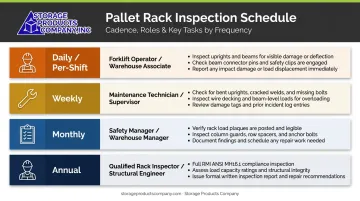
RMI recommends professional rack inspection at least annually, with more frequent inspections in higher-damage operations and immediate inspection after any forklift collision or seismic event.
Key Best Practices
Three practices make the biggest difference in day-to-day rack health:
- Protect forklift-vulnerable locations with column guards on lower uprights, end-of-aisle guards at aisle intersections, bollards near dock equipment and electrical panels, and guard rails along pedestrian walkways. Storage Products Company supplies these in steel and polymer-encased steel configurations — sized to absorb impact before it reaches structural components.
- Enforce load capacity limits at every level — floor staff, supervisors, and new hires alike. Placards must be updated whenever rack configuration changes; an outdated placard is as dangerous as no placard.
- Keep forklift operator training current. Operators need to know safe clearance requirements, speed limits near rack ends, and the protocol for reporting any impact immediately — even ones that look minor.
Repair vs. Replace: A Practical Framework
When damage is found, the response depends on severity. This framework covers the most common scenarios:
| Damage Type | Recommended Action |
|---|---|
| Small dent, single missing safety clip, surface rust | In-house repair or part replacement |
| Bent upright beyond 0.5"/10 ft tolerance | Unload, isolate, professional engineering review |
| Cracked weld, frame distortion | Component replacement — do not return to service without assessment |
| Multiple interconnected bays affected | Full section replacement — typically the safer and more cost-effective choice |
Annual inspections conducted by a qualified partner ensure damage is evaluated against current ANSI MH16.1 standards and that any replacement components match original system specifications. Storage Products Company's rack inspection service produces severity-classified written reports with actionable recommendations — documentation suitable for insurance requirements and OSHA compliance records.
Conclusion
Pallet racking maintenance is a continuous operational responsibility, not a one-time task. It directly determines how long a system lasts, how safely workers can operate around it, and what a warehouse ultimately spends on storage infrastructure over time.
A sound maintenance program covers all four types — preventive, corrective, condition-based, and overhaul. It pairs that coverage with a structured inspection schedule, trained staff, protective accessories, and periodic professional review. Warehouses that treat maintenance as a core operational discipline tend to see fewer injuries, less unplanned downtime, and longer system lifespans. If you're reassessing your current approach, a professional rack inspection is a practical starting point — one that identifies existing damage, flags compliance gaps, and gives your team a clear baseline to work from.
Frequently Asked Questions
How often should pallet racking be inspected?
Daily visual checks by operators are recommended as a baseline, with full in-house inspections conducted monthly using a standardized checklist. A professional engineering inspection should be performed at least once per year — more frequently in high-traffic environments, and immediately after any forklift collision or near-miss event.
What are the hazards associated with pallet racking?
Primary hazards include rack collapse from overloading or damaged uprights, falling inventory from dislodged beams, forklift impacts on rack legs, and floor anchor failure. All of these can cause serious injury or fatalities if damaged components are not identified and addressed promptly.
What is a rack failure?
Rack failure is the structural collapse or critical compromise of one or more rack components, typically triggered by overloading, accumulated damage, or a significant forklift impact. Adjacent bays often follow in a chain collapse, posing serious risk to nearby workers and inventory.
What is rack protection?
Rack protection refers to physical accessories installed to shield vulnerable rack components from forklift impact and daily operational wear — including upright column guards, end-of-aisle guards, bollards, and impact barriers. These limit structural damage between formal inspections and extend the service life of rack components.
What are the OSHA regulations for pallet racking?
OSHA does not have a dedicated pallet racking standard. Enforcement relies on 29 CFR 1910.176 and the General Duty Clause, which require employers to keep storage equipment free from hazards — and OSHA has cited the RMI's ANSI MH16.1 standard as the industry benchmark in enforcement actions.
What is the life expectancy of pallet racking?
According to RMI, industrial steel pallet racking can remain in service for several decades under proper conditions, and many manufacturers back systems with 10-year warranties. Actual longevity depends on installation quality, load management, operating environment, and how consistently the rack is inspected and maintained.