RMI notes that unchecked rack damage can lead to beam disengagement, pallet drops, or partial rack collapse. An OSHA citation from 2021 documented exactly this scenario: forklift impact damage to steel column legs and baseplates, plus a damaged vertical column and horizontal member — all affecting structural load-carrying capacity with stored product weighing approximately 3,500 lbs.
This guide provides a practical, component-by-component checklist for identifying and assessing forklift damage — including how to measure deformation, classify severity, and decide what action to take.
Key Takeaways
- Forklift damage most commonly affects uprights, load beams, braces, and baseplates — inspect each systematically
- Use the plumbness standard from ANSI MH16.1: columns must be straight and plumb within 0.5" per 10 feet of height
- Beam deflection exceeding 1/180th of span (e.g., 0.53" on a 96" beam), or permanent sag after unloading, signals replacement
- Classify findings as green (no action), yellow (schedule repair), or red (unload immediately and restrict access)
- Document everything with photos and written logs; consult a professional for any out-of-spec damage
What You Need Before Inspecting for Forklift Damage
Good inspection starts before you look at a single column. Inspecting around loaded product creates blind spots that miss the most structurally significant deformation, particularly at column bases and low-height impact zones near the floor.
Come prepared with the right tools and a clear plan — both affect what you catch and what you miss.
Tools Required
| Tool | Purpose |
|---|---|
| Steel straightedge or long level | Measure column deformation and plumbness |
| Tape measure | Calculate beam deflection against L/180 formula |
| Plumb bob or laser line | Verify column plumb (RMI-recommended method) |
| Flashlight or headlamp | Inspect brace connections and column bases |
| Damage tags (red tags) | Mark compromised bays immediately |
| Camera or smartphone | Photo documentation of findings |
Preconditions Before Starting
- Pause forklift traffic in the inspection zone and confirm aisles are clear
- Schedule inspections during low-traffic periods or planned maintenance windows
- Start at the highest-risk zones: aisle ends, column corners at pallet entry points, and turn zones take the most forklift impact
RMI also recommends conducting an immediate inspection after any forklift collision.
The Pallet Rack Forklift Damage Inspection Checklist
Forklift impacts rarely damage one component in isolation. A hit to a column base can stress the bracing, displace the baseplate, and transfer force into adjacent beam connections simultaneously. Treat each component as part of an interconnected system.
Uprights and Columns
What to look for visually:
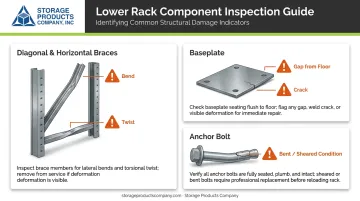
- Paint scrapes or bare metal at low heights near fork entry points — bare metal anywhere on a column means physical contact occurred and requires further assessment
- Dents or visible bends in the column face
- Twisting of the column along its vertical axis (RMI notes that twisted columns can greatly reduce rack capacity and may not safely bear weight)
- Cracked or separated welds at brace attachment points
How to measure column deformation:
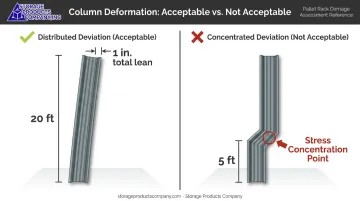
Per ANSI MH16.1 (as cited by RMI), loaded rack columns must remain within 1/240 of their height — equal to 0.5" per 10 feet. Hold a straightedge or plumb line against the column and measure deviation from true vertical.
RMI offers a useful illustration of how distribution matters:
- Distributed deviation: A 20-foot column with 1" of total out-of-plumb spread across the full height may still be within tolerance
- Concentrated deviation: The same 1" deviation between the floor and 5 feet — a classic forklift-impact "dogleg" — is not acceptable, because the localized bend concentrates stress at a single point
Column protectors: If guards are installed, check them for severe denting. Significant deformation suggests the column behind it absorbed impact. Remove and inspect the underlying column if guards show that level of damage.
Load Beams
Visual inspection:
- Dents, scrapes, or bent flanges along the beam face
- Connector tabs displaced from their column punch holes — even partial dislodgement is a critical finding requiring immediate bay unloading
Per RMI, a disengaged beam cannot support the system's rated load capacity and creates risk of loads falling from the rack. ANSI MH16.1 requires beam locking devices capable of resisting 1,000 lbs of upward force per connection. Forklift impacts that push loads upward or laterally can compromise these clips.
Measuring beam deflection:
The acceptable deflection limit under ANSI MH16.1 is L/180 — beam length divided by 180.
- A 96" beam: 96 ÷ 180 = 0.53" maximum deflection under load
- Measure at mid-span with product loaded
Critical rule: If deflection remains after the bay is unloaded, the beam is permanently deformed. Replace it — do not reload it.
Safety hardware check: Verify that all safety pins or locking clips are present and fully seated at every beam-to-column connection.
Braces, Baseplates, and Anchor Bolts
These components are often overlooked during forklift damage assessments, but they're where impact forces travel after hitting a column.
Braces (horizontal and diagonal):
- Look for bending, twisting, or missing brace members
- RMI describes braces as the components that counter cross-aisle forces and enhance overall stability — a missing or bent brace reduces this resistance immediately
- Any missing brace requires immediate action.
Baseplates:
- Inspect for cracking, bending, or a gap between the baseplate and the floor
- RMI notes that cracks or damage near rack baseplates may indicate an impact occurred — even if the column above looks intact
Anchor bolts:
- Check that all anchor bolts are present, tight, and undamaged
- Bent, loose, or sheared anchor bolts impair resistance to overturning forces
- ANSI MH16.1 requires at least one anchor per baseplate — verify compliance at each column base
How to Interpret Forklift Damage Severity
Misclassifying findings is where inspections fail. Loading a bay that should be unloaded accelerates deformation under weight — and deformation under load ends in uncontrolled collapse, not a controlled repair.
Green — No Immediate Action Required
A green finding means:
- No measurable deformation beyond surface paint scuffs
- Columns are straight and plumb within 0.5" per 10 feet
- Beams are straight; deflection under load falls within L/180 and fully recovers when unloaded
- All beam connectors are fully seated with safety pins present
- Anchor bolts are tight with no visible floor cracking at baseplates
Log every green finding with a date and photo. Trend data across multiple inspections reveals areas accumulating damage before any single impact crosses the tolerance threshold.
Yellow — Monitor and Schedule Repair
Yellow conditions include:
- Minor dents in column faces with paint damage, but deformation within or at the edge of plumb tolerance
- Beam connectors showing slight displacement but still fully seated in punch holes
- Minor brace bending with no missing components
- Slight baseplate movement with no visible cracking or anchor bolt damage
Action for yellow-tagged bays:
- Reduce loads in that bay to manufacturer-rated capacity or below
- Flag for repair within a defined timeframe (typically 30 days)
- Re-inspect more frequently until repaired
Red — Unload Immediately and Restrict Access
Red conditions require immediate action:
- Column deformation exceeding the 0.5" per 10 ft plumb tolerance, or a concentrated dogleg bend near the floor
- Twisted columns
- Beam deflection that does not recover after unloading
- Beam connectors dislodged from column slots (even partially)
- Missing braces
- Cracked or displaced baseplates, or sheared anchor bolts
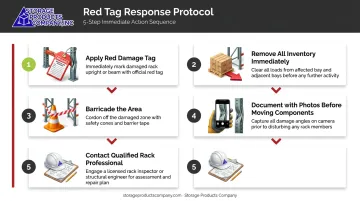
The "tag, unload, report" protocol:
- Apply a visible red damage tag to the bay
- Remove all inventory from the affected section immediately
- Barricade the area
- Document with photos before any components are moved
- Contact a qualified rack professional for assessment before any return to service
Per ANSI MH16.1 as cited by RMI, the rack owner must immediately isolate affected portions and initiate a mitigative response. A registered design professional must then certify that repaired components have been restored to at least original design capacity before return to service.
For red-tagged damage requiring structural replacement, component compatibility is non-negotiable. Storage Products Company, as an authorized Frazier pallet rack dealer, can help facilities source compatible replacement uprights and frames — Frazier's two-year pallet rack damage warranty covers qualifying structural components.
Common Errors When Assessing Forklift Damage
Most inspection mistakes follow a predictable pattern: inspectors miss damage that's either out of their sightline or beyond the visible impact point. These three errors account for the majority of overlooked structural problems.
Only inspecting at eye level. Forklift impacts occur at low heights near fork entry points and column bases. Inspectors who walk the aisle and scan mid-column height miss the most structurally significant damage. Get low and check the bottom 18 inches of every column in high-traffic zones.
Treating paint damage as cosmetic. Bare metal on a column or beam means physical contact occurred — run the straightedge and plumb checks before moving on. Distance looks mean nothing until you've verified the component up close.
Stopping at the visible impact point. When an upright shows forklift damage, impact forces have already traveled through braces and into adjacent frames. Always inspect the entire bay — including the neighboring upright frames on both sides — when any single component shows evidence of a strike.
Safety and Best Practices During Inspection
During the inspection itself:
- Never stand under or between loaded bays that have been flagged as potentially damaged
- Wear appropriate PPE: hard hat, safety glasses, and high-visibility vest when working near active forklift zones
- Use a buddy system when inspecting in areas where forklifts may still be operating nearby
Inspection frequency:
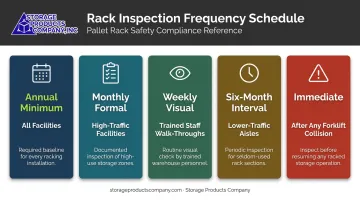
RMI recommends that formal inspections occur at minimum annually, with immediate inspection following any forklift collision or seismic event. Beyond that baseline:
- High-traffic facilities: monthly formal checks
- Weekly visual walk-throughs by trained staff across all aisles
- Lower-traffic aisles: six-month intervals are generally acceptable
- Repeat-damage zones: monthly checks regardless of traffic volume
Assign a named responsible person to each inspection cycle. Programs without clear ownership tend to slip — a named inspector creates a direct line of accountability when findings need to be acted on.
If your facility needs a formal third-party inspection, Storage Products Company provides RMI/ANSI MH16.1-compliant rack inspection services for distribution centers, manufacturing facilities, and 3PL operations across the Southeast — delivering documented severity classifications and specific repair recommendations.
Conclusion
Forklift damage to pallet racking is cumulative. Each undetected or unrepaired impact reduces structural capacity further — often invisible during routine walkthroughs — until the system reaches a failure threshold.
The checklist in this guide is designed to catch damage at the point when repair is still straightforward. That requires three things:
- Correct measurement criteria — plumb tolerance and L/180 deflection limits
- Consistent classification — green/yellow/red findings applied uniformly across the system
- Prompt action — no deferred repairs on yellow or red findings
When structural replacement is needed, Storage Products Company's rack inspection and repair services ensure replacement components are compatible with the installed system, correctly rated, and reinstalled to ANSI MH16.1 specifications.
Frequently Asked Questions
How often should pallet racking be inspected?
ANSI/RMI standards recommend a minimum of one formal annual inspection, plus an immediate inspection after any forklift collision. High-traffic facilities should conduct monthly formal checks, with weekly visual walk-throughs by trained staff as a baseline practice.
Does OSHA require pallet racking inspections?
OSHA has no rack-specific inspection standard, but enforces rack safety through the General Duty Clause (Section 5(a)(1)) and 29 CFR 1910.176(b) on material storage. OSHA citations routinely reference ANSI MH16.1 as the accepted industry standard — inadequate rack maintenance can result in OSHA citations and fines.
What should be checked during a pallet racking inspection?
Primary inspection points span structural components and operational conditions:
- Upright columns — bends, twists, and plumb deviation
- Load beams — deflection and connector integrity
- Horizontal and diagonal braces — missing or damaged members
- Baseplates and anchor bolts — displacement or cracking
- Safety hardware — pins and locking clips
- Pallet condition, load signage accuracy, and aisle clearance
What are the risks of pallet racking in a warehouse?
The primary risks are partial or full rack collapse, falling inventory, and significant operational downtime. Damaged sections that continue bearing loads are at heightened risk of sudden failure — particularly when deformation has reduced the system's rated capacity without any visible warning from a routine walkthrough.
How much does a pallet racking inspection cost?
Costs depend on facility size, rack complexity, and whether inspection is handled internally or by a third-party professional. Internal inspections cost less upfront but require trained staff; third-party inspections provide formal documentation and compliance-grade reporting. Contact Storage Products Company for a site-specific quote and assessment.