Introduction
The warehousing and storage sector recorded 32 fatal injuries in 2024, with a total recordable nonfatal injury rate of 4.8 per 100 full-time workers, according to Bureau of Labor Statistics data. OSHA's accident records document rack collapses specifically — including a 2020 incident that killed one worker and hospitalized another.
Pallet rack compliance is difficult partly because no single OSHA standard covers it. Compliance is built from multiple overlapping regulations, a national consensus standard, and an enforcement mechanism most warehouse operators underestimate — a combination that exposes many facilities to citations they never anticipated.
This guide breaks down exactly which regulations apply, what they require, and how to build an inspection and operations program that holds up when an OSHA inspector walks through the door.
Key Takeaways
- OSHA enforces rack safety through the General Duty Clause and 29 CFR 1910.176(b) — there is no single dedicated rack standard
- ANSI MH16.1-2023 is the benchmark OSHA references when issuing citations; in practice, it functions as the compliance rulebook
- Every rack must be anchored, load-labeled, and kept free of structural damage
- Damaged racks must be unloaded and taken out of service immediately — no partial fixes, no continued use
- Annual inspections are the minimum; high-traffic areas warrant checks far more often
Understanding OSHA's Pallet Rack Regulatory Framework
Many warehouse operators search for "the OSHA pallet rack standard" and come up empty — because it doesn't exist as a standalone regulation. Compliance is assembled from three overlapping sources.
29 CFR 1910.176(b): The Starting Point
The closest direct rule is 29 CFR 1910.176(b), which states: "Storage of material shall not create a hazard. Bags, containers, bundles, etc., stored in tiers shall be stacked, blocked, interlocked and limited in height so that they are stable and secure against sliding or collapse."
Broad language, deliberately. It doesn't specify beam dimensions, anchor bolt sizes, or load placard formats. That's where the General Duty Clause fills the gap.
The General Duty Clause: OSHA's Enforcement Engine
OSH Act Section 5(a)(1) requires every employer to provide "employment and a place of employment which are free from recognized hazards that are causing or are likely to cause death or serious physical harm."
Pallet rack collapse is a recognized hazard. OSHA has used the General Duty Clause to cite facilities for:
- Unanchored racks storing pallets up to 460 lbs. on top shelves (Citation 965408)
- Missing load placards on racks holding 1,510–3,000 lb. pallets (Citation 1412653)
- Visibly damaged rack systems with product weighing approximately 3,500 lbs. still loaded (Citation 1529215)
- Uprights out of plumb by approximately one inch (Citation 1242089)
ANSI MH16.1: The Technical Benchmark
When OSHA issues a General Duty citation for a rack hazard, it consistently references ANSI MH16.1-2023 — formally titled "Design, Testing, and Utilization of Industrial Steel Storage Racks" — as the recognized abatement standard. Meeting ANSI MH16.1 doesn't guarantee OSHA compliance, but it's the benchmark inspectors use to judge whether your rack design, load ratings, and installation meet a reasonable standard of care.
Construction and mixed-use facilities: 29 CFR 1926.250(a)(1) also applies, requiring all tiered materials to be "stacked, racked, blocked, interlocked, or otherwise secured to prevent sliding, falling or collapse."
Key OSHA Pallet Rack Safety Requirements
Anchoring and Structural Stability
ANSI MH16.1 requires rack columns to have base plates and be anchored to the floor with anchor bolts designed to resist applicable forces. OSHA Citation 1412653 quotes this requirement directly — unanchored racks are one of the most consistently cited General Duty violations.
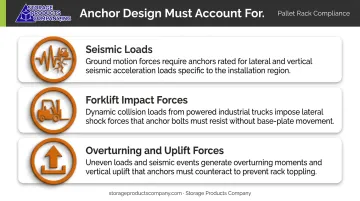
The number, size, and placement of anchors is engineered to your specific rack configuration. Factors include:
- Seismic loads — facilities in seismic zones require anchoring designed to seismic specifications
- Forklift impact forces — powered industrial truck operations near racks increase lateral force requirements
- Overturning and uplift forces — calculated based on rack height, load weight, and configuration
Back-to-back rack rows may also require row spacers and cross-aisle ties, particularly under the 2023 MH16.1 revisions, which added dedicated sections on frame tie and cross-aisle tie design. Getting anchor specifications wrong at installation — even by one bolt size or placement — can mean a non-compliant rack from day one. Storage Products Company's factory-recommended, insured installers set racks to manufacturer specifications and ANSI MH16.1 standards, so anchor requirements are documented and defensible before your first load goes up.
Load Capacity and Load Labeling
Every rack system must display a load placard in a clearly visible location. Per RMI guidance, placards must be at least 50 square inches and display:
- Maximum permissible unit load per level
- Maximum uniformly distributed load per level
- Average unit load (where applicable)
- Maximum total load per bay
If you reconfigure your rack — changing beam heights, adding levels, or modifying bay layouts — the existing placard is no longer valid. The rack owner must consult the original manufacturer or a qualified rack design engineer to update it. Individually labeling each bay is considered best practice and a common inspection finding when absent.
Rack Installation and Modifications
Correct installation is a compliance issue, not just a quality issue. Common installation defects that trigger General Duty Clause citations include:
- Missing locking pins on beam connectors
- Misaligned beam-to-upright connections
- Improperly leveled upright frames
On modifications: only manufacturer-approved repairs and changes are permitted under ANSI MH16.1. Field welding, drilling additional holes, or substituting beams from a different manufacturer voids load ratings and creates a structural condition that can't be verified. OSHA can — and does — cite this directly.
Aisle Clearance and Housekeeping
Two additional regulations apply here:
- 29 CFR 1910.176(a): Aisles and passageways must be kept clear for the safe movement of material handling equipment and employees. Racks cannot obstruct designated exit routes or emergency access.
- 29 CFR 1910.22: Storage areas must be free of materials that create tripping, fire, or collapse hazards — including debris at rack bases and items stored on uprights or cross-braces rather than on designated beam levels.
Pallet Rack Inspection Requirements
OSHA doesn't specify a mandatory inspection interval for pallet racks by name. But the General Duty Clause makes regular inspection mandatory: knowingly operating a damaged or degraded rack under load is a recognized hazard, period.
What Annual Inspections Must Cover
RMI states that "at a bare minimum, the entire rack system should be inspected at least once per year." A complete inspection must evaluate:
- Upright columns — dents, bends, tears, or deformation
- Beam connectors — locking pins fully engaged, no deformation at connection points
- Base plates and anchor bolts — condition and security
- Plumb alignment — horizontal and vertical tolerance of uprights
- Rack protection accessories — column guards, end-of-aisle protectors, guard rails
Row ends and pass-throughs carry the highest impact risk and warrant monthly checks. Any observed damage should trigger an immediate response regardless of inspection schedule.
The Damaged Rack Protocol
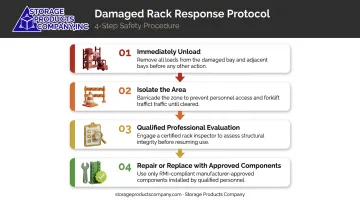
This is non-negotiable under OSHA's General Duty obligations:
- Immediately unload the affected rack section
- Isolate the area — keep workers and forklifts out
- Have a qualified rack design professional evaluate the damage
- Repair or replace using only manufacturer-approved components before returning the rack to service
OSHA Citation 1529215 cites this exact sequence as the required abatement standard, quoting ANSI MH16.1 owner-maintenance provisions directly. That written record matters: documented inspection reports are the primary evidence OSHA looks for when evaluating whether a facility maintained a routine inspection program.
Storage Products Company's rack inspection service produces documented reports using a green/amber/red severity classification, giving safety managers the compliance paper trail they need before an incident — not after.
Safety During Daily Rack Operations
Installation and annual inspections set the foundation — but daily operating habits determine whether that foundation holds. How racks are loaded, impacted, and used shift by shift is where most real-world compliance gaps occur.
Operator Responsibilities
- Observe posted load limits at all times — no exceptions for "just this once" overloads
- Never push or pull uprights or beams when maneuvering pallets
- Report any forklift-to-rack contact immediately, even if the rack appears undamaged; hidden deformation from impact can reduce load capacity significantly
Load Placement Rules
- Position pallets evenly across beam pairs
- Do not allow loads to overhang beams beyond manufacturer-specified limits
- Never store items on cross-braces, horizontal members, or top-of-frame areas not designed to bear load
Note: Uneven load distribution concentrates stress on individual columns, accelerating fatigue and lowering the effective load threshold — sometimes below what the rack is rated to carry.
Environmental and Operational Risk Factors
Certain conditions demand extra attention:
- High-traffic narrow aisles — increase forklift impact frequency at uprights
- Cold storage environments — can affect bolt torque and accelerate metal fatigue
- Seismic zones — require racks anchored and configured to manufacturer seismic specifications; a rack designed for standard installation conditions is not automatically seismic-compliant
When actual operating conditions diverge from a rack's original design assumptions — higher traffic, temperature extremes, seismic exposure — the system is working outside its validated parameters. That gap is one of the most common sources of compliance failure, and it rarely announces itself before a load incident does.
Common OSHA Compliance Mistakes to Avoid
Three mistakes account for a disproportionate share of OSHA rack citations — and all three are preventable with routine attention to load documentation, damage response, and configuration control.
Missing or Outdated Load Placards
This is one of the most direct citations an inspector can issue. Racks without placards, or with placards that don't reflect the current configuration, are an immediate finding. OSHA Citation 1412653 cited exactly this failure on a two-level rack storing pallets between 1,510 and 3,000 lbs. Updating a placard costs next to nothing; an OSHA citation — or a rack collapse — does not.
Continuing to Use Damaged Racks
"It's still holding" is not a safety assessment. A visible bend in an upright column can reduce rated load capacity by more than most operators realize, and when a damaged upright does fail, it goes suddenly — not gradually. Treat any structural damage as an automatic out-of-service trigger.
Unauthorized Modifications and Mixed Components
Making changes to a rack system without engineering review — adding beam levels, swapping in beams from a different brand, or welding on supplemental supports — creates a configuration whose actual load capacity is unknown. Common examples include:
- Inserting beams from a different manufacturer's system
- Adding a beam level not included in the original design
- Welding brackets or supports to uprights without structural review
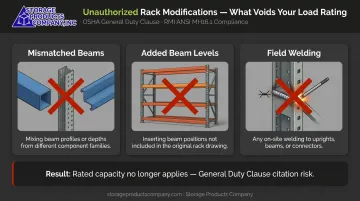
The manufacturer's rated capacity no longer applies once the original configuration is altered. OSHA can cite this under the General Duty Clause because the employer cannot demonstrate the rack is safe. If a configuration change is needed, involve the manufacturer or a qualified rack design engineer before making it.
Conclusion
OSHA pallet rack compliance comes down to two things working together: understanding that the General Duty Clause plus ANSI MH16.1 together define what "compliant" means, then applying that understanding consistently across installation, labeling, inspection, and daily operations.
The facilities that stay ahead of OSHA requirements treat rack safety as an ongoing operational discipline — not a one-time project completed at installation. That means scheduled inspections, immediate response to damage, correct labeling after any reconfiguration, and operators who know what to report and when.
That kind of ongoing discipline is easier to sustain with the right partner. Storage Products Company has worked with warehouses, distribution centers, and manufacturing facilities across Alabama and the Southeast since 1980, covering initial layout design, factory-recommended installation, ANSI MH16.1 rack inspections, and manufacturer-approved repair services. If your facility needs a compliance baseline or a rack inspection before your next OSHA walkthrough, contact us to get started.
Frequently Asked Questions
What is the OSHA standard for warehouse racking?
OSHA has no single dedicated pallet rack standard. Compliance is governed by 29 CFR 1910.176(b), the General Duty Clause (OSH Act Section 5(a)(1)), and ANSI MH16.1-2023, which OSHA references as the technical benchmark when issuing citations for rack hazards.
Does OSHA require pallet racking to be anchored?
OSHA has no explicit anchoring rule, but enforces anchoring through the General Duty Clause and ANSI MH16.1. ANSI MH16.1 requires columns to be anchored to the floor with base plate bolts sized for the rack's load and configuration — additional wall or overhead ties may also apply depending on the system design.
Does warehouse racking need to be certified?
OSHA doesn't require formal certification for installed racks, but racks must be designed and used per ANSI MH16.1 specifications. Any rack system should be verified against the manufacturer's structural requirements before being placed into service.
Does OSHA require racking inspections?
No specific inspection schedule is mandated by name, but the General Duty Clause effectively requires regular inspections — knowingly operating damaged or degraded racks constitutes a recognized hazard. ANSI MH16.1 supports routine inspection programs as the industry standard for meeting that obligation.
How often should pallet racks be inspected?
ANSI MH16.1 recommends formal inspections at least once per year, plus walk-arounds after any forklift impact or layout change. High-traffic facilities and heavy-load operations should inspect more often — quarterly reviews are common practice.
Does OSHA allow damaged storage racks to continue being used?
No. Racks with structural damage must be immediately unloaded and taken out of service. They cannot return to service until a qualified inspection is completed and manufacturer-approved repairs are made.