The problem is that many facilities treat freight lift maintenance reactively. Something breaks, a technician gets called, and the repair bill arrives alongside days of lost productivity. According to Deloitte, unplanned downtime costs industrial manufacturers an estimated $50 billion annually — and Gartner estimates an unplanned shutdown costs 4 to 15 times the price of the repair itself.
This guide covers why maintenance matters, the three types you need to know, three practical tips you can implement immediately, warning signs to watch for, and a structured maintenance schedule to keep your lift running.
Key Takeaways
- Reactive maintenance can cost up to 5x more than planned maintenance for the same work
- Freight lifts fall under ASME B20.1 standards and OSHA regulations — maintenance lapses create compliance and safety risk
- Three core maintenance types: preventive (daily/routine), corrective (reactive), and professional servicing (annual minimum)
- Skipping any of the three — daily checks, lubrication, or annual service — compounds risk and repair costs fast
- Unusual noise, slow operation, door problems, or hydraulic leaks are all signs your lift needs attention now
Why Freight Lift Maintenance Matters
The Cost Gap Between Planned and Reactive Work
Skipping scheduled maintenance feels like a cost savings — until something fails. Plant Engineering reports that breakdown maintenance can cost as much as 5 times more than the same activity performed in a planned fashion. For a freight lift running 30–50 cycles daily, that math adds up fast.
Beyond the repair bill itself, unplanned downtime hits hard: labor sits idle, shipments get delayed, and teams scramble to improvise workarounds. Each of those costs real money — and none of it shows up on the maintenance budget line.
Safety and Compliance Stakes
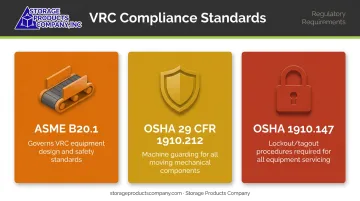
VRC freight lifts fall under several overlapping federal standards that maintenance teams need to know:
- ASME B20.1 — the safety standard governing conveyors and related equipment
- OSHA 29 CFR 1910.212 — requires machine guarding for all moving components
- OSHA 1910.147 — mandates documented lockout/tagout procedures for any servicing, including lubrication and cleaning
Maintenance lapses don't just mean equipment failures. They mean failed inspections, potential OSHA citations, and — in the worst cases — injuries. An OSHA accident report documents a 2007 VRC incident where a carriage fell after a technician separated the motor from the brake mechanism without securing the carriage first. The standards exist for a reason.
Asset Lifespan and Long-Term Value
McKinsey research shows that condition-based maintenance programs typically increase machine life by 20% to 40%. For capital equipment with a significant purchase and installation cost, extending service life by even a few years delivers real return.
A well-maintained freight lift also retains resale value, supports warranty compliance, and requires fewer emergency part replacements — all of which matter when you're managing equipment budgets across a facility.
Types of Freight Lift Maintenance
Understanding the three types of maintenance helps operations managers plan schedules and budget appropriately. They're not interchangeable.
Preventive (Routine) Maintenance
Preventive maintenance is scheduled, proactive servicing performed before failures occur. It includes daily operator checks, periodic lubrication, component inspections, and cleaning. This is the most cost-effective approach and should anchor every maintenance schedule.
Typical preventive tasks include:
- Checking hydraulic fluid levels, color, and viscosity
- Greasing chains, pulleys, and guide rails
- Inspecting limit switches and safety interlocks
- Testing safety features and control panel indicators
- Cleaning debris from rails, platform, and cab
Corrective and Professional Maintenance
Corrective maintenance is reactive — triggered by a failure or malfunction. Over-relying on this approach leads to higher costs, longer downtime, and cascading component failures. A worn chain that snaps, for example, can damage pulleys, guides, and the drive system in a single event.
Professional/overhaul maintenance is comprehensive servicing by qualified technicians, performed annually at minimum per PFlow Industries' recommendations. It covers components and systems that in-house operators cannot reliably assess on their own:
- Motor performance and electrical systems
- Hydraulic system integrity and fluid condition
- Safety devices and emergency stop functions
- Structural components and load-bearing elements
Professional service is not a substitute for daily checks. It's the layer that catches what routine inspections miss.
3 Essential Tips for Maintaining Your Freight Lift
These three tips apply to hydraulic and mechanical VRC-style material lifts across warehousing and industrial environments. They're practical, specific, and directly reduce failure risk.
Tip 1: Establish a Daily Inspection Routine
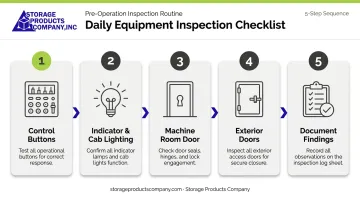
A pre-operation inspection takes less than five minutes and catches developing problems before they become failures. PFlow Industries recommends daily checks as a core maintenance practice, and the items covered are straightforward.
What to check each morning:
- Control buttons — tap lightly to confirm none are sticking or have debris wedged around them; avoid chemical cleaners that can cause internal corrosion
- Indicator lights and cab lighting — burned-out bulbs create safety and visibility hazards
- Machine room door: confirm self-locking, no unauthorized access, no improper storage
- Exterior doors: closed during all operations to maintain building pressure
Door problems deserve immediate attention. Door issues are among the most common freight lift maintenance problems and escalate quickly if ignored. Check door stops for sticking or signs of pulling away from the seal — both indicate wear that will worsen. Address door problems immediately rather than logging them for later.
Document every inspection. A written log of irregularities — even minor ones — creates a maintenance history that helps technicians diagnose developing problems faster, supports warranty compliance, and provides a defensible record if a safety incident is ever investigated. PFlow's VRC inspection guidance specifically calls out checklists and documented logs as crucial for tracking maintenance history and ensuring issues are addressed promptly.
Tip 2: Keep Mechanical Components Lubricated and Clean
Friction is the primary cause of premature wear in freight lifts. Regular lubrication of chains, pulleys, guide rails, rollers, and cylinder pins reduces friction, extends component life, and prevents unexpected failures. As a general baseline, grease these components every 3–6 months — but always defer to your specific equipment's owner manual for model-correct intervals.
For hydraulic freight lifts, check the hydraulic system regularly:
- Verify fluid level, color, and viscosity at appropriate intervals
- Change fluid per your model's manual schedule (PFlow's 21-Series, for example, includes monthly, 3-month, 6-month, annual, and 5-year hydraulic service items)
- Use the hydraulic oil grade specified for your operating temperature conditions
- Repair any hydraulic leaks immediately — fluid pooling around cylinders or the base signals a seal failure that will worsen under load
Cleaning belongs in the same routine as lubrication — not a separate task. Debris buildup on rails, in the cab, and around the platform accelerates wear and can trigger sensor or safety system malfunctions. Remove dust, dirt, and material residue each time you lubricate moving parts. A lift that's clean and properly lubricated consistently outperforms one that isn't.
Important: OSHA 1910.147 classifies lubrication as a servicing/maintenance activity requiring lockout/tagout energy control procedures. All lubrication and mechanical maintenance work must follow your facility's documented LOTO program.
Tip 3: Schedule Professional Preventive Maintenance
Daily in-house inspections keep obvious problems visible. Annual professional servicing catches everything else.
Qualified, factory-trained technicians inspect components at a depth operators simply cannot match. A professional visit typically covers:
- Motor performance and electrical systems
- Hydraulic system integrity and fluid condition
- Structural components and safety devices
- Wear patterns flagged from previous visits
Sharing your operator inspection logs before each service visit is worth the effort. Context from daily records lets technicians target known concerns rather than starting from scratch.
PFlow Industries recommends scheduling professional maintenance at least once per year to maximize equipment lifetime and warranty protection. Higher-usage environments (50+ cycles daily, dusty or high-temperature conditions) warrant semi-annual professional servicing.
Storage Products Company provides preventative maintenance programs for PFlow Industries VRC material lifts, with service based on factory-recommended procedures covering drive systems, chains, cables, and safety mechanisms.
Working with a provider that knows your specific equipment — rather than a generic contractor unfamiliar with VRC systems — means faster diagnosis and maintenance that aligns with manufacturer specifications.
Warning Signs Your Freight Lift Needs Attention
Even with a consistent maintenance routine, issues can develop between scheduled visits. Catching warning signs early keeps repairs planned and controlled — missing them turns minor faults into unplanned shutdowns.
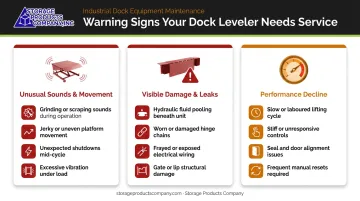
Unusual Sounds, Movement, or Behavior
- Grinding, squealing, or rattling during operation — worn bearings, loose chains, or insufficient lubrication
- Jerky or uneven platform movement — hydraulic pressure issues or rail misalignment
- Unexpected shutdowns or failure to complete a full cycle — electrical or control system faults
- Platform not stopping flush with the floor — potential misalignment from overloading or incorrect operation
Visible Wear, Leaks, or Physical Damage
- Hydraulic fluid pooling around the base or cylinders — seal failure requiring immediate attention; do not continue operation
- Visible wear, cracks, or deformation on chains, cables, or guide rails — structural risk
- Frayed or exposed electrical wiring near control panels — serious safety hazard; take out of service
- Gate, interlock, or safety cam damage — compliance-critical components that must be addressed before next use
Performance Decline and Operational Issues
Operators who work with the lift daily are best positioned to catch subtle performance changes. Watch for:
- Noticeable reduction in lifting speed or capacity
- Doors that don't open or close cleanly
- Control buttons that stick or fail to respond
- Increased frequency of manual resets or operator interventions
Any of these symptoms call for immediate attention, not a wait until the next scheduled visit. Per PFlow's guidance, if defects affect operating safety or reliability, the VRC should be taken out of operation until the issue is resolved.
Freight Lift Maintenance Schedule
Maintenance frequency should match usage intensity and environment. A lift running 50+ cycles daily in a dusty warehouse needs more attention than one used intermittently in a climate-controlled facility. Use the following as a baseline framework and adjust based on your model's owner's manual.
| Frequency | Tasks |
|---|---|
| Daily / Pre-Use | Operator visual and functional checks: controls, lighting, doors, machine room access |
| Monthly | Lubricate moving parts (chains, pulleys, guide rails); check hydraulic fluid level and condition; test limit switches and safety systems; clean platform, rails, and cab |
| Annual (minimum) | Full professional inspection and servicing by qualified technicians; motor, hydraulic, electrical, and safety device review; replace worn components |
Two points that fall outside the standard table but matter just as much:
- Hydraulic fluid change intervals are model-specific — always follow your owner's manual. Do not apply a universal interval across different lift models.
- Any lift that has been idle for an extended period should be tested unloaded before returning to loaded operation. Have a qualified technician clear it for use if it has been out of service due to damage or a defect.
Frequently Asked Questions
How frequently should a freight lift be serviced?
Most freight lifts require monthly routine checks by trained operators and at least one professional service visit per year — this is PFlow Industries' minimum recommendation. Facilities running 50+ cycles daily or operating in harsh environments should consider semi-annual professional servicing.
What is the monthly maintenance of a lift?
Monthly maintenance covers lubricating chains, pulleys, and guide rails; checking hydraulic fluid levels and condition; testing limit switches and safety systems; and cleaning the platform, rails, and cab of debris and buildup.
What are the most common freight lift maintenance issues?
The most frequently cited issues include hydraulic fluid leaks, worn or loose chains, door mechanism failures, electrical component wear, and control malfunctions. Most of these are preventable with a consistent daily inspection and lubrication routine.
Can I perform freight lift maintenance myself, or do I need a professional?
Daily inspections, cleaning, and basic lubrication can be handled in-house by trained operators following proper LOTO procedures. Motor, hydraulic system, and electrical work must be performed by qualified, certified technicians to ensure safety and compliance with ASME B20.1 and OSHA standards.
How do I know if my freight lift needs repair rather than routine maintenance?
If you observe hydraulic leaks, structural damage, repeated electrical faults, or significant loss of lifting capacity, the lift requires repair beyond routine maintenance. Take it out of service and contact a qualified technician for a full assessment before resuming operation.
What safety standards govern freight lift maintenance?
VRC-style freight lifts are governed by ASME B20.1. OSHA 1910.212 covers machine guarding requirements, and OSHA 1910.147 mandates documented lockout/tagout procedures for all servicing and maintenance activities.