That confusion is common. It's also expensive.
Warehousing and distribution are not the same thing. Warehousing is fundamentally about storing goods safely over time. Distribution is about moving goods efficiently to their next destination. That single distinction shapes facility design, equipment choices, staffing models, and technology investments. Get it wrong and you're either paying for storage capacity you don't need or bottlenecking throughput that's costing you customers.
This article breaks down what each model actually involves, where they differ, and how to determine which one — or which combination — fits your operation.
Key Takeaways
- Warehousing = long-term, high-capacity storage until goods are needed for production or sale
- Distribution focuses on active movement: order processing, picking, packing, and outbound shipping coordination
- Both are essential to supply chains but serve different purposes
- Your product type, order velocity, and customer delivery expectations determine the right model
- The right racking, shelving, and dock equipment determines how well either facility type performs
What Is Warehousing?
Warehousing is the organized storage of goods — raw materials, components, or finished products — in a dedicated facility until they're needed. The U.S. Census Bureau's NAICS 493 classification defines these establishments as facilities that store and secure goods without selling them. Storage is the primary function, not a byproduct of other operations.
Core warehouse operations include:
- Receiving and inspecting inbound shipments
- Tagging, organizing, and slotting inventory
- Managing stock levels and conducting cycle counts
- Dispatching goods in bulk when needed downstream
Daily activity volume in a warehouse is typically lower than in a distribution center. The focus is on inventory integrity and space efficiency, not throughput speed.
Characteristics of a Warehouse
Warehouses are designed for goods that may sit for weeks or months. That makes space utilization the top design priority.
The physical setup reflects this:
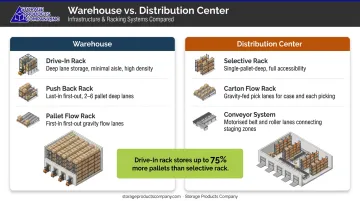
- High-density racking (Drive-In, Push Back, Pallet Flow) can hold up to 75% more pallets than selective rack in the same footprint
- Vertical storage via high-rise shelving systems that exceed 20 feet, maximizing cube utilization
- Climate control for temperature-sensitive or regulated goods
- Loading docks sized for bulk inbound and outbound shipments
The right storage infrastructure determines how much inventory a facility can hold and how efficiently it can be retrieved. Storage Products Company works with warehouses across the Southeast to design layouts that maximize every square foot — from racking system selection and AutoCAD space planning through installation.
Benefits of Warehousing
- Protects inventory from damage, theft, and environmental exposure
- Creates a buffer against supply chain disruptions and vendor lead time variability
- Supports bulk purchasing and seasonal stock management
- Eliminates the need for manufacturers or retailers to build and operate their own storage infrastructure
What Is Distribution?
A distribution center (DC) holds goods too — but that's not its purpose. The purpose is moving goods as quickly as possible to the next point in the supply chain, whether that's a retailer's shelf, a regional hub, or a customer's front door.
CBRE Investment Management defines distribution facilities as 350,000 to 1 million sq. ft. logistics facilities where products are resorted or repackaged before moving on. Speed and throughput are the primary metrics.
Key operations inside a distribution center:
- Receiving — inbound goods processed and staged quickly
- Short-term storage — inventory held only as long as needed before fulfillment
- Order processing — picking lists generated, orders released to floor
- Pick and pack — individual orders assembled and packaged
- Sorting and labeling — outbound shipments consolidated by carrier or route
- Cross-docking — goods moved from inbound to outbound with minimal or no storage
- Returns management — reverse logistics handled at the same facility
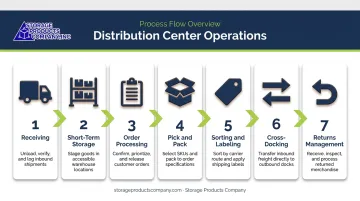
That combination of inbound, outbound, and reverse logistics functions makes DCs operationally more demanding than traditional warehouses — and drives very different infrastructure requirements.
Benefits of a Distribution Center
Distribution centers sit between suppliers and end customers — and their placement near population centers directly reduces delivery windows. According to Deloitte, last-mile delivery accounts for as much as 30–35% of total delivery cost, which is why DC location decisions carry real financial weight.
Key benefits:
- Faster delivery to retail or direct-to-consumer destinations
- Omnichannel fulfillment capability from a single facility
- Reduced last-mile shipping time and cost
- Scalable capacity through 3PL-operated facilities for businesses not ready to own the infrastructure
That 3PL option is no longer a niche workaround — it now defines a substantial share of the market. CBRE reported that 3PLs accounted for 35% of North American big-box lease transactions in 2023, and their share of U.S. bulk industrial leasing rose to 34.1% through Q3 2024 — a signal of just how much distribution capacity now runs through third-party operators.
5 Key Differences Between Warehousing and Distribution
Warehouses and distribution centers share physical similarities — both hold inventory, both require racking and dock access — but their operational priorities are fundamentally different. Understanding those differences determines which equipment, layout, and systems actually fit your operation.
Purpose and Primary Function
A warehouse's core job is to hold inventory safely and cost-effectively. A distribution center's core job is rapid order fulfillment and throughput. At a DC, storage is a byproduct of throughput, not the goal.
Storage Duration
Warehouses are built for long-term holds. Inventory may sit for weeks or months before it's needed. Distribution centers prioritize fast inventory turnover — goods move through quickly, often measured in hours or days rather than weeks.
The 2024 Warehouse/DC Operations Survey by Logistics Management reported average annual inventory turns of 6.5 across surveyed warehouse and DC operations — but high-velocity DCs turn inventory far more frequently than that benchmark suggests.
Facility Setup and Equipment
| Feature | Warehouse | Distribution Center |
|---|---|---|
| Primary goal | Maximize storage density | Maximize throughput speed |
| Racking | Drive-In, Push Back, Pallet Flow | Selective rack, carton flow |
| Floor space | Dense storage lanes | Open staging and sorting areas |
| Dock doors | Fewer, bulk shipments | Multiple docks, high-frequency use |
| Clear height | High vertical storage | Varies; modern DCs average ~30 ft |
| Conveyor systems | Minimal | Central to operations |
Modern logistics facilities require clear heights of 36–40 feet versus 18–32 feet in older buildings, and truck courts of 130 feet or more — physical specs that favor throughput over pure storage density.
For warehouses, Drive-In and Push Back rack systems can store up to 75% more pallets than conventional selective rack in the same footprint — a significant advantage when inventory sits for weeks. Distribution centers use selective rack and carton flow for fast-access picking, with powered conveyor systems handling movement between pick zones and staging areas.
Technology and Systems Used
Warehouses rely primarily on Warehouse Management Systems (WMS) to track inventory location and stock levels. The 2024 Logistics Management survey found 93% of respondents use some type of WMS, with average projected capex for warehousing equipment and technology reaching $1.8M — up from $1.15M the prior year.
Distribution centers layer additional technology on top:
- Transportation Management Systems (TMS) for carrier coordination
- Route optimization tools
- Real-time tracking and order processing automation
- Sortation and conveyor control systems
That technology investment directly shapes cost structure — which breaks down very differently between the two facility types.
Cost Structure
Neither model is inherently cheaper — the costs are structured differently, and that structure affects where optimization efforts actually pay off.
Warehousing costs are mostly fixed:
- Facility rent or ownership
- Racking and shelving infrastructure
- Climate control systems
- Labor for inventory management
Distribution costs are more variable:
- Transportation rates and fuel
- Carrier fees
- Higher labor intensity for fulfillment
- Last-mile delivery costs (up to 30–35% of total delivery spend)
Transportation costs account for 45–70% of total logistics spend, while facility rent represents just 3–6%. For distribution-heavy operations, controlling transportation and last-mile costs matters far more than optimizing rent per square foot.
Choosing the Right Fit for Your Business
The decision isn't always binary — but a few clear patterns emerge.
Traditional warehousing fits best when you have:
- Slow-moving or seasonal inventory
- Bulk orders with low order frequency
- Raw materials or components for manufacturing
- Products requiring climate control or long holds
Distribution-oriented setups fit best when you have:
- Fast-moving SKUs with high daily order volume
- Direct-to-consumer or omnichannel fulfillment requirements
- Tight delivery SLAs (next-day, two-day)
- High SKU diversity requiring fast picking access
Many mid-to-large businesses use both in tandem. A central warehouse feeds regional distribution centers, which in turn handle last-mile delivery. McKinsey has noted that e-commerce penetration remains 30% higher than pre-COVID levels, pushing retailers toward hybrid fulfillment models — Target, for example, fulfills about 95% of its digital orders from existing store locations rather than traditional DCs.
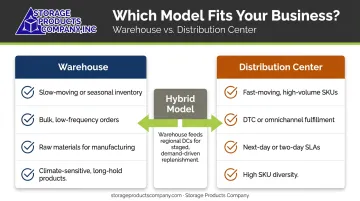
That shift toward hybrid models puts real pressure on your facility's physical infrastructure. Racking systems, shelving, mezzanines, and dock equipment directly determine how efficiently your space can support whichever model you run.
Storage Products Company has helped warehouses and distribution centers across the Southeast evaluate and install the right storage setups for over 43 years: from high-density pallet racking for bulk storage environments to selective rack and pick modules for fast-moving fulfillment operations.
Frequently Asked Questions
What is warehousing and distribution?
Warehousing refers to the storage of goods in a dedicated facility until they're needed for production or sale. Distribution involves moving those goods to customers, retailers, or the next supply chain node. Together, they form the core of physical logistics operations.
What is the difference between a distribution center and a warehouse?
A warehouse focuses on long-term bulk storage with lower daily activity. A distribution center handles short-term storage plus order fulfillment — picking, packing, sorting, and shipping — making it operationally more complex and throughput-driven.
How long does a package usually stay at a distribution center?
Distribution centers are designed for rapid throughput, so inventory moves quickly — often within a day or two. The 2024 Logistics Management survey reported average annual inventory turns of 6.5, though high-velocity DCs turn product significantly faster than that.
What are the storage options for a warehouse?
Common options include selective pallet racking, Drive-In and Push Back rack for high-density storage, pallet flow and carton flow systems for FIFO inventory, steel and wire shelving, mezzanines, and bulk floor storage. The right choice depends on SKU count, inventory velocity, and available building height.
What are the 5 types of warehouses and their functions?
The five main types are:
- Public warehouses — shared-use facilities operated by a third party
- Private warehouses — owned and operated by the business itself
- Bonded warehouses — hold imported goods without duty payment for up to 5 years (per CBP)
- Distribution/fulfillment centers — focused on order movement and fulfillment
- Climate-controlled/cold storage warehouses — for temperature-sensitive goods
What is the difference between a DC and an FC?
A distribution center (DC) primarily serves retailers and B2B supply chains, moving goods in bulk to stores or regional hubs. A fulfillment center (FC) is consumer-focused — it handles individual e-commerce orders with picking, packing, and direct-to-customer shipping as the core function.