
It matters in warehouses, distribution centers, retail stockrooms, manufacturing plants, and automotive parts operations. Controlled rotation, picking speed, space use, and safe handling all hang on how well the rack and the process match.
The two terms get tossed around together, but few people understand how they work on the floor. This article covers how the system works, what affects performance, and when another rack style is the better call.
Key Takeaways
- Flow racks use inclined rollers or wheels to move pallets, cartons, or totes to a pick face.
- Separating replenishment from picking keeps the oldest accessible load at the front.
- FIFO holds only with one SKU per lane, compatible loads, and accurate records.
- High-turnover goods benefit most; these systems are not right for every warehouse.
What Is FIFO Picking in a Flow Rack and Why Is It Used?
What Is a Flow Rack?
A flow rack is a dynamic storage system with sloped lanes fitted with rollers, wheels, or tracks. Stored goods travel toward an accessible pick face without a forklift or picker walking into the lane.
Typical components include:
- Uprights and beams
- Inclined lanes with rollers or wheels
- Lane dividers and entry guides
- Brake rollers or speed controllers
- End stops or pallet stops at the discharge end
Manufacturers document these parts differently, so treat the list as typical rather than universal.
There are two main families:
- Pallet flow moves full pallets or larger unit loads, loaded from one aisle and unloaded from another
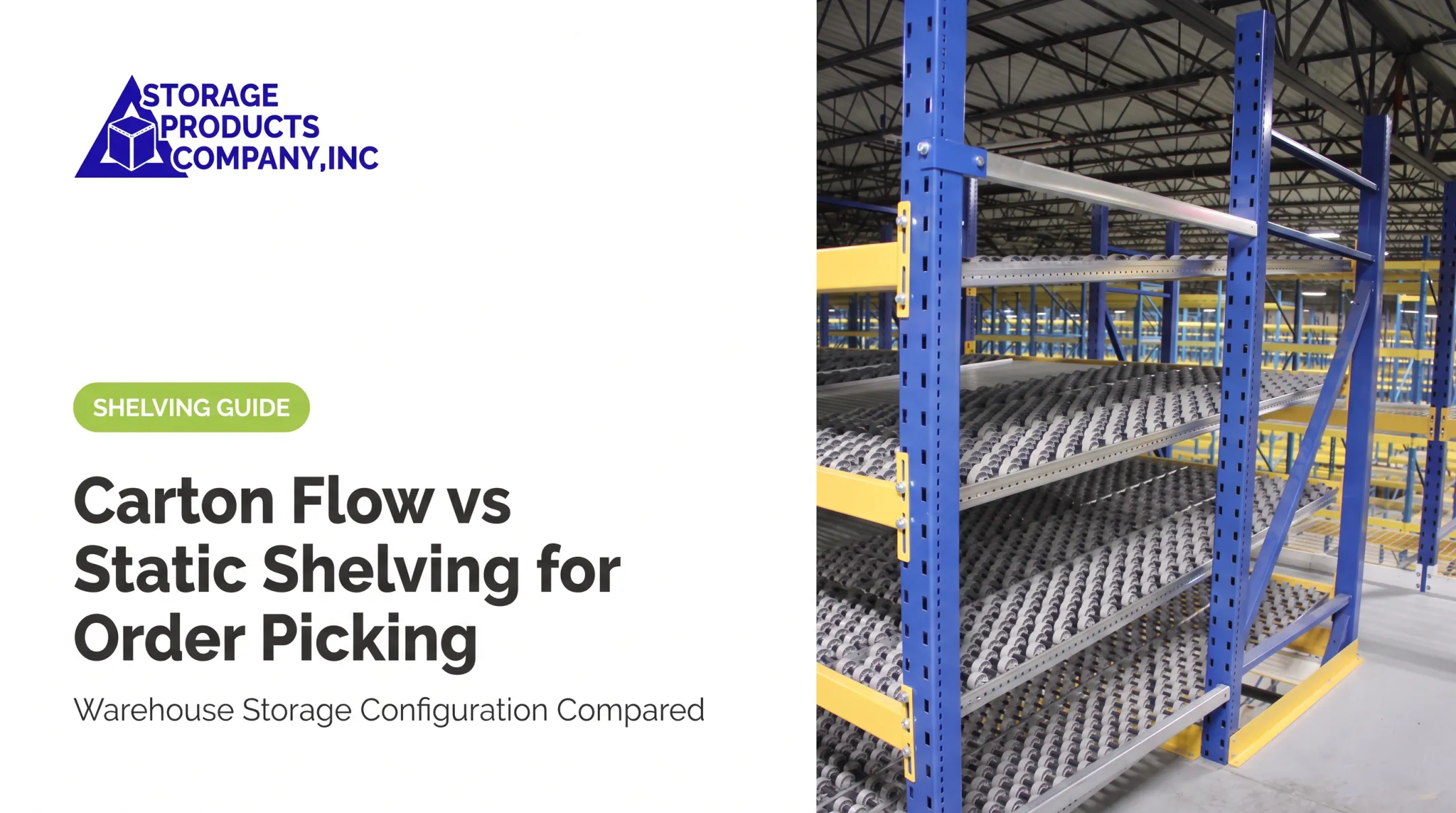
- Carton flow handles cases, totes, and smaller items for case picking
Storage Products Company's carton flow systems handle cartons, bins, and odd-shaped merchandise.
One distinction matters: FIFO is the inventory sequence, and the rack is the equipment that helps enforce it.
Why Is FIFO Picking Used in Warehouses?
Picking the oldest received stock first keeps inventory from aging behind newer arrivals. That reduces the chance of spoilage, obsolescence, and stranded stock. No credible figure ties those reductions directly to flow racks, so judge the benefit by your own turnover and shelf-life data.
Pallet flow is a true FIFO system, while push-back is LIFO, according to RMI's comparison.
FIFO also differs from FEFO:
- FIFO follows receipt order.
- FEFO picks the earliest expiration date first.
If dates vary within a product, a lane won't sort by expiry. Date-sensitive operations need lot and date controls, plus warehouse management rules, in addition to the rack itself.
How Flow-Rack FIFO Picking Works
Stock is replenished at the higher or rear end of a lane. Gravity carries it toward the front, the front load is picked, and the next load advances.
Lane performance depends on getting these inputs right:
- Pallet or carton dimensions and load weight
- Pallet and carton condition
- SKU and lot information
- Lane assignment and replenishment instructions
Step 1: Load the Lane
The replenishment team puts the correct SKU in its designated lane at the rear or high end. They center the load, confirm the pallet or carton suits the lane, and never place newer stock in front of older stock.
Step 2: Let the Load Travel
The load rolls down the slope. Brakes and speed controllers manage how fast it moves and how gently it stops. Entry guides, separators, and lane dividers keep it aligned.
The slope angle, or pitch, is specific to each system. Mallard's 2024 installation guide lists 3/8 or 7/16 inch per foot for its own systems with tight level tolerances. Follow the drawing for your rack, not a rule of thumb.
Step 3: Pick and Record
The picker removes the front load, verifies SKU and quantity, and records the transaction through labels or a warehouse management system. The next load slides forward.
The rack supports the physical sequence only. It doesn't verify receipt dates, expiration dates, lot priority, or inventory records. Procedures and system controls complete the FIFO process.

Where FIFO Flow Racks Are Applied and What Affects Performance
Where FIFO Flow Racks Are Applied
Common uses include:
- Food and beverage, including cooler and freezer storage
- Distribution centers and e-commerce order picking
- Retail replenishment
- Manufacturing line-side supply
- Automotive parts distribution
They fit best where turnover is high, product age matters, and replenishment is frequent. Inside the building, flow racks show up as reserve storage, case-pick modules, staging buffers, and production replenishment.
Results vary by site. A vendor-reported GLK Foods case describes a pallet-flow project with 850 pallet positions and 75% less aisle space than selective rack. Treat it as one project, not a benchmark.
Key Factors That Affect FIFO Picking Performance
Inputs and materials
- Pallet quality, load weight, stability, and packaging control whether loads move consistently
- Mixed or irregular loads cause hang-ups
- One SKU per lane, with lane quantities sized to that SKU
Operating conditions
- Lane depth, slope, turnover, replenishment frequency, temperature, and simultaneous picks drive flow and congestion
- Fast movers need enough lane capacity to avoid empty faces
Equipment and systems
- Match rollers or wheels, brakes, entry guides, separators, and end stops to the load
- Align forklift access, aisle layout, labels, barcode scanning, and WMS FIFO or FEFO rules with the design
Safety and compliance. Consider:
- Rack load ratings and posted load plaques
- Operator training and damaged-pallet rejection
- Regular inspection and maintenance
- Fire-protection and seismic requirements where they apply
- Coordination with the authority having jurisdiction and qualified rack professionals
Rack design follows ANSI MH16.1-2023, which covers pallet-flow and case-flow racks. Codes are adopted locally, so permit and fire-protection rules depend on your jurisdiction.

Storage Products Company, based in Mobile, Alabama, helps evaluate storage racking requirements. AutoCAD layout drawings, project management, and installation fit a flow-rack design to your space, load specifications, aisles, workflow, and safety goals. Fire sprinkler work stays with your fire-protection contractor.
Common Issues, Misconceptions, and When FIFO Flow Racks May Not Be Appropriate
Common Issues and Misconceptions
Gravity does not guarantee FIFO. These break the sequence:
- Mixed SKUs in one lane
- Loading from the wrong side or in the wrong order
- Damaged pallets or blocked rollers
- Poor lane assignments
- Inaccurate inventory records
Typical operating problems and what they point to:
- Pallet slows or hangs: check for a jammed brake, debris, or a poor pallet.
- Pallet speeds up: suspect a damaged brake.
- Cartons stall or race: look for debris, damaged rollers, changed pitch, or slick cartons.
- Wrong-lane picks: review labeling and lane discipline.
Any of these should trigger inspection. Escalate to a qualified rack professional when you see damaged beams, uprights, or lanes, and isolate the area until it's cleared.
When FIFO Flow Racks May Not Be Appropriate
Flow racks are a weak fit when you have:
- Very low-turnover inventory
- Irregular or fragile loads
- Frequent single-unit SKU changes
- Inconsistent pallet dimensions
- Direct access required for every load
Alternatives trade density, selectivity, and rotation:
| System | Rotation | Trade-off |
|---|---|---|
| Pallet flow | FIFO | High density, multiple-depth, high turnover |
| Push-back | LIFO | Denser than selective, needs uniform pallets |
| Drive-in | LIFO | Compact; storage cube over selectivity |
| Drive-through | FIFO | Access from both ends |
| Selective | FIFO or LIFO | 100% selectivity, lower density |

Pick by what your product and workflow demand. No single system wins everywhere.
Conclusion
A flow rack uses gravity-assisted lanes to deliver inventory to a pick face. FIFO picking means the warehouse removes older received stock before newer stock. The rack helps, but discipline completes it.
Load compatibility, lane configuration, replenishment habits, equipment controls, inventory data, and safety requirements all shape the result. Choose the rack to fit your product, turnover, space, handling equipment, compliance needs, and actual picking workflow, not the other way around.
Frequently Asked Questions
What is a flow rack?
A gravity-assisted rack with inclined roller or wheel lanes. Pallet flow moves full pallets; carton flow moves cases, totes, and small items to a pick face.
What is a racking system in a warehouse?
A structured arrangement for storing pallets, cartons, bins, or other loads. It's selected based on access, density, product type, and handling needs.
What is the best racking system for a warehouse?
There isn't a universal best. Compare turnover, SKU variety, load type, FIFO or LIFO needs, selectivity, space, equipment, and safety requirements.
How does FIFO picking work in a flow rack?
Newer stock is loaded at the rear or higher side. Older stock is picked from the front, and the next load advances once the front position empties.
What products are best suited to flow racks?
High-turnover, date-sensitive, palletized, or case-picked products with compatible dimensions and stable loads. Irregular or rarely accessed inventory may need another system.
What is the difference between pallet flow and push-back racking?
Pallet flow loads and picks from opposite sides, supporting FIFO. Push-back loads and retrieves from one side and typically runs LIFO.