
Introduction
The loading dock is where trucks meet the building. Every pallet crosses it, so its design shapes receiving speed, freight protection, and worker safety. A badly planned dock shows up daily as truck queues, damaged doors, and near misses.
Per OSHA's forklift eTool, forklift falls at docks can be fatal, and many fatalities involve a worker crushed by a forklift that overturned or fell from the dock. Design choices matter.
The challenges are familiar: mixed vehicle types, traffic conflicts, compatible equipment, current safety rules, weather exposure, and room to grow. This guide starts with workflow and layout, then covers equipment as a system, safety requirements, dock types and budgeting, and efficiency and maintenance.
Key Takeaways
- Design around real freight flows, vehicle dimensions, and peak volume, not isolated equipment.
- Equip each dock with a leveler, door, bumpers, seals or shelters, restraint, lighting, and fall protection.
- Separate trucks, forklifts, pedestrians, and staging, then back it up with training and inspections.
- Plan for maintenance, scheduling, and future changes in freight mix.
Warehouse Loading Dock Layout Design: Start With the Flow of Work
Map the workflow before drawing the dock
Trace the full path: truck arrival and check-in, unloading, inspection, staging, storage, picking, shipping, and departure. Inbound, outbound, cross-docking, returns, and rejected loads often need separate paths or dedicated zones.
Design for peak periods, not averages. Peaks drive truck queuing, trailer dwell time, pallet staging, labor shortfalls, and the overflow space you'll wish you had.
Plan vehicle circulation and the truck court
The approach road, truck court, dock face, parking positions, and exit route should let drivers move predictably with minimal reversing and no cross-traffic.
Manufacturer guidance gives useful starting points, not code minimums:
- McGuire's planning guide: trucks may need more than twice the combined tractor-trailer length to straighten while backing
- Road widths: 13 ft one-way and 26 ft two-way, plus separate employee roadways and truck waiting areas beside the docks
- Approach slope: 6% or less is ideal
- AASHTO WB-67 semitrailer: 45-ft minimum turning radius
Where adopted, the 2024 International Fire Code Appendix D requires fire-apparatus access. Confirm with your local authority which code applies. Always size the court for the largest vehicle you expect, and run a swept-path check.

Separate pedestrians, forklifts, and vehicles
Give people their own space:
- Dedicated pedestrian walkways with controlled crossings
- Forklift lanes marked on the floor and protected by bollards or barriers
- Mirrors and warning signs at blind corners
- Driver waiting areas and employee entrances placed so nobody crosses active loading paths
OSHA recommends using a spotter where needed and sounding the horn at blind corners, doorways, and aisles.
Allocate interior staging and storage space
Staging lanes should sit close enough to the doors for quick transfers, yet never block forklift aisles, fire exits, rack access, or neighboring dock positions. OSHA requires fire aisles and fire equipment to stay clear.
Pallet size, load weight, dwell time, temperature needs, and damaged-goods handling all change how much space you need. No universal staging dimension exists, so size it from your own volumes.
Document the design before construction or retrofit
Put everything on a scaled plan:
- Doors, levelers, seals, bumpers, and restraints
- Traffic lanes and pedestrian routes
- Staging zones and expansion areas
- Utilities, lighting, drainage, and barriers
Storage Products Company uses AutoCAD to lay out equipment and provides drawings so customers can see space requirements and catch conflicts before installation.
Essential Loading Dock Equipment and How to Select It
Choose dock levelers for the vehicle and load profile
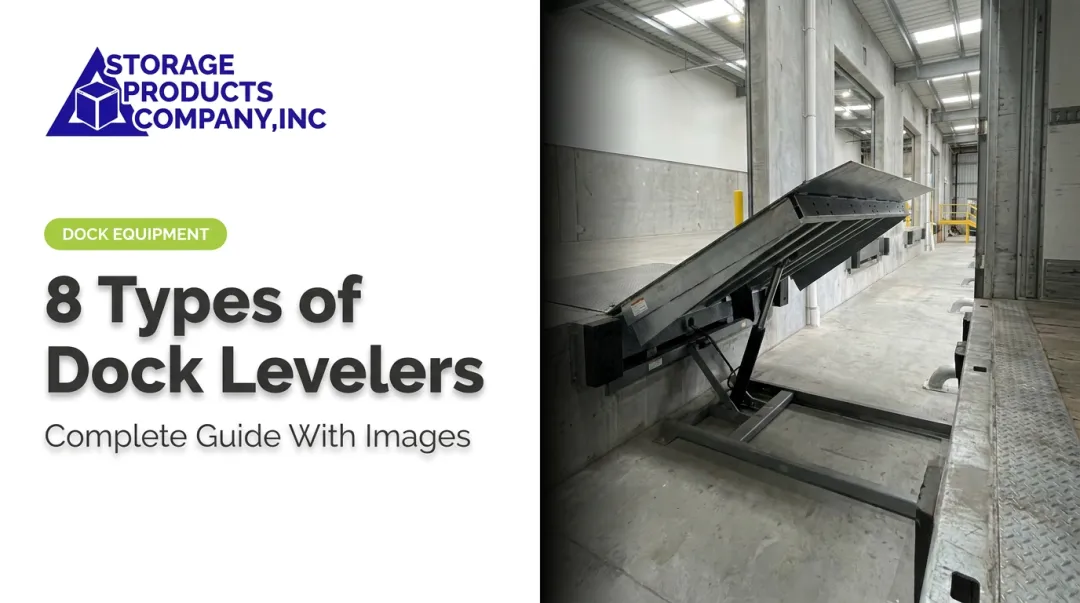
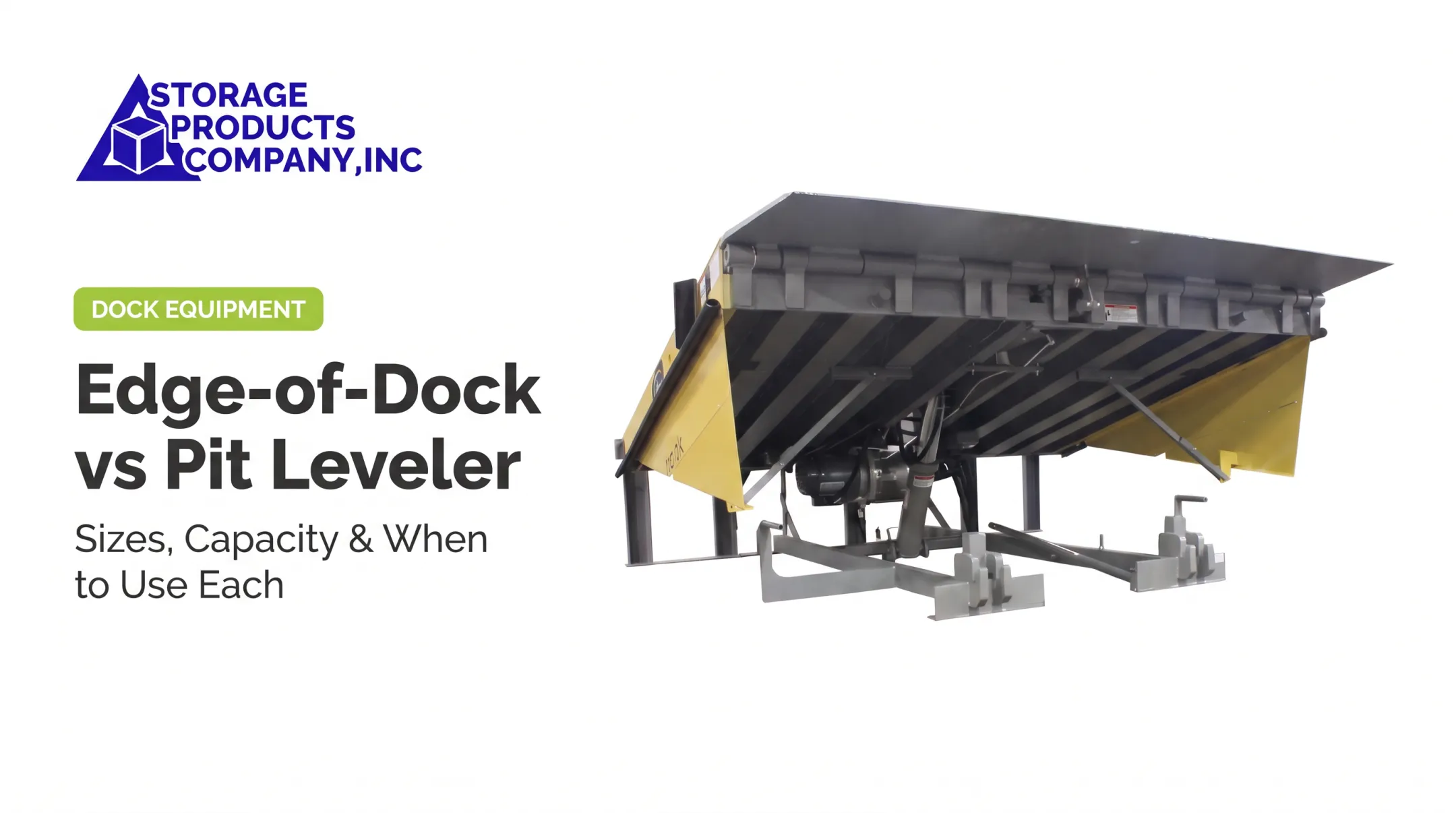
Levelers bridge the gap between dock and trailer bed. Specs below come from specific manufacturer models, so treat them as examples.
| Type | Example from manufacturer specs | Notes |
|---|---|---|
| Mechanical pit | Blue Giant M7010: 26,000 lb, 12 in above and below dock | Needs more regular service |
| Hydraulic pit | Blue Giant H7010: 12 in above and below; lip extends automatically | Less service than mechanical |
| Air-powered pit | Blue Giant A7010: 12 in above, 7-9 in below | Service falls between the two |
| Edge-of-dock | Working range +/-3 in, maximum +/-5 in | Mounts at the dock face, not in a pit |
Match capacity to:
- Heaviest expected load
- Forklift or pallet jack type
- Trailer-bed variation, dock height, and use frequency
Confirm the rating of the exact model. ANSI MH30.1-2022 covers dock leveler performance and testing.
Storage Products Company supplies mechanical and hydraulic pit levelers and edge-of-dock levelers from Dock Systems Inc.
Coordinate overhead doors, dock seals, shelters, and bumpers
Size doors for your fleet, cycle frequency, insulation needs, and security. Seals and shelters limit weather exposure, and bumpers protect the wall and trailer during backing.
- Blue Giant's glossary gives planning projections of 4-6 in for seals and roughly 18-20 in for shelters.
- Shelters vary in impactability and sealing efficiency.
- Check fit against the wall, trailer dimensions, and loading method.
Secure trailers with restraints or chocking provisions
OSHA requires brakes set and wheel chocks under the rear wheels during truck boarding. Wheel blocks must prevent movement during loading. Without a restraint system, trailers must be chocked. Communication lights tell drivers and forklift operators when it's safe to move.
Interlocks can sequence the restraint, door, and leveler. Rite-Hite describes this as reducing human error. Follow OSHA and manufacturer instructions. ANSI MH30.3 covers vehicle restraints.
Add safety and visibility equipment
Each item answers a specific risk:
- Dock and trailer lights for poor visibility
- Guardrails, barrier gates, and dock-edge protection for falls
- Bollards and wheel guides for vehicle impact
- Drainage and non-slip surfaces for slippery conditions
- Ventilation for exhaust
- Reflective markings and signs for uncontrolled pedestrian access
Storage Products Company also carries barriers, rails, and guarding for distribution-center safety.
Match material handling equipment to the dock
Select forklifts, pallet jacks, conveyors, dock lifts, and yard ramps by load size and weight, dock height, trailer access, floor conditions, and aisle geometry. Dock-high operations suit trailers matching the platform. Grade-level work suits box trucks and vans. Mixed fleets or unusual freight may justify more than one configuration.

Loading Dock Safety and OSHA Requirements
Identify the hazards before selecting controls
Build a site-specific assessment around:
- Falls from open dock edges
- Trailer creep and premature departure
- Forklift collisions and struck-by incidents
- Pinch and crush points
- Shifting loads, slips, and trips
- Poor lighting and exhaust fumes
Weather, congestion, poor housekeeping, damaged equipment, and unclear communication raise every one of these risks. Washington's FACE program documented a freight clerk crushed against a dock wall by a trailer in 2020. Another case in 2022 involved a driver caught between a trailer and truck cab at a warehouse dock.
Apply current OSHA and applicable local requirements
Key federal standards:
- 29 CFR 1910.26 (dockboards): must support the maximum intended load. Chocks or sand shoes must prevent vehicle movement while employees are on the board.
- 29 CFR 1910.28 (fall protection): general protection begins at 4 ft for unprotected edges, with limited loading-rack exceptions.
- 29 CFR 1910.178 (powered industrial trucks): brakes and chocks, trailer floor inspection, fixed jacks for uncoupled semitrailers, and clear fire aisles.
OSHA is a federal baseline. State plans must be at least as effective and may be stricter. Building, fire, and electrical codes adopted locally also apply, so verify requirements for your facility with the authority having jurisdiction.
Control fall and trailer-movement risks
Open dock doors may need guardrails, barrier gates, or chains, as long as they allow active loading without creating a new obstruction. A safe sequence looks like this:
- Trailer arrives and brakes are set.
- Restraint or chocks go in place.
- Door opens and leveler deploys.
- Loading proceeds.
- Leveler returns to stored position and door closes.
- Trailer is released only after the all-clear.

Improve visibility, traffic control, and environmental conditions
Good lighting inside, outside, and in the trailer helps crews spot hazards before they turn into incidents. Add floor markings, signs, mirrors, audible or visual warnings, and speed controls.
Seals, shelters, drainage, and housekeeping manage rain, heat, and cold. Internal-combustion forklifts can produce high carbon monoxide levels in enclosed areas. OSHA's limit is 50 ppm (8-hour average), and NIOSH recommends 35 ppm, so monitor where appropriate.
Build an ongoing safety program
- Operator training and forklift authorization
- Pre-shift checks and documented inspections
- Housekeeping assignments
- Emergency procedures
- Near-miss reporting and refresher training
Regular equipment inspections reinforce these practices. Storage Products Company's inspection service covers loading dock equipment and racking and reports on site conditions. It isn't a training organization, so pair inspections with your own safety program.
Choosing a Dock Type and Planning Dimensions, Capacity, and Cost
Compare common loading dock configurations
| Configuration | Key trade-off |
|---|---|
| Flush | Dock face flush with wall; bumper projection may be needed to protect wall and seals |
| Open | Exposed to weather and pilferage; generally not recommended, though sometimes necessary |
| Enclosed | Climate control, security, product protection; high construction cost and exhaust concerns |
| Depressed | Sloped driveway where the building has no basement or dock-level floor |
| Saw-tooth | Can reduce apron space needed to maneuver trucks |
| Grade-level / drive-in | Serves vehicles that can't align with a raised dock |
Match the dock type to vehicles, freight, and site constraints
Base the choice on your real operating mix, not a default template:
- Trailer mix, freight dimensions, and weight
- Throughput, temperature sensitivity, and security
- Truck court size, climate, and growth plans
A few patterns:
- Distribution centers: dock-high positions with pit or edge-of-dock levelers
- Manufacturing: often a mix of dock-high and grade-level doors
- Retail: box trucks and vans, so grade-level or edge-of-dock setups
- Tight sites: saw-tooth layouts to save apron space
Establish dimensions and capacity from actual operating inputs
Collect these inputs before you lock dimensions or capacity:
- Vehicle bed heights plus largest and smallest vehicle dimensions
- Door sizes, leveler range, and turning radius
- Load weights, equipment clearances, and staging needs
- Expansion plans
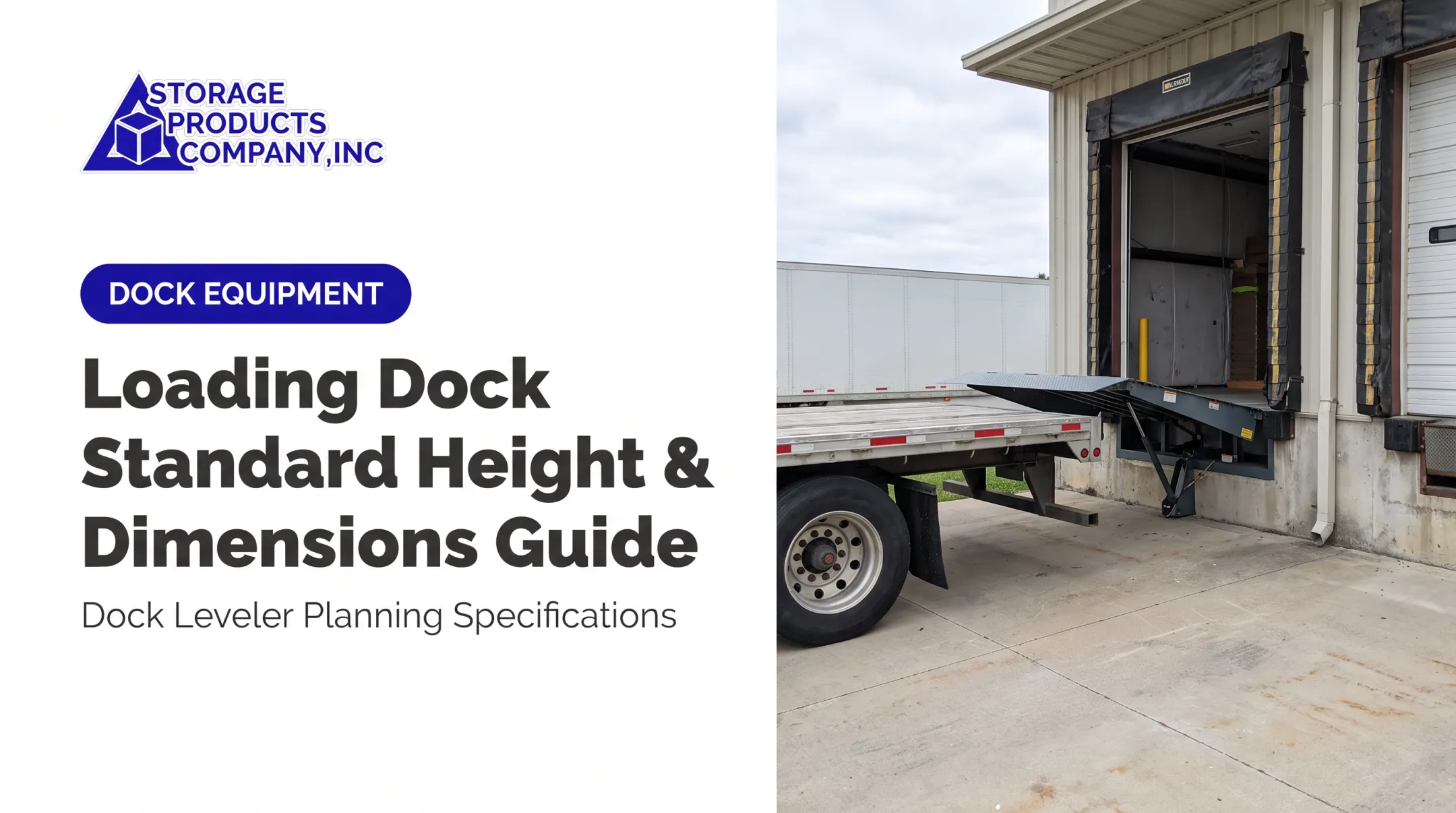
"Standard" is not universal. Poweramp's planning guide recommends 12 ft minimum and 14 ft preferred door-centerline spacing for trucks 8 ft to 8 ft 6 in wide. It lists 48-54 in as typical dock heights for semitrailers, while Blue Giant lists 48-52 in. Treat both as manufacturer starting ranges, then confirm against your fleet.

Build a realistic loading dock budget
Cost components include:
- Site preparation, concrete, and structural work
- Pits or platforms
- Doors, levelers, seals, and bumpers
- Restraints, lighting, and electrical work
- Drainage, ventilation, and barriers
- Permits, installation, commissioning, and downtime
New construction versus retrofit, unusual vehicles, high-volume equipment, site access, and code upgrades all move the price materially. Get a site-specific assessment instead of relying on a generic number.
Improving Loading Dock Efficiency and Maintenance
Manage appointments, communication, and dock flow
Appointment windows, door assignment, driver check-in, traffic lights, and WMS integration help balance labor and equipment. A GAO report notes some shippers use appointments to manage bays, staff, and loading equipment, though it gives no measured wait-time reduction.
Tie scheduling to real constraints: dock count, staging capacity, labor, trailer type, loading duration, and peak periods. FMCSA reports detention in 19% of medium-carrier stops, so waiting is a real cost.

Prevent downtime through planned maintenance
Check these on a schedule:
- Levelers, lips, and hinges
- Doors, seals, shelters, and bumpers
- Restraints and interlocks
- Lights and communication systems
- Barriers, floors, and drainage
- Ventilation and forklifts
Rite-Hite recommends daily checks and more thorough 90-day service. Follow that manufacturer guidance, and log inspections, defects, repairs, and recurring failures so unsafe patterns surface early.
Storage Products Company's preventative maintenance follows factory-recommended procedures, and repairs damaged doors, seals, and shelters.
Prioritize technology and automation upgrades
Common upgrade options include:
- High-speed doors and hydraulic levelers
- Automated restraints, sensors, and interlocks
- Dock management software and conveyors
Vendors claim benefits such as door speeds up to 100 in/sec. Request supporting performance data from the vendor and compare it with your own throughput before you buy.
Upgrade based on measured bottlenecks and risk. Compare upfront cost, installation disruption, expected benefit, and payback using your own data.
Complete a final design review
Confirm the dock supports:
- Your vehicle fleet and load profile
- Material handling equipment
- Traffic plan and staging volume
- OSHA requirements and local codes
- Emergency and maintenance access
- Utilities and future expansion
Bring in qualified design, equipment, installation, and safety professionals. Storage Products Company, in Mobile, Alabama, offers dock equipment, project management, and installation by factory-recommended, insured installers.
Frequently Asked Questions
How much does a loading dock cost?
Cost depends on construction type, configuration, equipment, site conditions, permits, electrical work, and safety upgrades. Get a site-specific quote, since no universal price holds.
What are the different types of warehouse loading docks?
Common types are flush, open, enclosed, saw-tooth, depressed, and grade-level or drive-in. Choice depends on vehicles, freight, weather, security, and available site space.
What are the OSHA requirements for loading docks?
Key rules cover dockboards (1910.26), fall protection (1910.28), and powered industrial trucks (1910.178), including chocking and training. Check OSHA's official sources and your state or local requirements.
Can a loading dock be ground level?
Yes. Grade-level or drive-in docks serve box trucks, vans, and forklifts where a raised platform won't work. Trade-offs include vehicle compatibility, weather exposure, security, and material flow.
What is the difference between a loading dock and a loading bay?
The loading dock is the broader structure and equipment for transferring goods. A loading bay is usually one operating position assigned to a truck.
What is the standard width of a dock?
There is no single universal width. It depends on door size, vehicle type, equipment, clearances, and layout. One manufacturer recommends 14 ft per door centerline, so verify current guidance.