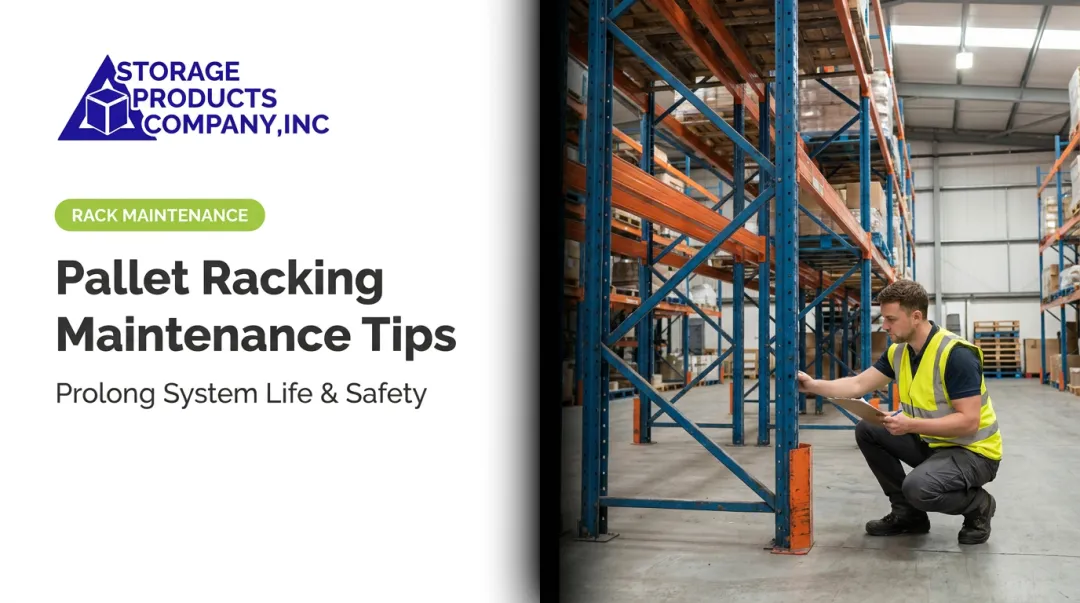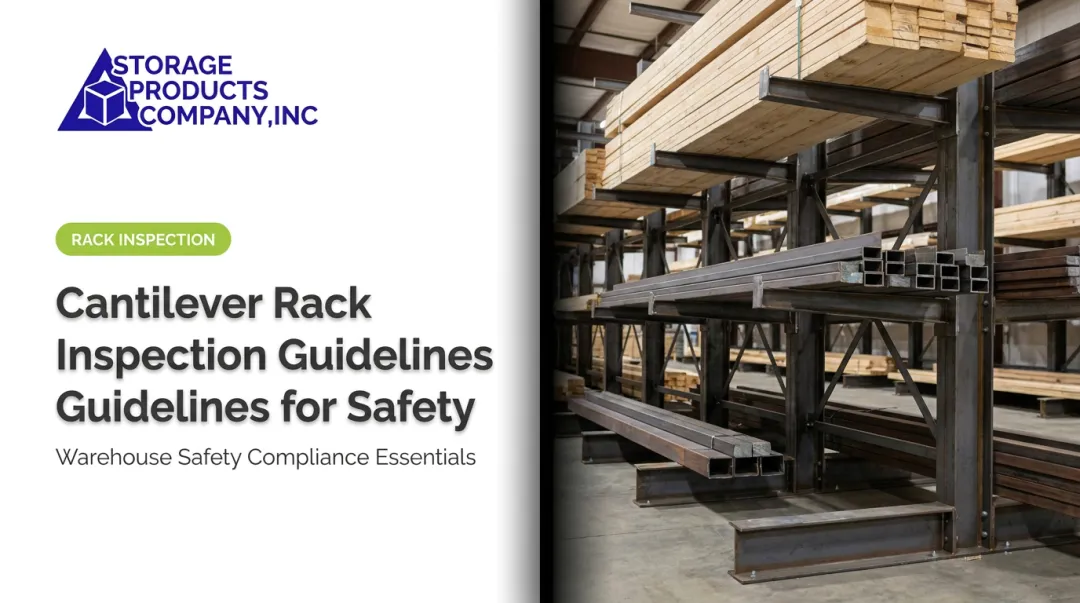

The stakes are real. OSHA's accident records include a 2020 case where a turret truck struck an upright at an aisle end with no impact protection. The rack collapsed, one employee died, and another was hospitalized. These are individual cases, not a national rate, but they show what damaged or unprotected rack can do.
Rack condition affects worker safety, pallet stability, equipment movement, and storage capacity. Requirements vary by facility, rack type, manufacturer guidance, and local codes. This guide covers what an inspector checks, how, and what to do with the results.
Key Takeaways
- Inspectors review uprights, beams, connectors, anchors, accessories, load signs, and aisle conditions.
- Visual checks are backed by drawings, plaques, past reports, and targeted measurements.
- Damaged rack gets isolated and assessed by a qualified person. Nobody improvises repairs.
- Check OSHA rules alongside manufacturer instructions, ANSI/RMI guidance, and local codes.
What a Rack Inspector Checks in an Annual Warehouse Inspection
The inspector starts by defining scope. Systems in the facility's program may include:
- Selective pallet rack
- Cantilever
- Drive-in or drive-through
- Shelving
- Rack-supported structures
- Specialty storage equipment
Scope matters because standards differ. ANSI MH16.1-2023 covers industrial steel storage racks but excludes drive-in, drive-through, and cantilever systems. Cantilever rack falls under the revised MH16.3-2025.
Tools and Indicators Required
RMI's guidance doesn't prescribe one universal tool kit, but a practical set looks like this:
- Current rack layout with row and bay labels
- Inspection checklist
- Flashlight and camera or phone
- Tape or laser measure, plus a level or plumb line
- Manufacturer component references
The inspector also pulls reference documents before the walk:
- Manufacturer's Load Application and Rack Configuration (LARC) drawings
- Load plaques and beam and frame specs
- Prior reports, repair records, and incident reports
- Modification records
Only trained, authorized personnel use lifts or elevated platforms, and only under site procedures. Climbing rack is never an inspection method.
Preconditions and Setup
Before the walk begins, the inspector coordinates with warehouse leadership and forklift operators. They control traffic, clear aisles for access, and handle pallets safely.
The inspector also confirms:
- Rack system identity, location labels, and inspection boundaries
- Previous findings and recent impacts
- Changes in load or layout
- Areas needing special attention
Poor lighting, blocked aisles, and heavy stock can hide damage. Record these as inspection limitations rather than quietly working around them.
Structural and Operational Indicators Reviewed
RMI's inspection checklist covers the core items. In practice, the inspector looks at:
- Uprights and frames: bending, twisting, cracking, corrosion, missing bracing, and distorted columns
- Baseplates and anchors: anchor count, location, condition, base-plate welds, shims, and floor damage
- Beams and connectors: deformation, unseated beams, damaged end connectors, missing locking devices, and signs of a strike or overload
- Alignment: visible leaning, out-of-plumb frames, and displaced components
- Accessories: wire decking, pallet supports, safety bars, backstops, row spacers, column guards, end-of-aisle protection, and netting, all compared with the approved design
- Load information: plaques, beam-level data, rack identification, pallet position, overhang, and whether stored goods match the system's intended use
Surroundings count too. The inspector notes:
- Forklift impact exposure
- Poor housekeeping and blocked aisles
- Floor deterioration
- Water or chemical damage
- Pedestrian routes
- Recurring operational problems
Fire-protection clearances are part of the review. NFPA 13 (2019) generally calls for at least 18 inches between top of storage and sprinkler deflectors, with exceptions. Local code editions govern.
Methods to Check Warehouse Racking During Annual Inspection
These methods work together. The walk-through finds conditions, records show what the rack is meant to support, and measurements or engineering review resolve uncertain findings.
Method 1: Systematic Visual Walk-Through
The inspector follows a consistent route through every row and bay, looking for damage, missing parts, displacement, corrosion, unsafe loading, weak protection, and departures from the approved configuration.
- Start at a defined entry point. Identify each aisle, row, bay, and elevation. Don't skip concealed or rarely used spots.
- Examine from floor level and approved access points. Compare both sides and adjacent bays for inconsistent alignment, damage patterns, or impact evidence.
- Photograph and record every finding. Note exact location, component, apparent condition, circumstances, and any immediate control applied.

Pros: Efficient at catching obvious damage and unsafe conditions.
Cons: Can't settle every structural or capacity question. Concealed damage and complex modifications need deeper review.
Method 2: Documentation, Configuration, and Load Verification
The inspector compares the physical rack with its design basis. RMI cites ANSI MH16.1 sections 4.5 and 4.6 for LARC drawings and plaques, which communicate rated capacity.
- Confirm specifications. Check rack type, beam levels, frame dimensions, load ratings, and anchorage against manufacturer data.
- Look for unapproved changes. Moved beams, altered elevations, substituted parts, removed braces, added decking, new pallet sizes, or heavier loads all count.
- Match against history. Compare with prior findings and repair records to spot recurring damage and overdue corrective actions.
Pros: Exposes capacity and configuration risks a walk-through can't see.
Cons: Only as good as the records, and someone qualified must interpret them.
Method 3: Targeted Measurement and Engineering Evaluation
When plumb, alignment, clearances, or component distortion can't be judged by eye, the inspector measures.
- Define the uncertainty. Decide what measurement or design value is needed.
- Measure from stable, repeatable positions. Never enter an unsafe area or disturb an unstable rack or load.
- Compare with the right criteria. Use manufacturer, engineering, ANSI/RMI, or site criteria, and escalate unresolved items to a qualified person.

Be careful with numbers. RMI cites a loaded-column plumbness limit of 1/240 (0.5 inch per 10 feet of height) under MH16.1, but that applies to a specific scope.
RMI's beam deflection guidance calls L/180 an industry-consensus figure that doesn't itself ensure structural safety. Neither is a universal damage cutoff.
Pros: Supports defensible decisions on borderline findings.
Cons: Doesn't replace competent inspection or let untrained staff make structural calls.
How to Interpret Rack Inspection Results
A good report ties each observation to a location, risk, recommended action, responsible party, and closeout record. A visual sign alone does not make a condition acceptable or unsafe. You still need to weigh rack design, damage type, load, and criteria.
Normal and Acceptable Conditions
An acceptable rack is intact, correctly connected, anchored, aligned, properly loaded, protected, labeled, and consistent with approved documents. RMI publishes no formal green-amber-red rating, so "acceptable" is a descriptive term.
Record acceptable findings too. They give future inspections a baseline for spotting change, repeat impacts, and deterioration.
Minor Issues
Minor issues include housekeeping lapses, faded identification, or low-priority accessory damage. They don't signal immediate loss of structural function but still need an owner and a due date.
RMI's damage guideline sets no universal "minor damage" threshold, and a supervising engineer owns the assessment. Use the manufacturer's criteria, your inspection program, and qualified advice to decide on continued use.
Out-of-Spec or Potentially Dangerous Conditions
Examples include:
- Severely damaged uprights or beams
- Missing locking devices or failed anchors
- Displaced components or unstable frames
- Unknown modifications or overloaded bays
- Anything the inspector can't safely verify
The response sequence:
- Protect people from exposure.
- Stop use or isolate the bay.
- Unload only through a safe, approved process.
- Notify management.
- Get qualified repair or engineering direction.
- Document the corrective action and recheck before normal use.
Don't straighten, weld, drill, or modify damaged rack based on informal judgment. RMI allows field repair only under a supervising engineer, with welding by a certified welder.
Common Errors and Safety Best Practices
Common Errors in Rack Inspection
- Inspecting only the front face, skipping high or concealed components, or missing damage behind stored product
- Failing to record exact bay locations
- Relying on appearance, outdated load data, or generic damage thresholds
- Ignoring previous findings or accepting unapproved modifications
- Moving loads, entering restricted areas, climbing rack, or measuring from unstable positions just to finish a checklist
Safety and Best Practices
- Control traffic, use safe access methods, and follow forklift and lift-platform procedures
- Communicate with warehouse staff and wear suitable PPE
- Take extra care with unstable loads, damaged bays, elevated work, poor lighting, and floor hazards
- Call a qualified engineer or rack specialist when a condition exceeds in-house expertise
Treat the annual review as one piece of a continuing program. Employees should report impacts promptly, and any impact damage needs review right away.
Conclusion
A reliable annual inspection pairs a systematic physical review with documentation, load, configuration, and operational checks. Findings should drive risk-based action, documented repairs, and verification before affected rack returns to service.
If your inspection points to repair, replacement, redesign, or layout needs, Storage Products Company can help with storage racking and material handling solutions, including AutoCAD layouts, factory-recommended installation, and rack relocation. Its Equipment Inspections service assesses and reports on rack condition on site and does not include inspection certification.
Frequently Asked Questions
What are the main types of warehouse inspections?
Routine daily or pre-use checks, periodic safety inspections, formal annual rack inspections, regulatory inspections, and operational or inventory audits. Depth and ownership differ for each type.
What are the steps of a warehouse inspection process?
Prepare and review documents, walk the site safely, check components and operations, document findings, classify risk, assign corrective action, then verify closeout.
What are OSHA requirements for warehouse inspections?
Federal rules don't set a rack-specific annual interval. Key citations include 29 CFR 1910.176 (storage), 1910.22 (surfaces), 1910.178 (powered trucks), 1910.37 (exits), and the General Duty Clause. Verify state-plan, local, manufacturer, and engineering requirements.
How often should warehouse racking be inspected?
RMI/MHI recommends a scheduled owner program at least annually, with more frequent checks for high traffic, heavy activity, or prior damage, plus prompt inspection after impacts or seismic events. Routine checks supplement the formal annual inspection.
What happens if a rack inspector finds damage?
The finding is documented and risk-assessed, and the area is isolated if needed. Qualified repair, replacement, or engineering review follows, then reinspection before return to service.
Can a warehouse employee perform an annual rack inspection?
Employees can handle housekeeping and routine visual checks. A formal inspection needs trained, competent personnel, proper access, documentation, and technical support for anything beyond their expertise.