
Introduction
Inventory keeps growing. The building doesn't. Many warehouse and facility managers hit the same wall: every fixed aisle eats floor space, yet workers still need safe, direct access to product.
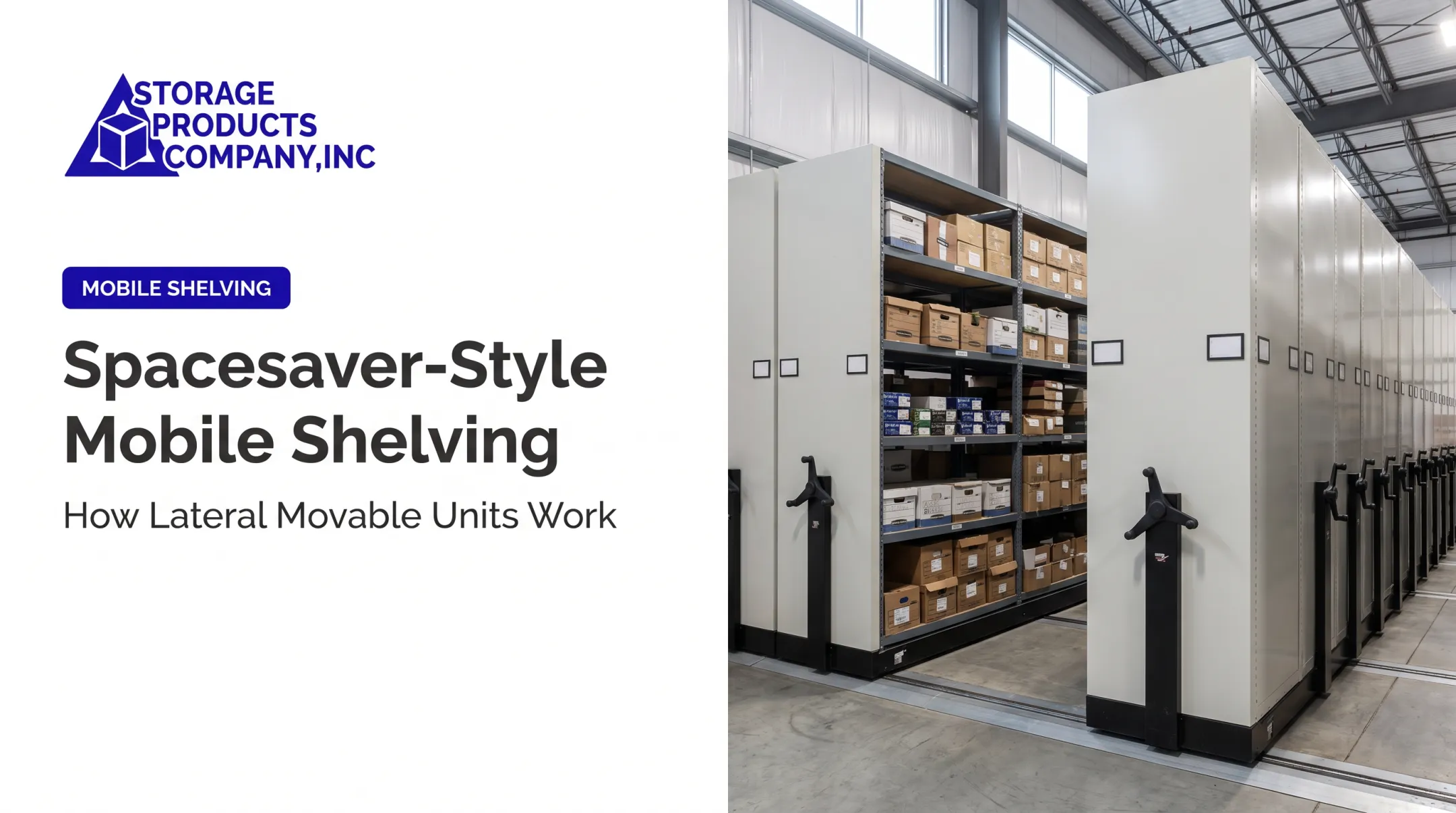
Mobile storage systems address that problem by mounting shelving, racking, or cabinets on movable bases. The rows slide sideways along tracks and open an aisle only where someone needs it.
This guide covers how lateral movable units work, where they fit, what you trade off in access speed, and what to evaluate before buying.
Key Takeaways
- Mobile storage consolidates rows and opens one aisle at a time.
- Density rises, but picking patterns and aisle availability change.
- Fit depends on load weight, dimensions, retrieval frequency, and floor space.
- Layout, installation, safety controls, and maintenance decide success.
What Are Mobile Storage Systems?
What "mobile storage system" means
In material handling, a mobile storage system is shelving, racking, or cabinets installed on manual or powered carriages that travel on fixed floor tracks. Typically only one aisle (or a few) stays open. Move the rows, and the aisle appears where you need it.
Don't confuse it with mobile-device storage, cloud storage, or digital file systems. This article is about physical inventory.
Lateral movable units are high-density mobile shelving that reclaim aisle space. Storage Products Company supplies them for slower-moving inventory and record storage, where limited concurrent access is acceptable.
Main components of a lateral movable unit
A manufacturer component guide breaks the system into a few parts that work together:
- Rails or tracks guide movement and transfer loads into the floor.
- Carriages or bases carry the storage and move it sideways.
- Shelving, pallet rack, or cabinets hold the inventory.
- Handwheels, motors, controls, sensors, and emergency stops govern movement and access.
How mobile storage differs from static storage
Fixed shelving and pallet racking keep permanent aisles. Mobile systems trade those aisles for density, but add moving parts, more planning, and a wait while an aisle opens.
Automated storage and retrieval systems (AS/RS) are a different category. Mobile units only move rows to open an aisle. AS/RS machinery also stores and retrieves items for you.
What inventory is a good fit?
Mobile storage works best when you hold a lot of product in a defined footprint and still need direct access to selected rows. Examples include:
- Distribution centers and warehouses with slower-moving stock
- Retail back rooms holding seasonal goods or records
- Manufacturing facilities storing spare and component parts
- Automotive-parts distributors with many varied part sizes
It fits poorly where many people need different rows at once, or where a large number of unrelated SKUs must be picked very fast.
How Do Lateral Movable Units Work?
The basic operating sequence
A typical retrieval cycle looks like this:
- The operator identifies the row that holds the item.
- They activate the control (a handwheel or a powered button).
- The carriages move laterally and open the aisle.
- The operator retrieves or stores the product.
- The rows close or reposition afterward.

Manual, mechanical-assist, and powered versions differ in controls and speed, so confirm exact features with the manufacturer. Procedures must also keep people and equipment out of an aisle that is moving.
Layout, load transfer, and movement
Loads travel from shelf to carriage, wheels, rails, and finally the building structure. Spacesaver's floor guidance notes that load planning assumes roughly equal rail loads. Concentrated or uneven loading and damaged floors can hurt performance.
Coordinate the system with columns, doors, dock areas, sprinklers, lighting, utilities, forklifts, and required clearances before anything is ordered.
Controls and safety features
Depending on the product, safety features may include:
- Aisle-presence detection and foot-level infrared beams
- Emergency stops, including in-aisle options
- Audible or visual warnings
- Lockable access and interlocks
Verify which features come standard. Then check the OSHA provisions that apply to your hazards:
- Walking-working surfaces (1910.22)
- Exit routes (1910.36 and 1910.37)
- Machine guarding (1910.212)
- Lockout/tagout (1910.147)
Also review adopted fire and electrical codes with your local authority. Training, posted procedures, rated-load labels, and routine inspections are part of the job.
Workflow example
Picture an automotive-parts distributor with eight rows of slow-moving parts. Staff open one aisle, pull a bracket, close it, and the other seven rows stay packed tight. The tradeoff: a second picker needing a different row waits. Evaluate retrieval frequency, peak demand, and how many workers need access at once.
Factors that affect performance
- Retrieval time and how often aisles must open
- Number of operators and inventory turnover
- Equipment traffic and warehouse procedures
Validate throughput with manufacturer specifications, floor observations, or a pilot layout. Don't assume a universal gain.
Benefits, Applications, and Limitations
Space utilization and storage density
Consolidating fixed aisles frees floor area. Actual gains depend on unit size, aisle needs, building limits, and inventory.
In one Spacesaver design guide, a mobile layout held 1,360 linear inches in 24.9 sq. ft., versus 34.9 sq. ft. for five static eight-tier shelf units. That is one shelving example, not a promise for pallet racking or your site.

Productivity and operating costs
Better use of existing space can delay expansion or relocation. Savings aren't guaranteed, though, and aisle movement can slow retrieval in high-volume operations.
Compare these cost factors:
- Equipment, tracks, and controls
- Electrical work and floor preparation
- Installation and training
- Maintenance and future reconfiguration
Safety, organization, and inventory protection
Controlled aisle access, defined storage locations, and load-rated equipment support safer handling. Lockable access, user permissions, and barriers add protection where inventory warrants it.
Mobile storage does not automatically eliminate hazards. Outcomes depend on design, training, maintenance, and compliance.
Best-fit applications
- Distribution centers and warehouses that need density before a building expansion
- Retail stockrooms holding back-of-house, seasonal, or records inventory
- Manufacturing and automotive parts operations with varied component sizes and tight space
Limitations and tradeoffs
- Higher initial complexity and specialized installation
- Moving parts and maintenance; powered units depend on reliable power and controls
- Only one open aisle in some configurations, so no simultaneous access
- Floor capacity, ceiling height, fire protection, egress, and forklift path conflicts
Weigh mobile storage against static shelving, pallet racking, cantilever racks, mezzanines, or automation based on your goals.
Types and Selection Considerations
Common mobile storage configurations
- Manual and mechanical-assist shelving
- Electrically powered mobile shelving
- Mobile pallet-rack systems
- Mobile cabinets and lateral files
Vendor figures show the range. One Spacesaver brochure cites mechanical-assist systems up to 45 ft and powered systems up to 81 ft long, with mobile pallet racking listed at 3,000 to 30,000 lb per carriage. Those ratings are vendor-specific, so confirm them by model. Start with inventory dimensions, unit loads, weights, and handling equipment, not appearance.

Selection criteria
Physical factors:
- Load capacity, shelf or beam size, unit height, row length
- Aisle width, floor loading, ceiling height
- Environment, power availability, access controls
Workflow factors:
- Turnover, picking frequency, replenishment patterns
- Simultaneous users and forklift or cart traffic
- Future expansion
Mobile storage comparison
| Factor | Mobile | Static | Automated (AS/RS) |
|---|---|---|---|
| Density | Highest for manual-access storage | Lower | High |
| Access speed | Slower, one aisle at a time | Direct | Fast retrieval |
| Labor | Operator-driven | Operator-driven | Machine-assisted |
| Installation | Complex | Simple | Most complex |
| Best for | Slow-moving stock, records | Fast picking | High throughput |
The "best" option depends on your priorities. Higher density isn't automatically better for a high-throughput operation.
Planning, Safety, and Implementation
Site assessment and layout
Survey these factors first:
- Dimensions and floor condition
- Obstructions, utilities, and sprinklers
- Doors, emergency exits, and pedestrian routes
- Equipment paths
Installation guidance from MH-USA calls for confirming floor tolerances and surveying rail lines at the design stage.
Then test row positions, aisle clearances, and expansion space in a scaled or AutoCAD layout before committing.
Installation and commissioning
Typical installation sequence:
- Finalize the design.
- Prepare the floor and utilities.
- Install tracks and bases.
- Mount shelving or racking.
- Test controls and safety devices.
- Load the system and train operators.

Use qualified, manufacturer-approved installers, and ask for system-specific instructions. Verify warranties, service arrangements, inspection schedules, and parts availability.
Storage Products Company, based in Mobile, Alabama, has supplied storage equipment since 1980. It offers AutoCAD layout drawings, project management, and installation through factory-recommended, insured installers. Lateral movable shelving is part of that lineup for high-density storage projects.
Ongoing maintenance and review
Follow the manufacturer's instructions. Routine checks typically cover:
- Tracks, wheels, and motors
- Controls, sensors, and emergency stops
- Structural connections, labels, and visible damage
Installer guidance suggests keeping rails clean, avoiding harsh chemicals, and scheduling an annual inspection. Review the system again whenever inventory, staffing, or workflow changes.
Frequently Asked Questions
What is a mobile storage system?
It is shelving, racking, or cabinets mounted on movable bases that shift along tracks to create an access aisle where needed.
How do lateral movable storage units work?
Rows move side to side on tracks, manually or with powered controls, to open the aisle required for retrieval.
How much space can mobile storage systems save?
It varies with layout, inventory, aisle requirements, and building constraints. One vendor design guide showed the same capacity in 24.9 sq. ft. versus 34.9 sq. ft. for static shelving.
Are mobile storage systems safe?
Safety depends on proper design, rated loading, sensors or guarding, emergency controls, training, inspections, and compliance with applicable requirements.
What is the difference between mobile storage and static shelving?
Static shelving keeps permanent aisles and direct access to every row. Mobile storage consolidates rows and opens one aisle at a time, trading access speed for density.