
Introduction
Often, yes. But the answer comes from the local authority having jurisdiction (AHJ), not from a federal rule. That could be a city or county building department, a parish authority, a fire marshal, or another designated agency.
Several things trigger review:
- Rack height and top-of-storage height
- Anchoring and load capacity
- Commodity type and sprinkler coverage
- Egress paths and changes to an existing layout
Many warehouse managers learn this after the racks are already on order. This guide covers what usually triggers a permit in Alabama, Florida, Texas, and Louisiana, what documents reviewers ask for, and how to avoid rework.
Verify requirements before you buy or install anything.
Key Takeaways
- Building approval and fire or high-piled-storage approval can be separate reviews.
- Reviewers focus on anchorage, storage height, commodity class, rack loads, aisles, exits, and sprinklers.
- Confirm requirements with the AHJ for your facility's address, since rules vary by municipality.
- Gather site-specific drawings, load data, and anchorage details before applying.
When Do You Need a Permit for Warehouse Racking?
New or fixed warehouse racking
Permanently installed or floor-anchored systems are the ones most likely to be reviewed. That includes selective, drive-in, push-back, and cantilever racks. The model code treats steel storage racks in IBC Section 2209, which points to RMI/ANSI MH16.1 for design and testing.
The IBC permit exemption is narrow. The 2024 IBC exemption covers nonfixed, movable racks no more than 5 ft 9 in. high. It is not a blanket pass for fixed industrial racking.
Height, storage, and commodity triggers
Rack height and stored-product height are different measurements. High-piled storage rules in IFC Chapter 32 use top of storage:
- Generally above 12 ft
- Above 6 ft for high-hazard commodities
Your AHJ's adopted edition and amendments control the actual trigger. Don't assume one national number applies. Combustible products, dense storage, and plastics raise the level of fire review.
Changes to an existing system
An approved layout isn't permanent. These changes can require a new review:
- Adding beam levels or increasing loads
- Changing aisle widths or relocating racks
- Adding wire decking
- Switching stored commodities
- Altering sprinkler clearances

Mezzanines, pick modules, and structural modifications
Mezzanines, elevated work platforms, and pick modules often need broader structural, building, or occupancy approval. The 2024 IBC addresses industrial work platforms in Section 2212 and stairs and guarding in Section 2213. Ask the AHJ whether your structure counts as a rack, a platform, or a mezzanine.
Mezzanine drawings usually carry an engineer's stamp. Storage Products Company supplies Cubic Designs free-standing mezzanines with PE-stamped drawings and calculations.
Possible exemptions
Low, mobile, non-fixed equipment that doesn't change structural or fire conditions may be exempt. Get that in writing from the AHJ. Also check your insurer. FM Global Data Sheet 8-9 is guidance, not law. Its thresholds (above 10 ft for Class 1-3, above 6 ft for Class 4 and plastics) can still be stricter than local triggers.
How Requirements May Differ in Alabama, Florida, Texas, and Louisiana
Four-state snapshot
| State | State-level code position | What to confirm locally |
|---|---|---|
| Alabama | 2021 IBC listed by the state construction office; State Fire Marshal adopts the 2021 IFC | Local building and fire editions and amendments |
| Florida | 2023 Florida Building Code (8th Ed.) now; 9th Ed. takes effect Jan. 1, 2027 | Local amendments, fire review, vesting dates |
| Texas | Varies by city and county | Adopted fire code, portal, drawing and seal rules |
| Louisiana | 2021 IBC under LSUCC; 2015 NFPA 101 remains in effect | Parish or city fire-code edition and review path |
Alabama
The state lists the 2021 IBC and the State Fire Marshal adopts the 2021 IFC, with stated exclusions. No single statewide rack checklist exists. Ask whether your city or county building department and fire marshal review separately.
Florida
The Florida Building Code works alongside the Florida Fire Prevention Code, which includes NFPA 1 and NFPA 101 with state amendments. Local amendments expire when a new code is adopted, so your application date matters. Davie's fire checklist is a useful local example: it asks for rack tier count, aisle dimensions, maximum pile volume, and commodity class.
Wind design also matters here. Miami-Dade and Broward carry high-velocity wind values, so engineered anchorage is essential.
Texas
Requirements vary by city. Houston publishes a 2021 IFC high-piled-storage checklist asking for intended use, aisle widths, and high-piled area square footage. Dallas identifies its own 2021 Fire Code. Texas engineering law defines the practice of engineering. Ask your AHJ what PE seals it requires for rack drawings, since those expectations are set locally.

Louisiana
The State Fire Marshal reviews commercial structures for LSUCC compliance for local jurisdictions that request help, and may contract with parish or municipal authorities. Confirm the parish or city fire-code edition and plan-review path, because IFC adoption for rack permitting is set locally.
What Documents and Safety Details Are Usually Required?
Rack layout and engineering drawings
Expect to supply scaled plan views and elevations showing:
- Rack rows, bay spacing, and beam elevations
- Aisle widths, exits, and doors
- Rack type and maximum load ratings
- Anchor locations
A PE seal may be required, depending on the AHJ and project. Storage Products Company builds layouts in AutoCAD, which gives reviewers something concrete to read.
Structural, anchorage, and floor information
Include:
- Upright and beam capacities
- Baseplates, anchor type, and spacing
- Slab condition
Manufacturer catalog data is not site-specific engineering. Base anchorage on the current standard, ANSI MH16.1-2023, plus project loads and the AHJ-approved design.
Fire and life-safety information
- Commodity classification and maximum top-of-storage height
- Sprinkler type, coverage, and in-rack sprinklers if used
- Flue spaces and required clearances
- Aisle access, exits, and fire-department access
The 2024 IFC sets a 44-in. minimum aisle in sprinklered buildings and 96 in. for specified cases. Exact flue-space dimensions depend on the adopted NFPA 13 edition and design. NFPA 230 is withdrawn, so don't cite it as current.

Product, pallet, and operating details
Gather these operating details:
- Pallet dimensions and maximum pallet weight
- Packaging and stored materials
- Forklift traffic patterns
- Expected inventory changes
Flag anything combustible or hazardous early.
Standards, manufacturer records, and used equipment
Find out which IBC, IFC, and NFPA editions your AHJ has adopted. OSHA 29 CFR 1910.176 requires stored materials to be secure, but it doesn't set rack capacity or anchor values.
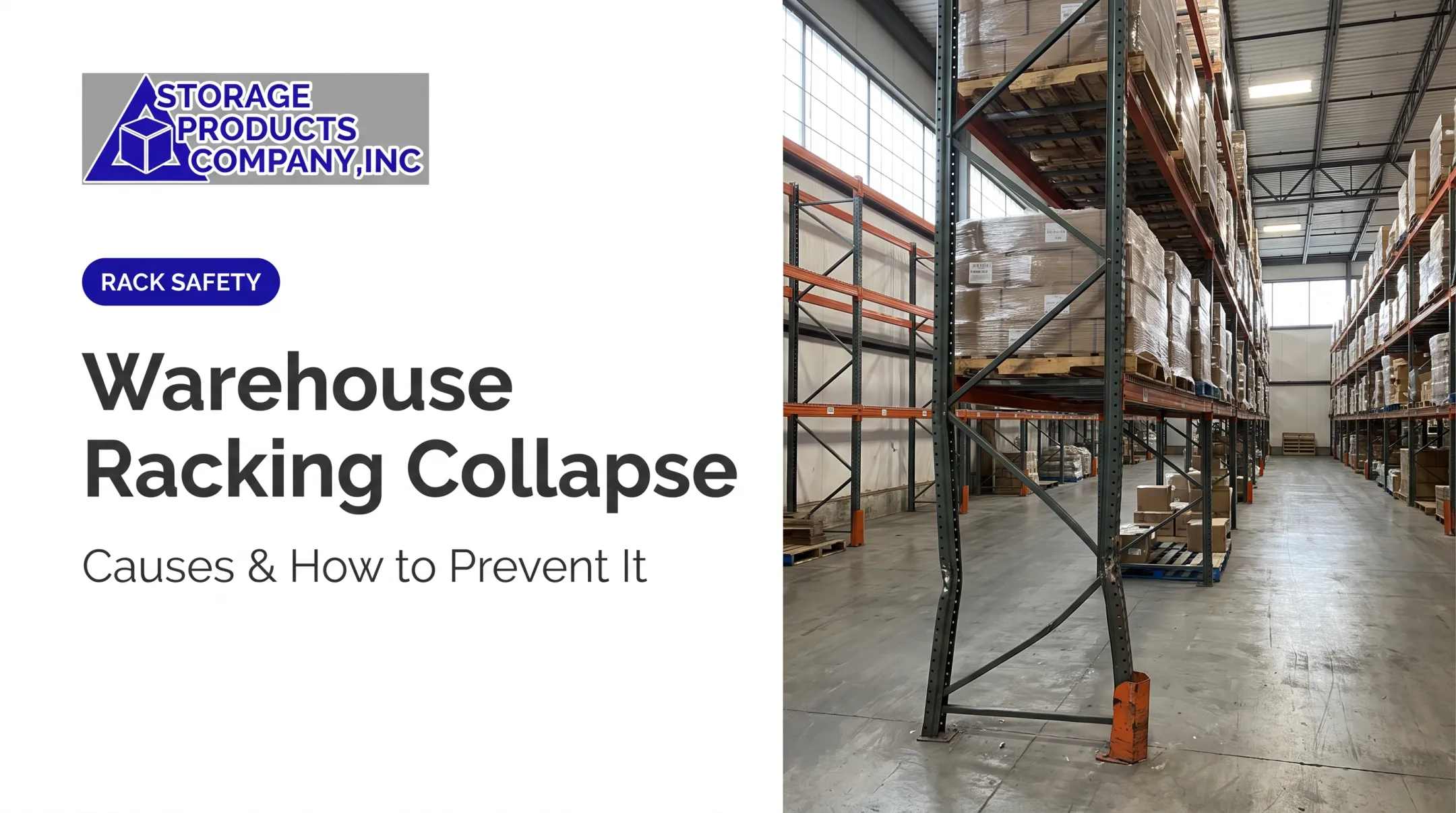
Used racks, damaged components, and generic drawings need inspection and updated documentation. RMI recommends periodic rack inspections, including monthly checks.
How to Get Approval and Avoid Common Problems
Plan with the AHJ before buying
- Identify the facility address and its AHJ.
- Ask whether building and fire permits are separate.
- Request the current checklist.
- Confirm height and commodity triggers.
- Keep all guidance in writing.
A dealer can help at this stage. Storage Products Company assists with rack selection, AutoCAD layouts, project management, and installation planning. The company does not install fire suppression, so coordinate sprinkler changes with a fire protection contractor.
Prepare a complete, site-specific package
Build a site-specific submittal that includes:
- Rack drawings and load data
- Anchorage details
- Fire-protection plans
- Forms, fees, and professional seals where required
Never rely on generic plans, and don't order equipment before the design is approved.
Install, inspect, and maintain
- Install exactly as the approved plans specify
- Schedule progress and final inspections with the AHJ
- Post load plaques on every rack system
- Fix correction notices promptly
- Document any later changes for the project record
After installation, inspect regularly. RMI guidance is to report damage and unload the affected portion until it is repaired with engineering input.
If work has already started or doesn't match approved plans, stop and contact the AHJ before continuing.
Frequently Asked Questions
Can I get a warehouse racking permit after work is done?
Some AHJs allow as-built review, but may require engineering, fees, corrections, or removal. Contact the building and fire authorities before using the system.
How high is warehouse racking?
No universal maximum exists. Rack height differs from top-of-storage height, so check building height, sprinklers, commodity, equipment, and local code limits.
Do you need a permit to install warehouse racking?
It depends on your AHJ and the project: anchorage, height, loads, fire protection, egress, and whether you're changing an approved layout.
What documents are required for a warehouse racking permit?
Typically site-specific layouts, elevations, load ratings, anchorage details, slab information, commodity data, sprinkler and flue-space details, forms, and PE documentation when required.
Do requirements vary by city or county?
Yes, within all four states. Check with the building department, fire marshal, or parish authority, and get the current local checklist.
What happens if racking is installed without a permit?
Possible results include correction orders, failed inspections, fines, delayed operations, required engineering, removal, and insurance complications. Resolve it with the AHJ promptly.