
Manual handling remains a major injury driver. Cal/OSHA's manual handling guide notes that manual material handling contributes to a large share of the more than half a million musculoskeletal-disorder cases reported annually in the US. It also lists scissor lift tables among the devices that let workers slide loads instead of lifting them.
The biggest or priciest table isn't automatically the right one. This guide covers capacity, platform, and power so you can match the table to the job.
Key Takeaways
- Size capacity to the heaviest load, its distribution, and its center of gravity, not the average item.
- Fit the platform to both the load and the workspace.
- Match hydraulic, electric, or manual power to duty cycle and available utilities.
- Compare safety features, serviceability, and lifecycle cost, not just price.
What Is a Heavy-Duty Lift Table?
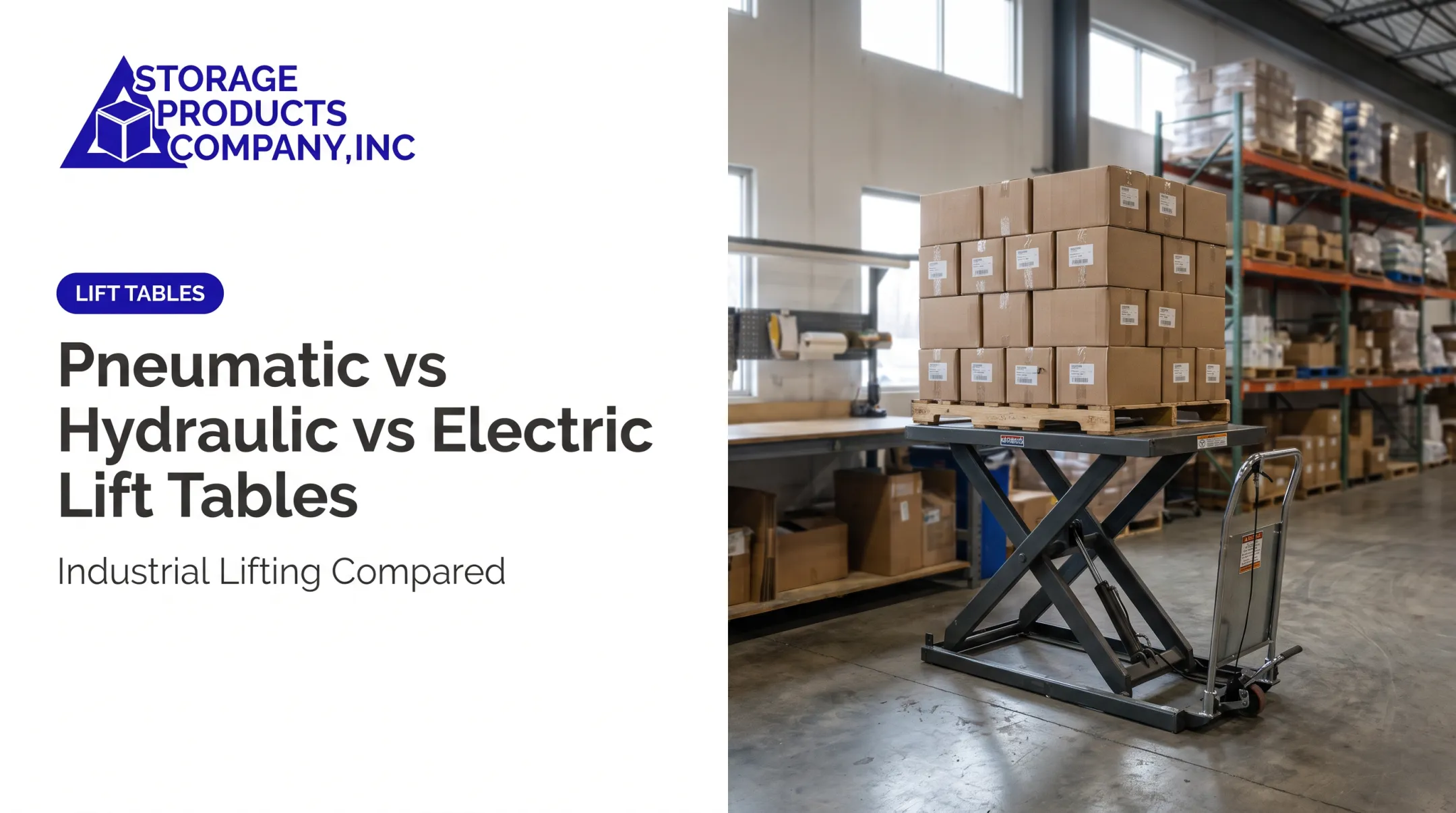
A heavy-duty lift table is a manual or powered platform that raises, lowers, and positions substantial loads for assembly, loading, maintenance, or storage tasks. Most industrial versions use a scissor mechanism. The relevant safety standard, ANSI MH29.1-2020, covers industrial scissors lifts with hydraulic, pneumatic, or mechanical actuation, in stationary or mobile form.
Types vary: stationary or mobile, single or double scissor, hydraulic, electric, or manual. Load weight alone won't tell you which fits. The application does.
Core Components
Knowing the anatomy helps you tie each specification to stability, service life, and operator safety.
- Frame and lifting assembly: scissor legs, cylinders, rollers, and supports that raise and stabilize the platform. Rated capacity applies only under the manufacturer's load-distribution and load-center assumptions.
- Platform and deck: length, width, surface, edge protection, and restraints control how pallets, carts, or fixtures sit and how operators reach them. Options include stainless steel, roller conveyor tops, turntables, and tilting decks.
- Power and controls: pumps, motors, limit switches, emergency stops, and lowering systems govern smoothness, speed, duty cycle, and upkeep.
Why the Right Table Pays Off
A well-matched table:
- Cuts manual lifting and strain
- Puts work at a comfortable height
- Keeps workflows consistent
- Reduces handling delays
Those gains hold when the table is installed and operated to the manufacturer's specs.
What to Consider When Choosing the Best Heavy-Duty Lift Table
Start with the actual task: what you lift, where, how often, and in what space. Only then compare models. Each factor below links a specification to an outcome such as safe handling, uptime, or space use.
Load Capacity and Load Distribution
Rated capacity equals live load (the material) plus dead load (anything permanently attached, like a conveyor top or scale). Advance Lifts' scissor lift white paper advises giving the manufacturer the load weight, dimensions, and center of gravity. The ideal load sits at the platform center.
Check these points:
- Heaviest load you'll ever place, not the average
- Whether the load is concentrated or off-center
- Whether the rating holds across the full lift range
- Rolling, impact, or off-center transfers, since some catalog end and side ratings are static only
Overload shortens structural life and raises the risk of unstable loads. Fatal cases are documented: a 1,800-lb steel spool fell from a hydraulic lift table in a New York State case report. When loads vary, confirm specifications with the manufacturer.

Platform Dimensions, Clearance, and Stability
Measure the load footprint, required overhang, pallet or container size, and the lowered and raised heights. Then check aisles, doorways, and nearby equipment.
Bigger isn't better. The deck must keep the load centered, reachable, and clear of pinch points.
Overhang can cost capacity too: one manufacturer's rule of thumb derates about 2% per inch beyond minimum platform size. That figure is vendor-specific, so ask for the rating on the exact model.
Power Source and Operating Performance
Options include manual hand or foot pumps, hydraulic power units, and battery-powered DC units. No single option fits every application. Compare them on:
- Lift frequency and duty cycle
- Lift speed and control precision
- Available voltage or utilities
- Noise and operating environment
Duty cycle matters most. Advance Lifts warns that frequent upward jogging can overheat a standard motor. Specify cycles per hour, day, and year. Also verify motor and hydraulic specs, controls, and emergency-lowering provisions.

Lift Height and Workflow Integration
Identify the lowered height, working height, transfer height, and maximum elevation. Raised height equals lowered height plus travel, so a low-profile table needs enough stroke to reach your critical position.
Match heights to operator ergonomics and to any conveyor or dock equipment the table feeds. A conveyor attached to the platform counts as dead load.
Safety Features and Requirements
Evaluate:
- Maintenance struts or locks for work under the platform
- Toe guards or safety skirts
- Anti-slip surfaces and guarding
- Wheel brakes on mobile units
- Emergency stops and controlled lowering
- Clearly marked controls
Relevant US rules include OSHA's machine guarding standard (29 CFR 1910.212) and lockout/tagout (29 CFR 1910.147), which covers hydraulic energy. Neither standard prescribes a specific lift-table design. Involve qualified safety and equipment professionals, and consult the full ANSI standard.
Environment, Maintenance, and Total Cost
Dust, moisture, washdown, corrosive materials, temperature extremes, outdoor exposure, and floor quality all change the construction you need.
Southworth's lift table brochure describes stainless platforms for washdown, special fluids and seals for hot or cold areas, and NEMA-rated electrical packages. Verify the package for your environment.

When comparing cost, include:
- Installation requirements and training
- Access to service points and leak inspection
- Replacement parts and warranty terms
- Preventive maintenance needs and expected downtime
How Storage Products Company Can Help
Storage Products Company, based in Mobile, Alabama, has helped businesses with material handling and storage since 1980. As a single-source dealer across multiple manufacturers, the company matches equipment to your application instead of locking you into one catalog. Southworth lift tables are part of that lineup, covering vertical lifting and work positioning.
Support for a heavy-duty lift table project includes:
- Application and space assessment
- AutoCAD layout drawings to confirm clearances
- Factory-recommended, insured installers
- Project management and installation coordination
- Preventive maintenance and equipment inspections
For a useful recommendation, gather your heaviest load, platform needs, lift heights, operating frequency, and facility constraints. Pricing is available on request.
Conclusion
Choosing a heavy-duty lift table starts with the application. Define the load, platform footprint, required heights, operating cycle, power availability, safety needs, and space limits.
Choose the table that handles your workflow safely and reliably, not the largest capacity or the longest feature list. Revisit that choice as loads, layouts, volumes, and safety requirements change.
Frequently Asked Questions
What is the best hydraulic lift table?
No single model wins. The right one depends on verified capacity, load distribution, platform size, lift height, duty cycle, safety features, workspace, and maintenance needs.
How much do hydraulic lifts cost?
Price varies with capacity, platform size, lift range, hydraulic system, controls, mobility, safety options, and customization. Request an application-specific quote rather than relying on a generic figure.
What capacity should a heavy-duty lift table have?
Base it on the heaviest intended load, its distribution and center of gravity, and operating conditions. Follow the manufacturer's rated-load requirements, not average weight.
How do I choose the right lift table platform size?
Start with the load footprint, pallet or container size, and needed overhang. Then check stability, operator access, aisles, doorways, and clearance from surrounding equipment.
Are hydraulic or electric lift tables better for heavy loads?
Neither is universally better. Compare load demands, duty cycle, control precision, lift frequency, available power, noise, environment, and maintenance.
Do heavy-duty lift tables require regular maintenance?
Yes. Inspect for hydraulic leaks, fasteners, structure, controls, safety devices, and wheels or brakes. Lubricate where specified and follow the manufacturer's schedule.