
Introduction
Getting pallets, carts, and equipment up to a mezzanine sounds simple until the forklifts start queuing at the same staging lane. Add manual carrying, stairs, and open edges, and you have labor drag plus real injury exposure.
OSHA's Severe Injury Report counted 1,190 forklift-related severe injuries in 2022-2023, including 994 hospitalizations and 196 amputations. OSHA notes the data is not statistically representative, but it shows the stakes.
A vertical reciprocating conveyor (VRC), a freight elevator, and a forklift can all move loads between levels. They differ in capacity, footprint, labor, installation, and compliance. This guide compares them so you can match the tool to your workflow.
Key Takeaways
- VRC: fixed material-only lift; freight elevator: building transport system; forklift: flexible operator-driven vehicle.
- Match VRCs to repetitive floor-to-mezzanine cycles; choose freight elevators for larger or multi-floor needs.
- Use forklifts for lower-volume, flexible moves when access and edge protection stay compliant.
- Judge load, cycles, height, space, and lifecycle cost, not purchase price alone.
VRC vs Freight Elevator vs Forklift: Quick Comparison
Cost and Total Ownership
Compare lifecycle cost, not the sticker price.
- VRC: No fixed price exists. PFlow's cost guide lists capacity, rise, carriage size, integration, safety options, and installation complexity as cost drivers. Add mezzanine framing, controls, inspections, and maintenance. Hydraulic models typically cost less than mechanical ones but have lifting limits.
- Freight elevator: Hoistway or shaft, pit, overhead, machine room, entrances, permits, plan review, and specialized service all add scope. Costs vary widely by site and jurisdiction.
- Forklift: Count acquisition or rental, batteries or fuel, chargers, tires, training, maintenance, and the cost of congestion and downtime.
Load and Personnel Suitability
- VRC: Built for materials; the MHI application guideline states people must not ride the carriage. Match load rating, platform size, load balance, and guarding to the application. PFlow's 21 Series, for example, lists up to 6,000 lb, a carriage up to 12 x 10 ft, and 22 ft of rise (one model, not a typical spec).
- Freight elevator: Moves freight between designated levels within rated capacity and code limits. California, for instance, defines freight classes and bars passenger service on freight elevators. Personnel rules depend on the equipment and jurisdiction.
- Forklift: Carries loads and moves horizontally, but OSHA requires loads to stay within the rated capacity on the data plate at the load center. A brochure number is not enough.
Safety and Compliance
- VRC: ASME B20.1 covers conveyor safety. The MHI guideline calls for enclosures, landing doors with mechanical locks and electrical door-status switches, and "No Riders" signage. Lockout/tagout under OSHA 1910.147 applies during servicing.
- Freight elevator: ASME A17.1/CSA B44 governs design, inspection, and maintenance, but adoption is jurisdiction-specific. Ohio, for example, lists A17.1-2019 as effective July 2024 even though ASME publishes a 2025 edition. Confirm the edition with your local authority.
- Forklift: OSHA 1910.178 requires formal training and evaluation, visibility while traveling, and a safe distance from platform edges. Mezzanine edges need fall protection under 1910.28 and 1910.29, with guardrails at 42 in plus or minus 3 in and gates or offsets at access openings.

Throughput and Floor-Space Impact
- VRC: Creates a repeatable vertical route between fixed landings. It can reduce repeated forklift trips and avoid the footprint of a ramp. PFlow's 21 Series lists 10 cycles per hour, a model-specific figure.
- Freight elevator: Reaches multiple levels but needs dedicated structural and circulation space.
- Forklift: Flexible routing, but needs aisles, turning room, and staging. One Toyota electric model lists a 70.5-in turning radius and an 87.2-in right-angle stacking aisle.
Installation, Flexibility, and Maintenance
- VRC: Options include hydraulic and mechanical drives, pit or surface mounting, and custom configurations. Most units need support from the building structure. PFlow ties hydraulic models to less frequent use and mechanical models to repetitive use.
- Freight elevator: Plan for hoistway, pit, overhead, structural work, permitting, commissioning, and specialized service.
- Forklift: Fastest to deploy if a suitable truck and compliant mezzanine access already exist. Plan for charging, operator coverage, and recurring service.

What Are the Three Options?
VRCs: Definition, Benefits, and Use Cases
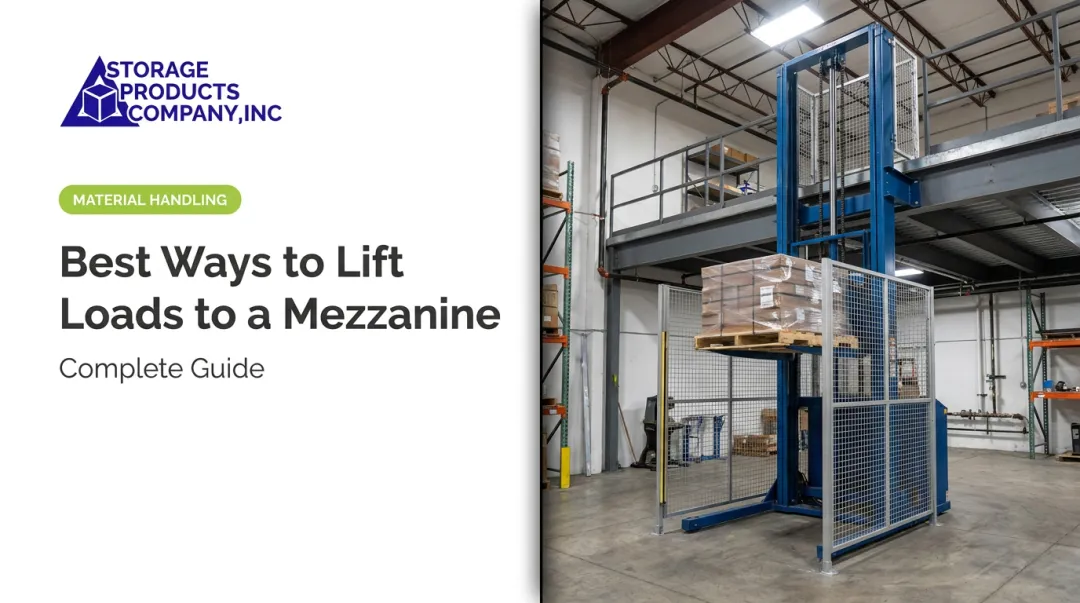
A VRC is a stationary material lift that moves goods between levels. It supports mezzanine replenishment, receiving, manufacturing, and storage flows in warehouses and distribution facilities.
Practical benefits:
- Separates vertical travel from forklift traffic
- Creates a consistent transfer point
- Uses a compact footprint
- Cuts manual carrying and stair trips
Configurations include single-platform, multi-level, straddle, cantilever, hydraulic, and mechanical designs. Capacity, platform size, travel height, cycle frequency, and load balance drive the selection.
Best fit: repetitive pallet, cart, tote, or equipment moves between a fixed lower floor and a mezzanine. Never for passengers. Storage Products Company, a dealer for PFlow Industries VRC material lifts, supplies and installs these systems.
Freight Elevators: Definition, Benefits, and Use Cases
A freight elevator is a building-integrated system for moving goods between floors. Unlike a VRC, it falls under elevator code, and personnel-access rules vary by jurisdiction.
It can make sense when you have:
- Larger or oversized freight
- Multiple floors needing access
- Frequent building-wide traffic
- A need for a bigger cab and conventional doors
TK Elevator's planning guide shows example capacities of 2,500 to 10,000 lb. The trade-offs are structural and permitting complexity, dedicated space, elevator-specific inspections, and higher project cost. Verify requirements with local authorities and qualified elevator professionals.
Forklifts: Definition, Benefits, and Use Cases
A forklift is an operator-driven powered industrial truck that combines travel with lifting. It remains useful for receiving, put-away, staging, and rack access.
It works well where routes change, vertical moves are occasional, and a trained fleet already exists. Mezzanine use has real limits:
- Approach space and mast clearance
- Capacity at height
- Visibility and edge protection
- Pedestrian traffic and congestion
A forklift can serve as an interim or supplemental solution. It should never be used to bypass guarding, gates, training, load limits, or local safety rules. Storage Products Company does not sell forklifts. It sells the storage and lifting equipment that surrounds them.
VRC vs Freight Elevator vs Forklift: What Is Better?
Pick the system that fits your vertical-flow pattern, not the one with the lowest upfront price.
- Choose a VRC for a defined floor-to-mezzanine route, repetitive cycles, material-only movement, adequate structural support, and a priority on controlled transfers.
- Choose a freight elevator for larger or varied freight, multiple floors, or a big cab where construction and compliance complexity are justified.
- Choose a forklift when routes shift, vertical moves are occasional, trucks and operators already exist, and aisles, staging, and mezzanine protection are in place.

Decision Checklist
Gather these before comparing quotes:
- Heaviest load weight, dimensions, and center of gravity
- Travel height and number of landings
- Cycles per hour or day
- Available footprint and ceiling clearance
- Floor and mezzanine capacity
- Power and charging needs
- Operator labor and safety controls
- Permits, maintenance, and future expansion
Site Evaluation
Before specifying equipment, verify on site:
- Heaviest and most awkward load
- Pallet or cart size and landing approach
- Fire egress, framing, and overhead obstructions
- Electrical requirements
Confirm egress with your local building and fire authority.
Storage Products Company, based in Mobile, Alabama, and in business since 1980, offers AutoCAD layout drawings and project coordination to help teams work through these questions.
Real World Examples/Case Studies
A published PeakLogix case study describes MGC Advanced Polymers. Staff carried repair and maintenance materials, averaging 300 lb, up three flights of mezzanine stairs.
PeakLogix reports installing a custom Model M VRC in a confined area serving three mezzanine levels. The lift has 37 ft of travel, a 2,000 lb capacity, and a 5 x 5 x 7 ft carriage.

Why a VRC fit:
- Heavy, repeated loads on a fixed route
- Tight floor space with limited staging room
- Multiple mezzanine landings on one path
The case study reports safer transport and better efficiency. Those gains are described qualitatively, without hard before-and-after numbers.
Situational takeaway: If your team hand-carries or stair-hauls loads along one fixed route in limited space, your operation resembles this one.
To compare VRC, freight elevator, and forklift options using your load data, mezzanine conditions, and workflow priorities, request a site and layout evaluation from Storage Products Company.
Conclusion
A VRC typically suits repeatable, material-only transfers between defined elevations. A freight elevator fits larger or multi-floor freight needs. A forklift handles flexible movement where safe access and trained operators exist.
Evaluate these factors together before you choose:
- Capacity and load dimensions
- Cycle volume
- Safety systems and structure
- Permitting, labor, and maintenance
- Future growth
Frequently Asked Questions
What is a VRC in a warehouse?
A vertical reciprocating conveyor is a fixed material lift that moves goods between warehouse levels. It is generally not intended for passengers.
What is a VRC used for?
Common uses include moving pallets, carts, totes, cartons, or equipment between a warehouse floor, mezzanine, dock, or other designated elevations.
What are the different types of lifts used in warehouses?
Options include VRCs, freight elevators, dock lifts, scissor lifts, conveyors, and forklifts. The right type depends on load, height, route, capacity, and whether people or materials move.
What are conveyors in a warehouse?
Conveyors move goods along a set path. Horizontal conveyors move loads across a level, while vertical systems such as VRCs transfer loads between levels.
Can a forklift be used to move loads to a mezzanine?
Yes, when the truck, load, mezzanine, edge protection, traffic controls, and operator training meet applicable requirements. Verify the complete application first.
When is a freight elevator better than a VRC?
A freight elevator may suit larger or varied freight, multiple floors, bigger cabs, or building-wide access. Review structure, code, permitting, and lifecycle cost first.