
There is no single national dimension. The common figure of 48 inches is an industry average, not a rule. A facility that handles only road semi-trailers needs a different dock than one that also takes vans, containers and reefers.
This guide covers the standard US dock height, related dimensions, truck and site variables, measurement methods, safety considerations, and when a non-standard design makes sense.
Key Takeaways
- "Standard" dock dimensions are common design ranges, not one size for every site.
- Match dock height to your trailer mix, leveler range and handling equipment.
- Coordinate doors, bay spacing, levelers, bumpers, apron depth and approach grade together.
- Verify the final design against OSHA, manufacturer data and field measurements.
What Standard Loading Dock Height and Dimensions Represent
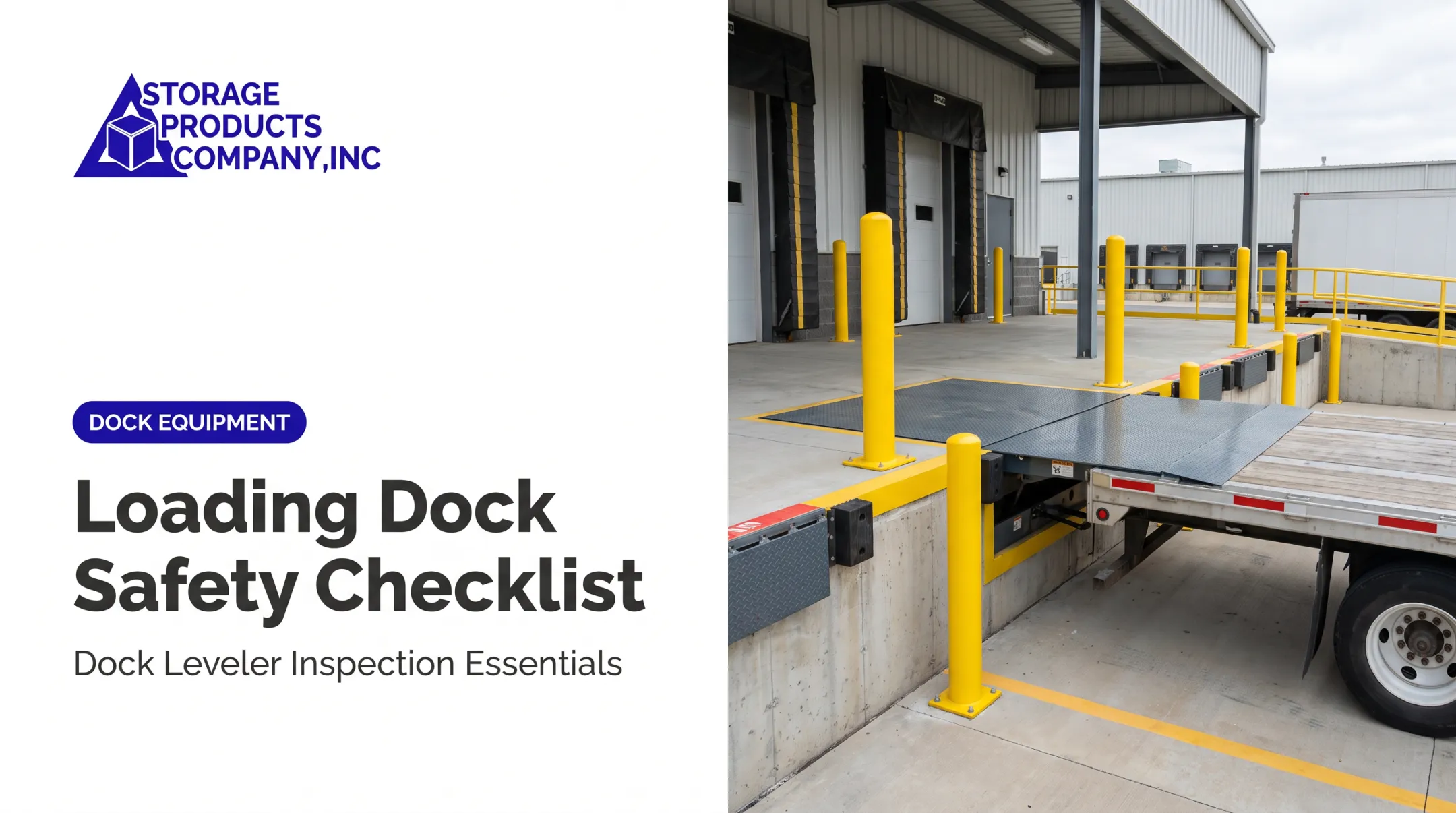
Dock height is the vertical distance from driveway grade to the top of the dock floor, per NOVA's planning guide. Don't confuse it with the other terms:
- Dock face: the outside wall of the loading bay.
- Grade: the slope of the approach, expressed as a percentage.
- Leveler working range: the manufacturer-recommended travel above and below dock level.
- Door height: the nominal opening size, a separate dimension from dock height.
These dimensions work as a set. Together they create a safe, near-level transition for forklifts, pallet jacks, workers, and freight, while leaving room for doors, seals, restraints, and truck access.
Factors That Influence Dimensions in Real Operation
A dimension that works on paper can fail in the field. Kelley reports that truck-bed height can vary by as much as 6 inches between loaded and unloaded conditions, and air-ride suspension adds to the movement. Beds rise as a trailer is unloaded at a receiving dock and drop as it is loaded at a shipping dock.
Other variables that change real-world performance:
- Pavement grade, drainage, and weather
- How squarely the driver positions the trailer
- Fleet mix: semi-trailers, containers, reefers, straight trucks, and vans
- Slab elevations and structural openings
- Forklift wheelbase and turning radius
- Leveler capacity, seals, restraints, and bumpers
- Available truck-court space
For a mixed fleet, Kelley recommends setting dock height at the midpoint of the observed bed-height range. Very high or low vehicles may need a separate position or special arrangement.
Key Technical Trade-Offs
Changing one dimension shifts others. Raising dock height or steepening the approach changes leveler travel, seal fit, bumper projection, drainage, and accessibility. Those choices also affect construction cost and how flexible the dock stays when the fleet changes.
Design for the range of vehicles you expect, not one ideal trailer.
Standard Loading Dock Height and Dimension Ranges
Nominal dimensions come from the building design, fleet, handling equipment, site grade, local requirements and chosen dock equipment. Treat published figures as starting points.
Nominal Operating Range
Blue Giant's design guide reports 48 inches as the industry average dock height, with 48 to 52 inches a common range.
Bed heights vary widely by vehicle, according to Blue Giant and Kelley guides:
| Vehicle | Bed height (in.) |
|---|---|
| Road semi-trailer | 48-52 |
| Double-axle semi-trailer | 44-52 |
| City delivery trailer | 44-48 |
| Container | 56-62 |
| Refrigerated trailer | 50-62 |
| Straight truck | 36-48 |
| High-cube van | 36-42 |
| Furniture van | 24-36 |
| Step van | 20-30 |
| Flatbed | 48-60 |

Ranges differ slightly between manufacturers, so check the guide for your equipment.
Other dimensions belong in a dock schedule. These are manufacturer examples, not code requirements:
- Doors: 8 ft wide is common, with heights of 8, 9 or 10 ft. Blue Giant cites 9 ft width for 8-ft-6-in trailers and 10 ft for wide loads.
- Bay spacing: 12 to 14 ft on center, to fit seals, shelters and lights.
- Levelers: Typical widths are 6, 6.5 and 7 ft; lengths 6 to 12 ft; capacities 25,000 to 150,000 lb by model.
- Bumpers: at least 4 in. projection on most level approaches; recessed or declined approaches may need more.
- Truck court: Blue Giant gives 135 to 150 ft for a 65-ft truck (about twice truck length). Kelley examples run 108 to 120 ft, plus 20% for 48-ft trailers.
Allowable Tolerance and Boundary Limits
Set your upper and lower limits from manufacturer data, measured fleet heights, leveler travel, door and seal needs, approach grade and your heaviest expected load.
Keep four concepts apart: nominal dimensions, construction tolerances, equipment adjustment ranges and safe operating limits. Leveler travel shows how those differ:
- One hydraulic model: 12 in. above and below dock level
- NOVA special configurations: up to 18 in. each way
- McGuire edge-of-dock levelers: 3 to 5 in.

Those figures are model ratings, not legal limits.
The same goes for capacity. A manufacturer's rating is an equipment spec. OSHA only requires that a dockboard support its maximum intended load.
Safe Operating Margin
Don't design for one trailer height or one perfect parking position. Leave adjustment margin. A leveler used beyond its stated working range is outside the manufacturer's specification.
Operating near the limits tends to cause:
- Steep leveler angles and forklift shock
- Gaps between trailer and dock
- Seal and bumper damage
- Premature wear
- Reduced flexibility when the fleet changes
NOVA specifies at least 4 in. of lip overlap into the truck. That is an overlap spec, not a universal gap limit.
How Loading Dock Dimensions Are Specified, Measured, and Validated
Treat dimensions as a design spec and as an operational check. Verify them before new construction, equipment replacement, a lease or a retrofit.
Specification and Documentation
Build a coordinated package showing:
- Dock and finished floor elevation, and grade
- Door opening and bay spacing
- Leveler pit or mounting dimensions (pit drawings are model-specific)
- Bumper position, approach and truck court
- Clearances and equipment ratings
Compare architectural or AutoCAD drawings, manufacturer datasheets, applicable standards and field conditions. No single document is complete. ANSI MH30.1-2022 covers dock-leveler performance and testing, and MH30.3-2022 covers vehicle restraints.
Measurement and Verification Methods
- Pick reference points. Use driveway grade and the top of the dock floor.
- Measure elevations. Record the finished dock and approach.
- Measure the approach grade. McGuire's guide calculates grade as rise divided by length, typically over 45 to 50 ft. Each 1% of grade produces roughly 1 in. of trailer-to-wall difference.
- Record doors and bays. Note sizes, spacing and equipment condition.
- List the vehicles and handling equipment. Note every type the dock must serve.

Account for loaded and unloaded trailers, suspension movement, slope, drainage and forklift operating envelopes. Where conditions are uncertain, bring in a professional.
Application Review and Layout Validation
Storage Products Company uses AutoCAD layout technology to help clients understand space requirements. The team coordinates dock equipment, storage systems, installation and project details before work begins so dimensional fit is confirmed against the planned layout.
Before approval, confirm:
- Dimensional fit and structural capacity
- Equipment compatibility
- Worker safety and maintenance access
- Future fleet needs
- Compliance review
Implications of Incorrect Dimensions and Common Misinterpretations
Wrong dimensions cost efficiency. Common results include:
- Forklift shock and freight damage
- Leveler, seal, and bumper wear
- Awkward worker access
- Vehicle interference
- Unplanned modifications
Safety and compliance need a separate review. OSHA 29 CFR 1910.26 requires that dockboards support their maximum intended load and be secured against movement. Wheel chocks or similar measures must keep the vehicle from moving while employees are on the dockboard.
Boards placed in service on or after January 17, 2017 must also prevent run-off from edges, subject to the rule's exception.
OSHA does not set one universal dock size. Check building, fire, accessibility, and local requirements, plus insurance and warranty terms.
Common Misinterpretations
- Treating 48 inches as an absolute requirement
- Assuming a leveler can safely absorb any mismatch
- Applying one dimension to a mixed fleet
- Ignoring grade and trailer movement
- Trusting a drawing without checking finished field conditions and equipment ratings
Conclusion
Dock height and dimensions are governing design parameters that shape every loading bay decision. The right specification accounts for vehicles, equipment, building geometry, site grade, safety, and future needs.
Published values only get you started. Engineering judgment, field verification, and coordinated equipment planning matter just as much.
Frequently Asked Questions
What is the standard loading dock height used in trucking operations?
Blue Giant gives 48 inches as the industry average and 48 to 52 inches as common, measured from driveway grade to the dock floor. The right height depends on trailer mix, site grade, leveler range and handling equipment.
What are the standard design guidelines for a loading dock?
Match the dock to your vehicles, then coordinate dock elevation, door and bay sizes, leveler capacity, truck court, approach, bumpers, restraints and drainage. Verify the result against current OSHA and local requirements.
What are the standard dimensions for a loading dock?
Manufacturer examples include 48-inch height, 8-ft-wide doors in 8 to 10 ft heights, and 12 to 14 ft bay centers. Leveler sizes, bumper projection and apron depth vary, so confirm against current manufacturer guides.
What are the OSHA standards for loading docks?
OSHA 1910.26 covers dockboard load capacity, securing and run-off protection. It doesn't prescribe one dock dimension. Check current OSHA guidance and state or local rules.
How far apart should loading docks be?
Blue Giant recommends 12 to 14 ft on center to fit seals, shelters and lights. Trailer size, turning room, structural bays and fire or building requirements may change that, so confirm with your designer.
What is the ideal slope for a loading dock?
NOVA calls 6% or less ideal and 5% or less for heavy loads, while Blue Giant doesn't recommend grades above 10% for leveler performance. These are manufacturer recommendations, not legal limits. Confirm site-specific limits with your equipment supplier.